
Polypropylene suture: buying guide
81 products in the catalogue
Polypropylene suture is a synthetic, non-absorbable monofilament suture, blue in almost all references. The needle is part of the product and determines the reference being bought, so the choice is not limited to the thread.
The description should be read as a whole: the needle shape (3/8 circle, 1/2 circle, 5/8 circle or straight), the point (taper point, trocar tapercut or reverse-cutting triangular), its size in millimetres, the USP size and the thread length in centimetres. The arming also varies, with a single needle or a double needle, and most references are supplied in a box of 12, which should be confirmed for each one.
Other related families
-
 NON-ABSORBABLE SUTURES
General framework for separating polypropylene from other non-absorbable sutures before narrowing down by needle.
-
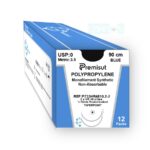 Polypropylene- 1/2 Circle Cylindrical Body Conical Tip Taperpoint
Groups the 1/2 circle needle with a round body and taperpoint, one of the combinations that must be told apart from the trocar point.
-
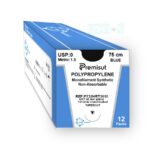 Polypropylene - 1/2 Circle Cylindrical Body Trocar Point Tapercut
Identifies the 1/2 circle variant with a round body and trocar tapercut point, useful for comparing with the taper point.
-
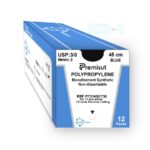 Polypropylene - 1/2 Circle Body And Triangular Reverse Cutting Point
Separates the 1/2 circle needle with a triangular body and reverse-cutting point, different from the round-bodied needles.
-
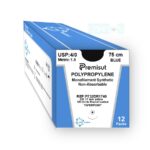 Polypropylene - 3/8 Circle Cylindrical Body Conical Point Taperpoint
Brings together the 3/8 family with a round body and taperpoint, for checking sizes and lengths.
-
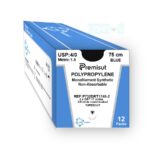 Polypropylene - 3/8 Circle Cylindrical Body Trocar Tapercut Point
Distinguishes the 3/8 variant with a round body and trocar tapercut point.
Products in this guide
- Normal 79
- Prime 3
- 1/2 circle 44
- 3/8 circle 34
- Straight 2
- Straight Cut 2
- HR 25 9
- DS 19 6
- HR 35 6
- DS 24 5
- DS 16 4
- DS 30 4
- DS 36 4
- HR 30 4
- 45 cm 4
- 75 cm 53
- 90 cm 22
- 1 × 75 cm 2
-
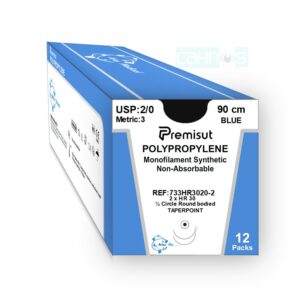
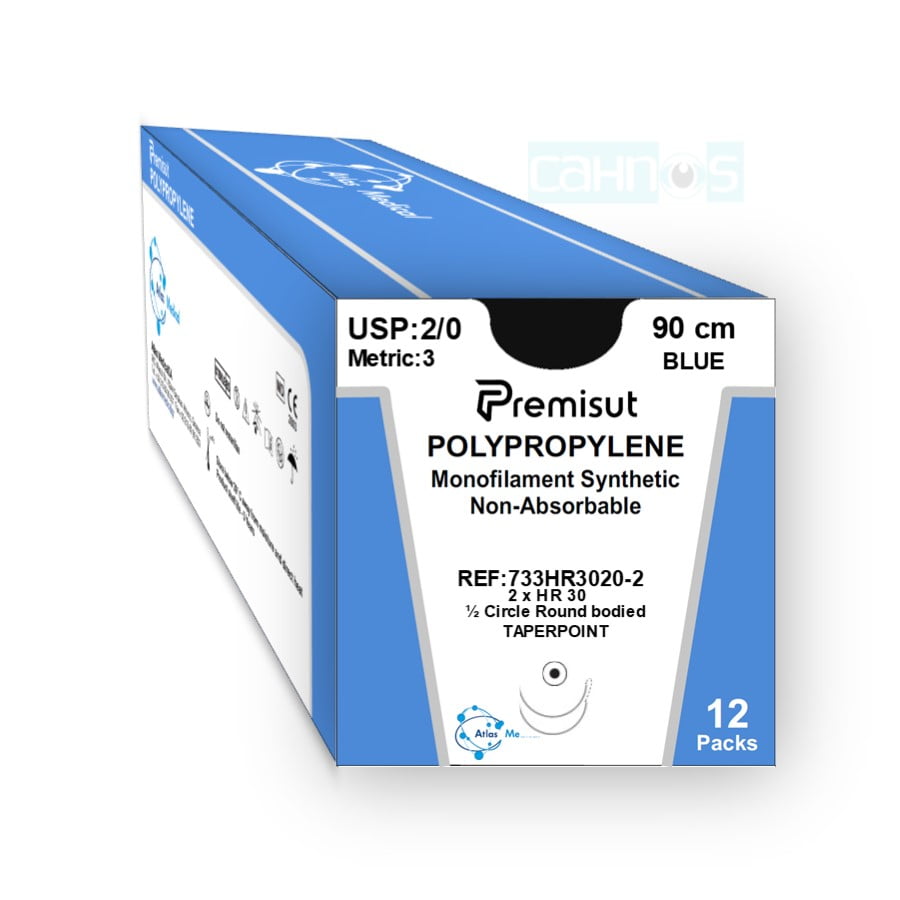
Polypropylene Suture PREMISUT Non-Absorbable – 1/2 Circle Double Needle 2xHR30 Conical Point Taperpoint, USP 2/0 Blue 90 cm – Box of 12 units (Ref. 733HR3020-2)
23,72 € In stockAdd to basket -
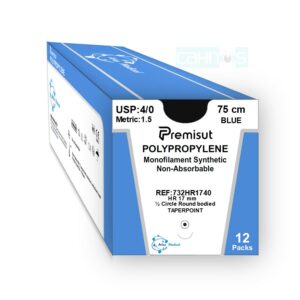
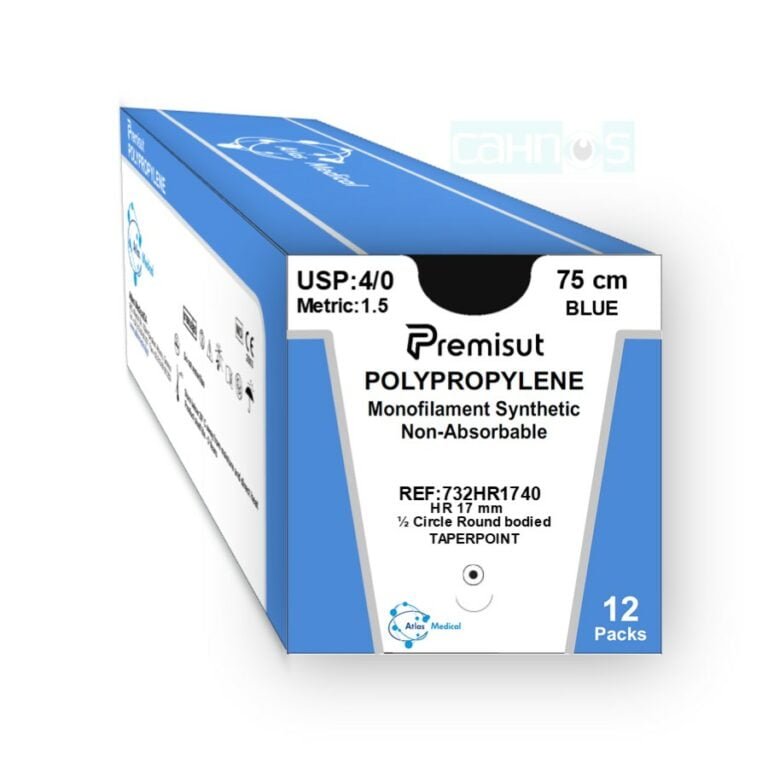
Non-Absorbable Polypropylene Suture PREMISUT · ½ Circle Cylindrical Needle Conical Point Taperpoint HR17 (17 mm) · USP 4/0 (Metric 1.5) · Blue Thread 75 cm · Box of 12 units (Ref. 732HR1740)
17,24 € In stockAdd to basket -
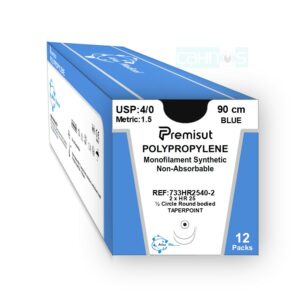
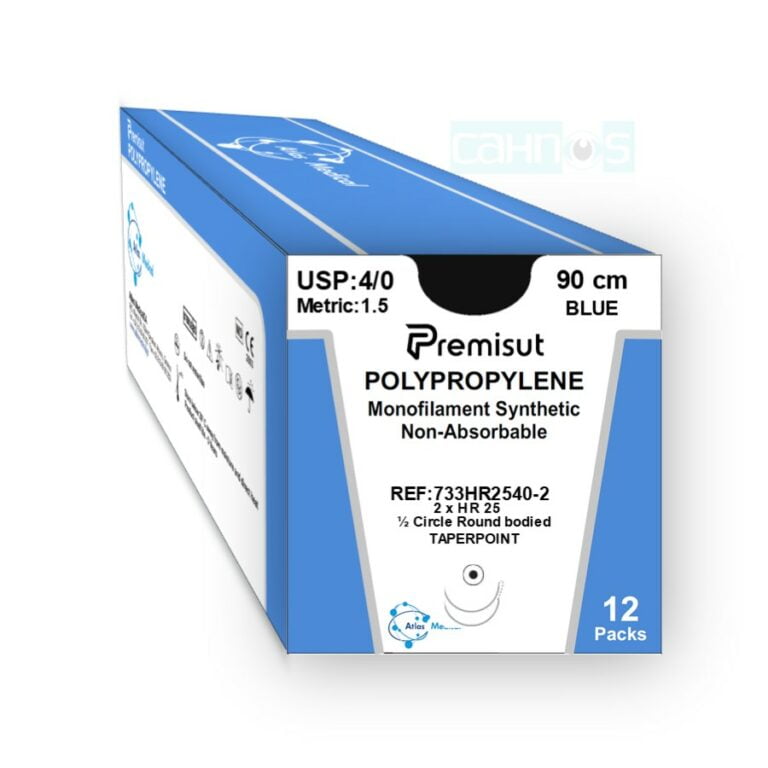
Non-Absorbable Polypropylene Suture PREMISUT – 1/2 Circle Double Needle 2xHR25 (25 mm), Taperpoint Conical Tip, USP 4/0, Blue Thread 90 cm – Box of 12 units (Ref. 733HR2540-2)
23,72 € In stockAdd to basket -
Sale!
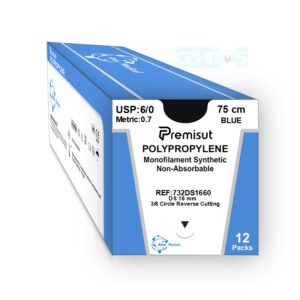
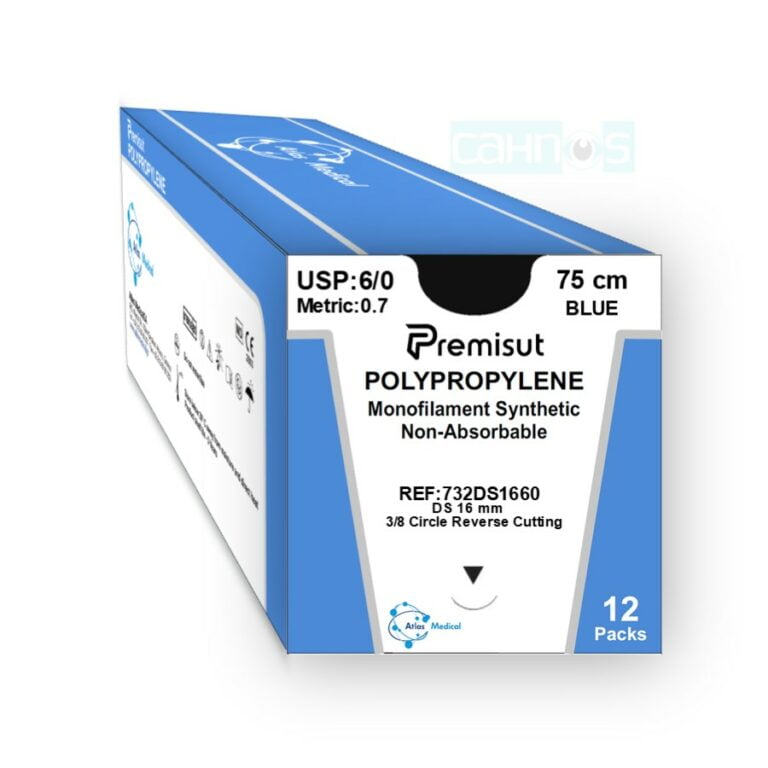
Non-absorbable polypropylene suture Premisut blue USP 6/0 – 3/8 circle DS16 needle (16 mm) reverse cutting triangular point, 75 cm thread – Box of 12 units (Ref. 732DS1660)
Original price was: 18,38 €.9,19 €Current price is: 9,19 €. In stockAdd to basket -
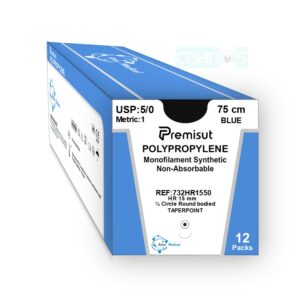
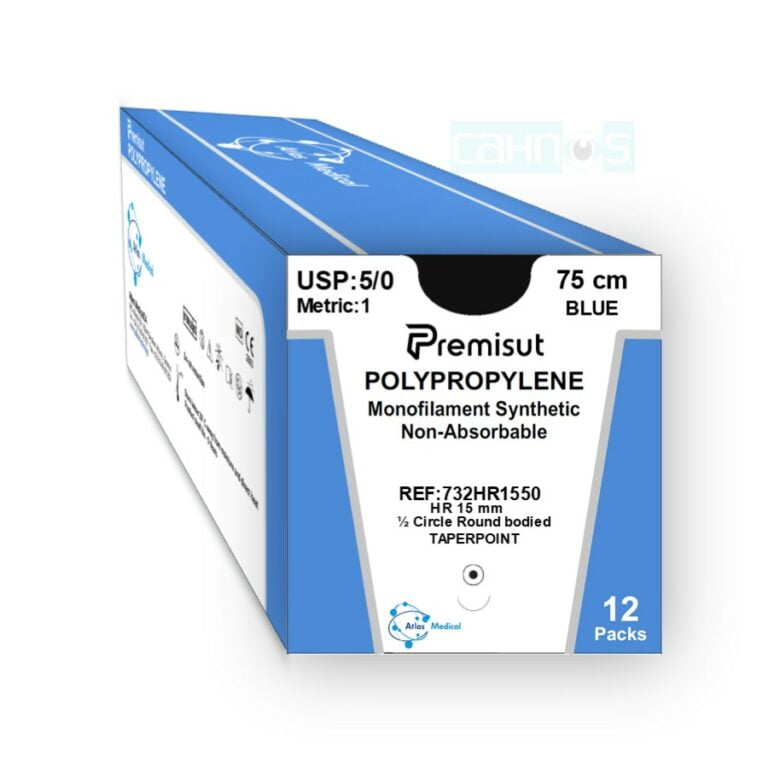
Non-absorbable monofilament polypropylene suture PREMISUT · Half-circle cylindrical needle, Taperpoint conical point HR15, 15 mm · USP 5/0 (metric EP 1) · Blue thread 75 cm · EO sterilised · Ref. 732HR1550 · SKU AM732HR1550
17,77 € In stockAdd to basket -
Sale!
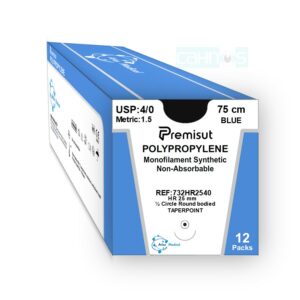
Non-Absorbable Polypropylene Suture PREMISUT – ½ Circle Cylindrical Body Taper Point Taperpoint HR 25 mm Needle, USP 4/0 (Metric 1.5), Blue Grooved Thread 75 cm – Box of 12 units (Ref. 732HR2540)
Original price was: 24,90 €.18,80 €Current price is: 18,80 €. In stockAdd to basket -
Sale!
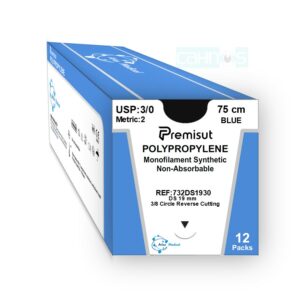
Non-absorbable polypropylene surgical suture Premisut USP 3/0 – 3/8 circle needle DS 19 mm reverse cutting triangular point, blue thread 75 cm (Ref. 732DS1930)
Original price was: 34,90 €.21,90 €Current price is: 21,90 €. In stockAdd to basket -
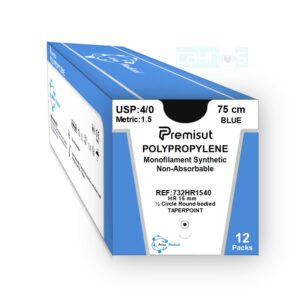
Non-Absorbable Polypropylene Suture PREMISUT · Needle ½ Circle Cylindrical Conical Point Taperpoint HR15 (15 mm) · USP 4/0 (Metric 1.5) · Blue Thread 75 cm · Box 12 units (Ref. 732HR1540 · SKU AM732HR1540)
17,77 € In stockAdd to basket
Buying and selection tips
-
Start with the needle shape
The needle shape is a purchasing criterion that changes the reference: 3/8 circle, 1/2 circle, straight, compound curve or 5/8 circle. Confirm the shape before comparing needle sizes and thread lengths.
-
Tell the taper point from the trocar point
A taperpoint and a trocar tapercut point are not the same needle even if they share curvature and size. The description distinguishes a round body with a taper point from a round body with a trocar point; choose one or the other according to the intended use.
-
Fix the size in millimetres
Needle size is expressed in millimetres and should not be confused with thread length in centimetres. Check both figures in the description before comparing references.
-
Check length and arming
Thread length is measured in centimetres and the arming shows whether it has one needle or two. There are 75 cm and 90 cm presentations, and also double-armed ones; confirm that the length and the number of needles match the intended use.
-
Check the USP and the metric size
The size is declared in USP and, where given, also in metric (EP). Do not simply read the large number: check that the USP and metric sizes in the description are the ones you need.
-
Confirm the box quantity
The box of 12 appears in the product information; confirm that the specific reference keeps that presentation. Also check the thread colour before closing the order.
Compatibility
- 1/2 circle needle with taper point
- Combine the 1/2 circle curvature with a taperpoint when the description states a round body and taper point; do not confuse it with the trocar-point variant.
- Double needle with 90 cm thread
- The double-armed configuration is described with 90 cm lengths in several references; before choosing it, confirm that you need two needles and that the thread length suits the intended use.
Frequently asked questions
How do I tell a taper-point needle from a trocar-point needle of the same curvature?
Look at the description: the taper point is associated with taperpoint and a round body; the trocar point is associated with tapercut. Even if they share 1/2 circle and 25 mm, they are not the same needle.
What is the difference between a 3/8 circle and a 1/2 circle needle for the same size?
The curvature changes the geometry of the needle and the reference; both shapes exist in polypropylene. Compare the shape, size and point before choosing.
When does it make sense to choose a double-armed presentation?
When the description states two needles mounted on the same thread and the intended use requires two ends. Check that the thread length and USP size match the single-needle reference.
How do I check that the thread is non-absorbable polypropylene monofilament?
The reference description should declare a monofilament structure, polypropylene composition and non-absorbable nature. If any of these details is missing, do not assume equivalence.
What should I check on the box before confirming the purchase?
Confirm units per box, colour, USP size, thread length, and needle shape and size. The box of 12 is a presentation that appears in the product information, but it must be verified for each reference.
Are the 75 cm thread length and the 25 mm needle the same figure?
No: the needle is measured in millimetres and the thread in centimetres. A reference can have a 25 mm needle and a 75 cm thread; read both fields separately.
Common questions
Confusing the taper point with the trocar point
Both can come on a round body and in 1/2 circle, but the taperpoint and the trocar tapercut are described differently. The difference lies in the type of point, not only in the size.
Confusing the straight needle with the straight cutting edge
A straight needle describes the shape; the straight cutting edge describes the cutting profile. The product information separates the straight taperpoint needle from the straight cutting one; they are not the same variant.
Taking the thread length for the needle size
The needle is expressed in millimetres and the thread in centimetres. A figure such as 75 cm refers to the thread, not the needle; check the full description.
Thinking that the needle shape does not change the reference
1/2, 3/8, straight, compound curve and 5/8 are different shapes and carry different references. The shape must match before comparing lengths and sizes.
Assuming the box is always 12 units
The box of 12 appears in the product information, but it should not be extrapolated to every reference. Confirm the units per box in the specific presentation.
More products in this guide
-
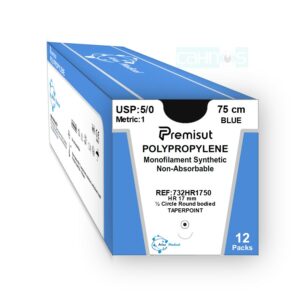
Non-Absorbable Monofilament Polypropylene Surgical Suture PREMISUT · ½ Circle Cylindrical Body Taperpoint Conical Tip Needle HR17 (17 mm) · USP 5/0 (Metric EP 1) · Blue Fluted Thread 75 cm · Box of 12 units (Ref. 732HR1750)
17,24 € In stockAdd to basket -
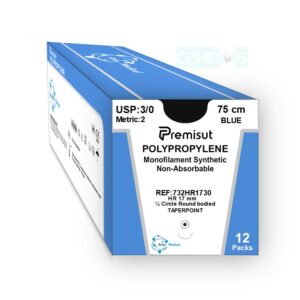
Non-Absorbable Polypropylene Suture PREMISUT · ½ Circle Cylindrical Needle Conical Taperpoint Point HR17 (17 mm) · USP 3/0 · Blue Thread 75 cm · Box of 12 units (Ref. 732HR1730)
17,24 € In stockAdd to basket -
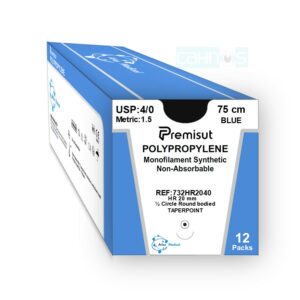
Non-Absorbable Monofilament Polypropylene Suture PREMISUT · ½ Circle Cylindrical Body Conical Taperpoint Tip Needle HR20 20 mm · USP 4/0 · Blue Thread 75 cm · Box of 12 units (Ref. 732HR2040)
17,24 € In stockAdd to basket -
Sale!
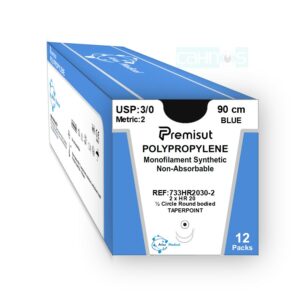
Non-Absorbable Polypropylene Suture PREMISUT · Double Needle ½ Circle 2×HR20 (20 mm) Taperpoint Conical Point · USP 3/0 · Blue Grooved Thread 90 cm · Box of 12 units (Ref. 733HR2030-2)
Original price was: 29,90 €.20,20 €Current price is: 20,20 €. In stockAdd to basket -
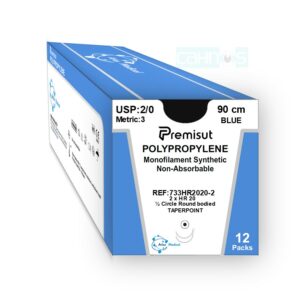
Non-Absorbable Polypropylene Suture PREMISUT · Double Needle ½ Circle Taperpoint Conical Point 2×HR20 (20 mm) · USP 2/0 · Blue Thread 90 cm · Box of 12 units (Ref. 733HR2020-2)
23,72 € In stockAdd to basket -
Sale!
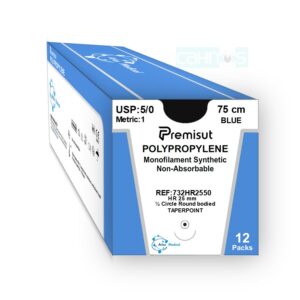
Non-Absorbable Polypropylene Suture PREMISUT · ½ Circle Cylindrical Needle, Taperpoint Conical Point HR25, 25 mm · USP 5/0 · Blue Thread 75 cm · Box of 12 units (Ref. 732HR2550)
Original price was: 24,90 €.18,80 €Current price is: 18,80 €. In stockAdd to basket -
Sale!
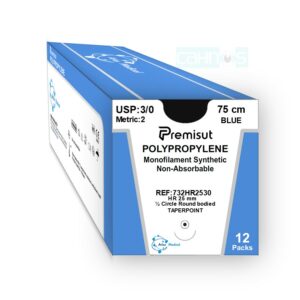
Non-Absorbable Polypropylene Suture PREMISUT · ½ Circle Cylindrical Needle, Taperpoint Conical Tip HR25, 25 mm · USP 3/0 · Blue Thread 75 cm · Box of 12 units (Ref. 732HR2530 / SKU AM732HR2530)
Original price was: 24,90 €.18,80 €Current price is: 18,80 €. In stockAdd to basket -
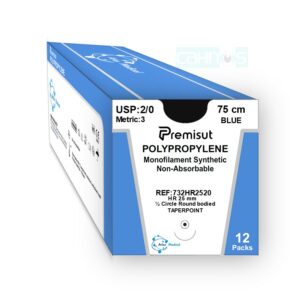
Non-Absorbable Polypropylene Suture PREMISUT · ½ Circle Cylindrical Needle, Taperpoint Conical Point HR25, 25 mm · USP 2/0 · Blue Thread 75 cm · Box of 12 units (Ref. 732HR2520)
17,24 € In stockAdd to basket