
Polyglycolic acid: sutures buying guide
137 products in the catalogue
Polyglycolic acid suture is an absorbable, multifilament suture supplied braided, in violet or undyed. Because it is absorbable, buying it is not just a matter of gauge: you need to check the needle shape, the point, the colour, the thread length and the box presentation.
References are organised by needle shape and point, with half-circle, three-eighths, five-eighths and straight needles, and by armament, with a single needle, a double needle or no needle. Within each family the needle size, the USP thread gauge, the colour and the length in centimetres change, and there is also a rapid variant. That combination defines the reference, so ordering a gauge alone is not enough.

Other related families
-
 ABSORBABLE SUTURES
Brings together the general family of absorbable sutures and helps frame the comparison before moving on to needle shape.
-
 PGA - 1/2 Circle Cylindrical Body Taper Point Taperpoint
Groups half-circle needles with a taper point, one of the criteria that changes the reference most.
-
 PGA - 1/2 Circle Cylindrical Body Tapercut Triangular Point
Lets you separate half-circle needles with a trocar point from taper-point ones.
-
 PGA - 1/2 Circle Body and Reverse Cutting Triangular Point
Identifies reverse-cutting triangular points so they can be compared with other points.
-
 PGA - Suture Without Needle WITHOUT NEEDLE
Covers needle-free presentations, with their own lengths and configurations.
-
 PGA - Straight Cut
Includes straight conventional-cutting needles, a shape that should not be mixed up with curved ones.
Products in this guide
- Normal 136
- Prime Heavy 2
- Prime 1
- Needle-free 29
- HR 36 11
- DS 19 9
- HR 26 8
- DS 16 7
- HR 45 6
- HR 48 6
- HR 13 5
- 10 cm 3
- 45 cm 9
- 70 cm 34
- 75 cm 49
- 90 cm 19
- 150 cm 5
- 180 cm 4
- 2 × 70 cm 4
- Ethylene oxide 125
- Radiation 12
-
Sale!
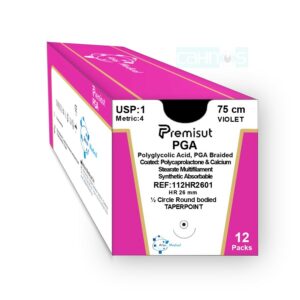
Absorbable Multifilament PGA Suture (Polyglycolic Acid) | ½ Circle Cylindrical Body Taperpoint Needle HR 26 mm | USP Gauge 1 (Metric 4) | Fluted Violet Suture 75 cm | Ref. 112HR2601 | Box of 12 units
Original price was: 34,90 €.27,40 €Current price is: 27,40 €. In stockAdd to basket -
Sale!
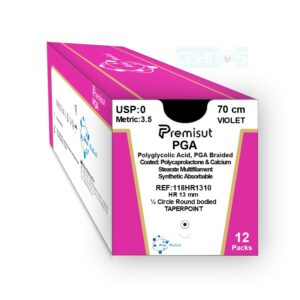
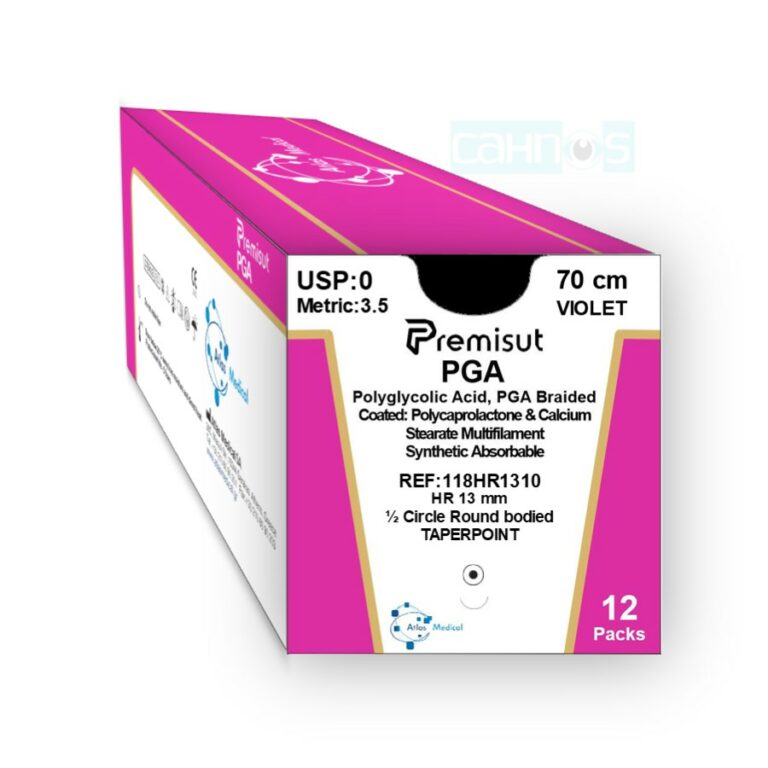
Absorbable Multifilament PGA Suture (Polyglycolic Acid) | ½ Circle Cylindrical Needle, Taperpoint Conical Point, HR 13 mm | USP 0 (Metric 3.5) | Violet Fluted Thread 75 cm | Sterile EO | Box of 12 units | Ref. 118HR1310 (AM118HR1310)
Original price was: 39,90 €.30,50 €Current price is: 30,50 €. In stockAdd to basket -
Sale!
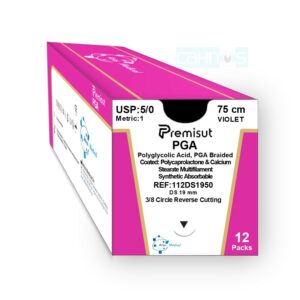
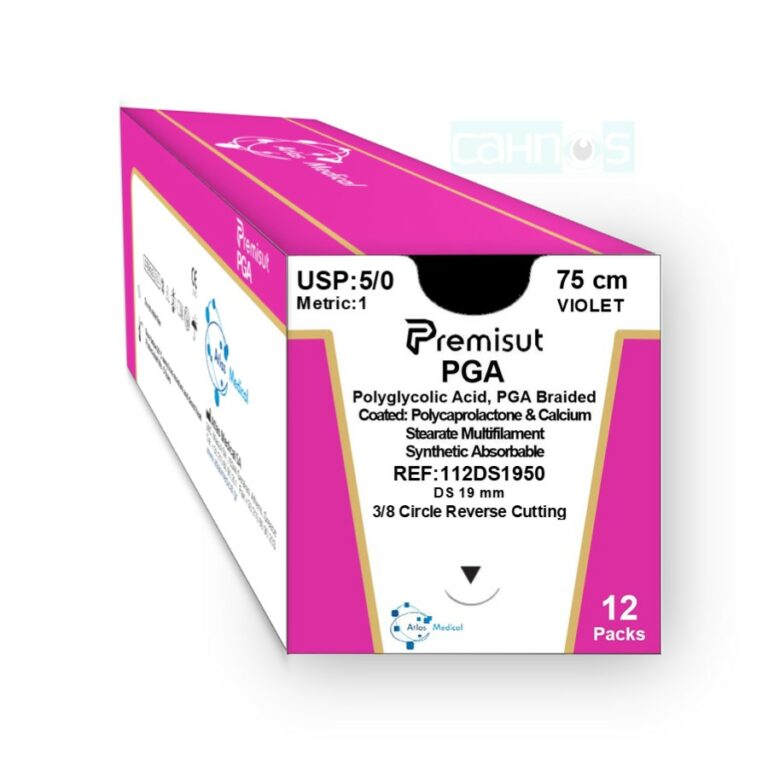
Absorbable PGA (Polyglycolic Acid) Multifilament Suture – 3/8 Circle Reverse Cutting Triangular Point Needle DS19 (19 mm) – USP 5/0 – Violet – 75 cm – Ref. 112DS1950 – Box of 12 units
Original price was: 34,90 €.26,90 €Current price is: 26,90 €. In stockAdd to basket -
Sale!
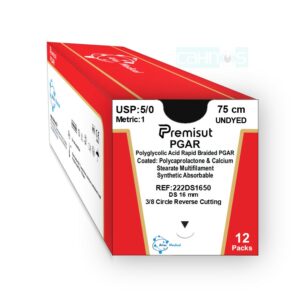
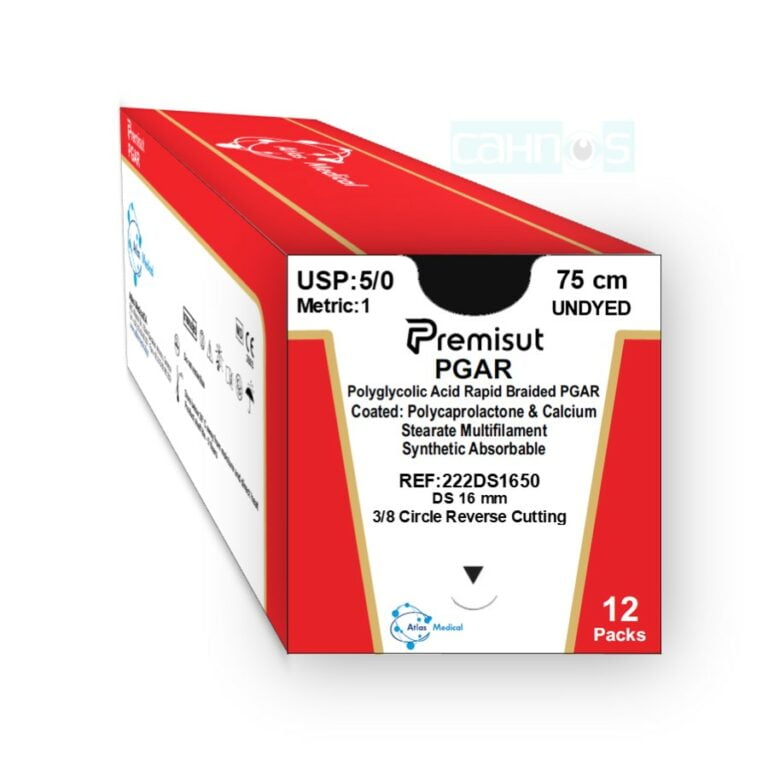
Multifilament Absorbable Suture PGAR RAPID (Polyglycolic Acid) | ⅜ Circle Triangular Reverse Cutting Needle DS16 (16 mm) | USP 5/0 (Metric 1) | Undyed · 75 cm | Ref. 222DS1650 · Box of 12 units
Original price was: 39,90 €.30,50 €Current price is: 30,50 €. In stockAdd to basket -
Sale!
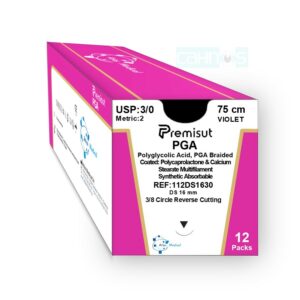
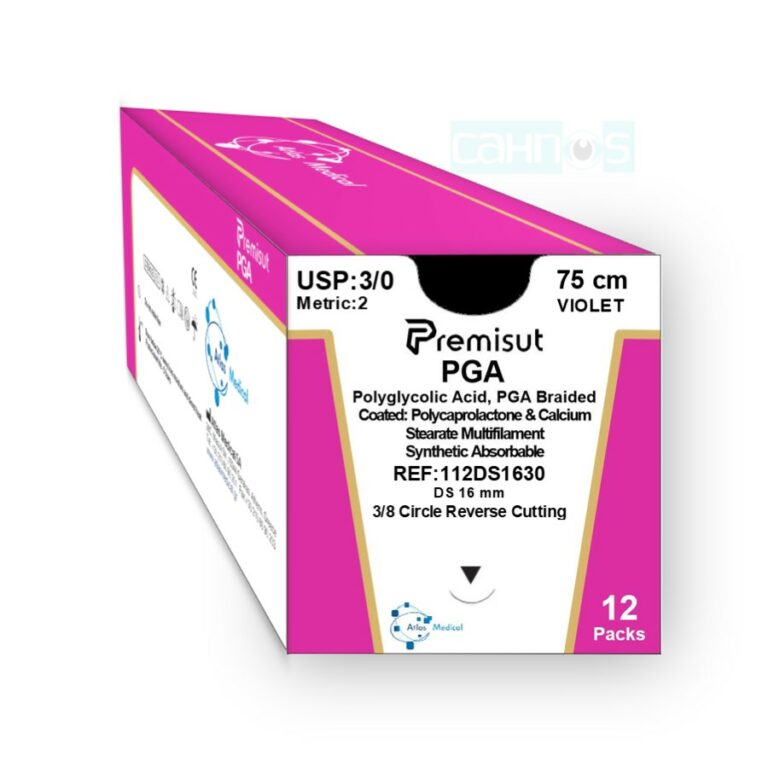
Multifilament PGA Absorbable Suture (Polyglycolic Acid) PREMISUT | ⅜ Circle Needle Triangular Point Reverse Cutting DS16 (16 mm) | USP Gauge 3/0 (Metric 2) | Violet Fluted Thread 75 cm | Ref. 112DS1630 | Box of 12 Units
Original price was: 34,90 €.26,90 €Current price is: 26,90 €. In stockAdd to basket -
Sale!
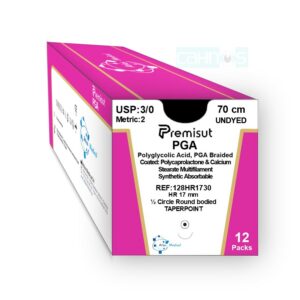
Absorbable Multifilament PGA Suture (Polyglycolic Acid) | ½ Circle Cylindrical Body Taperpoint Conical Point Needle HR17 (17 mm) | USP 3/0 Gauge (Metric 2) | Colourless Thread 70 cm | Box of 12 units | Ref. 128HR1730 (SKU AM128HR1730)
Original price was: 34,90 €.26,10 €Current price is: 26,10 €. In stockAdd to basket -
Sale!
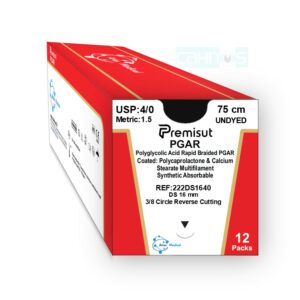
Absorbable Multifilament Suture PGAR RAPID (Polyglycolic Acid) | ⅜ Circle Reverse Cutting Triangular Needle DS16 (16 mm) | USP 4/0 (Metric 1.5) | Undyed · 75 cm | Ref. 222DS1640 · Box of 12 units
Original price was: 31,47 €.30,50 €Current price is: 30,50 €. In stockAdd to basket -
Sale!
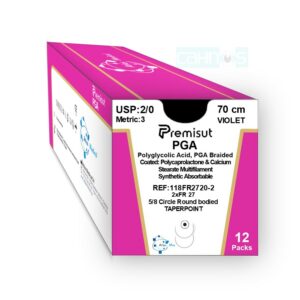
Absorbable Multifilament PGA Suture (Polyglycolic Acid) | Double Needle 5/8 Circle Cylindrical Body Taperpoint Conical Point 2xFR 27 mm | USP Gauge 2/0 (Metric 3) | Violet Grooved Thread 70 cm | Ref. 118FR2720-2 | Box of 12 units
Original price was: 44,45 €.27,60 €Current price is: 27,60 €. In stockAdd to basket
Buying and selection tips
-
Settle the needle shape and point first
The needle may be half-circle, three-eighths, five-eighths, straight, or there may be no needle at all. Within the same shape, the point may be taper, reverse-cutting triangular, trocar or spatulated; these are different references and are not interchangeable.
-
Read the USP gauge together with the length
The USP gauge and the length in centimetres should be read as a combination, not as two separate data points. The references include threads from 30 to 90 cm and gauges from 8/0 up to 2, depending on the presentation.
-
Tell colour and finish apart
The thread comes in violet and undyed, and some references are described as grooved and others as ungrooved. Colour and finish cannot be deduced from the gauge: they must appear in the reference name.
-
Do not mix the conventional variant with the rapid one
There is a rapid variant, identified as such in the reference name. Order each one by its full name and do not treat them as equivalent.
-
Check whether it has one needle, two or none
There are references with one needle, with a double needle and without a needle. Double needle means two needles on a single suture, not two boxes or two separate sutures.
Frequently asked questions
How do I tell a taper needle from a trocar-point one when buying?
The taper needle is described as taperpoint and the trocar-point one as tapercut. Both can share a half-circle shape and size, so the difference must appear in the point description.
What is the difference between the conventional and the rapid variant when ordering?
The rapid variant is identified as such in the reference name. Check the variant before the gauge so that you do not order one for the other.
Why are there threads of the same gauge with different lengths?
Because the length is part of the reference and cannot be deduced from the USP gauge. The descriptions include threads of 30, 45, 70, 75 and 90 cm with repeated gauges.
Does the double-needle presentation double the amount of suture?
No. Double needle means two needles on a single suture, not two boxes or two separate sutures. The purchase unit should be confirmed in the presentation.
How do I check whether the thread is grooved or ungrooved?
It must be stated expressly in the reference description. Colour and gauge do not allow the finish to be deduced, so ask for the full name before comparing.
What should I check on a needle-free suture?
The thread length and the USP gauge, because the needle-free presentation does not include a needle. Do not assume it is equivalent to a suture with a needle of the same size.
Common questions
Confusing the USP gauge with the needle size
The USP identifies the thread gauge and the size in millimetres refers to the needle. Both appear in the same reference name, and changing one does not make up for the other.
Assuming the whole range is the rapid variant
The rapid variant is identified in the reference name and does not define the whole family. Check the name before ordering.
Assuming that colour determines use
Violet and undyed appear across different needle shapes and gauges. Colour is a feature of the reference, not an equivalence of use.
Equating double needle with double quantity
A double-needle suture carries two needles but is still one unit. On its own it does not double the box or the number of threads.
Believing that the box of 12 applies to every reference
The box of 12 appears in most descriptions; confirm it for each reference and do not extrapolate it to the whole family.
More products in this guide
-
Sale!
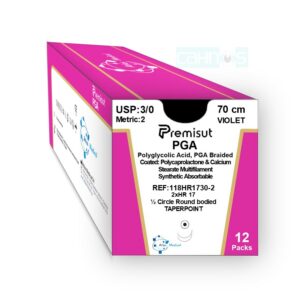
Absorbable Multifilament PGA Suture (Polyglycolic Acid) | 1/2 Circle Cylindrical Body Taperpoint Conical Point Double Needle 2xHR17 mm | USP 3/0 (Metric 2) · Violet Grooved 2×70 cm | Box of 12 units | Ref. 118HR1730-2 (AM118HR1730-2)
Original price was: 38,56 €.27,55 €Current price is: 27,55 €. In stockAdd to basket -
Sale!
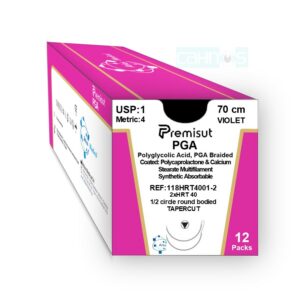
Absorbable Multifilament PGA Suture (Polyglycolic Acid) Premisut | Double ½-Circle Needle, Cylindrical Body, Trocar Point Tapercut 2xHRT 40 mm | USP 1 (Metric 4) Gauge | Violet Fluted Thread 70 cm | Ref. AM118HRT4001-2 – Box of 12 units
Original price was: 37,33 €.27,55 €Current price is: 27,55 €. In stockAdd to basket -
Sale!
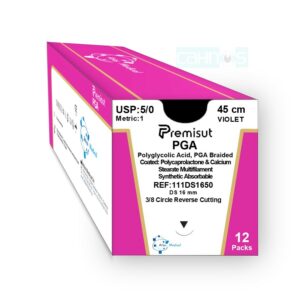
Absorbable Multifilament PGA Suture (Polyglycolic Acid) PREMISUT | 3/8 Circle Needle, Reverse Cutting Triangular Point, DS16 (16 mm) | USP 5/0 | Violet Fluted Thread 45 cm | Ref. 111DS1650 | Box of 12 units
Original price was: 34,90 €.26,10 €Current price is: 26,10 €. In stockAdd to basket -
Sale!
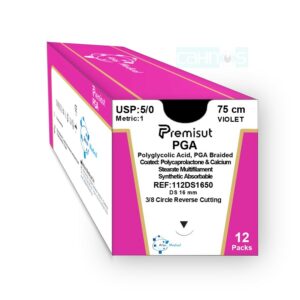
Absorbable Multifilament PGA Suture (Polyglycolic Acid) PREMISUT | 3/8 Circle Needle Reverse Cutting Triangular Point DS16 (16 mm) | USP 5/0 | Violet Fluted Thread 75 cm | Ref. 112DS1650 | Box of 12 units
Original price was: 34,90 €.25,00 €Current price is: 25,00 €. In stockAdd to basket -
Sale!
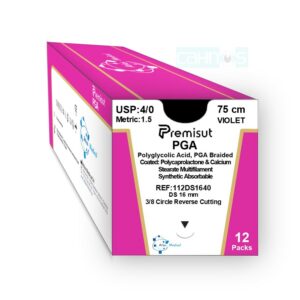
Absorbable Multifilament PGA Suture (Polyglycolic Acid) PREMISUT | Needle ⅜ Circle Triangular Point Reverse Cutting DS16 (16 mm) | USP Gauge 4/0 | Violet Fluted Thread 75 cm | Ref. 112DS1640 | Box of 12 units
Original price was: 34,90 €.26,90 €Current price is: 26,90 €. In stockAdd to basket -
Sale!
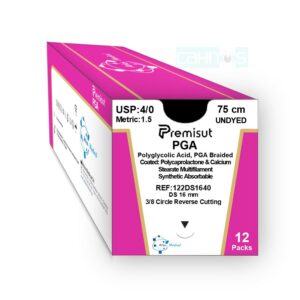
Multifilament Absorbable PGA 4/0 Suture (Polyglycolic Acid) PREMISUT | 3/8 Circle Needle Reverse Cutting Triangular Point DS16 (16 mm) | Undyed Fluted Thread 75 cm | Ref. 122DS1640 | Box of 12 units
Original price was: 34,90 €.26,10 €Current price is: 26,10 €. In stockAdd to basket -
Sale!
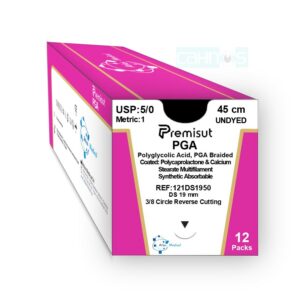
Absorbable Multifilament PGA Surgical Suture (Polyglycolic Acid) | ⅜ Circle Needle with Reverse Cutting Triangular Point DS19 (19 mm) | USP 5/0 | Colourless Fluted Thread 45 cm | Ref. 121DS1950 | Box of 12 units
Original price was: 39,90 €.32,60 €Current price is: 32,60 €. In stockAdd to basket -
Sale!
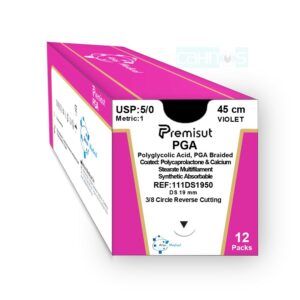
Absorbable PGA (Polyglycolic Acid) Multifilament Suture – ⅜ Circle Needle Reverse Cutting Triangular Point DS19 (19 mm) – USPP 5/0 – Violet 45 cm – Ref. 111DS1950 – Box of 12 units
Original price was: 34,90 €.26,10 €Current price is: 26,10 €. In stockAdd to basket