
Polydioxanone (PDO) suture: buying guide
283 products in the catalogue
Polydioxanone (PDO) suture is a synthetic, absorbable monofilament suture. It is supplied mounted on a needle or without a needle, with thread in different lengths depending on the reference, and the assortment contains numerous combinations of needle, size and arrangement.
The choice is not limited to size. The needle shape (1/2 circle, 3/8 circle, 5/8 circle or straight), the point type (taper point, trocar or reverse-cutting triangular) and the arrangement (single needle, double needle or no needle) determine which reference you receive. This guide sets out the criteria worth settling before placing the order so that the reference received matches the one requested.

Other related families
-
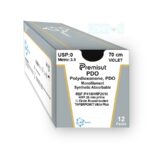 PDO - 1/2 Circle Cylindrical Body Conical Point Taperpoint
Groups sutures with a 1/2-circle needle and taper point.
-
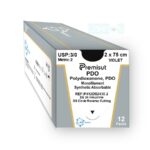 PDO - 3/8 Circle Body and Triangular Point Reverse Cutting
Brings together 3/8-circle needles with a triangular body and reverse-cutting point.
-
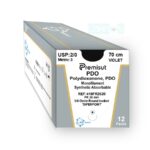 PDO - 5/8 Circle Cylindrical Body Conical Point Taperpoint
Groups references with a 5/8-circle needle and taper point.
-
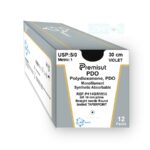 PDO - Straight Cylindrical Needle Conical Point Taperpoint
Brings together sutures with a straight round-bodied needle and taper point.
-
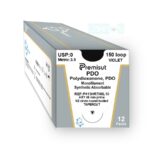 PDO - 1/2 Circle Cylindrical Body Trocar Tapercut Point
Groups references with a 1/2-circle needle and trocar point.
-
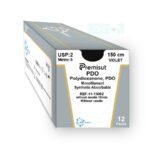 PDO - Suture without Needle WITHOUT NEEDLE
Sutures without a needle, for those who only need to replenish thread and already have the needle.
Products in this guide
- Prime 196
- Normal 86
- Prime Heavy 1
- 1/2 circle 202
- 3/8 circle 60
- Straight Cut 11
- Straight 7
- Without Needle 5
- 5/8 circle 4
- J Shape 1
- Polydioxanone 281
- Poliglecaprone 1
- Polyester 1
- Polyglycolic acid 1
- HR 40 20
- HR 26 17
- HR 22 15
- HR 13 11
- HR 17 10
- HR 30 10
- HR 36 9
- DS 24 8
-
Sale!
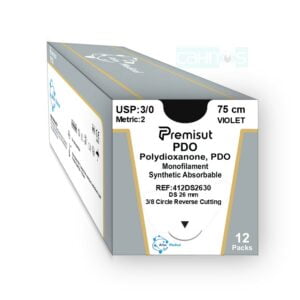
Absorbable Monofilament Suture Polydioxanone PDO/PDS · Needle ⅜ Circle Triangular Reverse Cutting DS26 (26 mm) · USP 3/0 (Metric 2) · Violet Fluted Thread 75 cm · Box of 12 Units · Ref. 412DS2630
Original price was: 44,90 €.32,35 €Current price is: 32,35 €. In stockAdd to basket -
Sale!
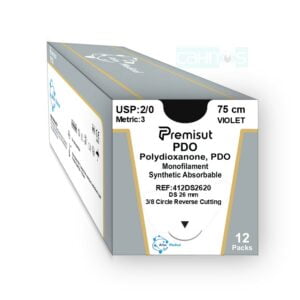
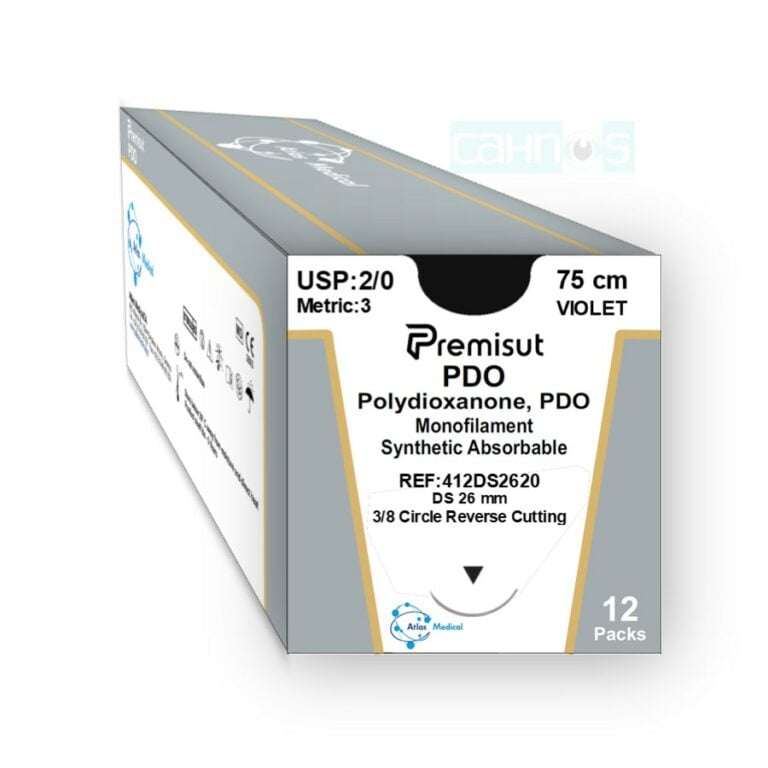
Absorbable Monofilament Polydioxanone Suture (PDO/PDS) · ⅜ Circle Triangular Reverse Cutting Needle DS26 (26 mm) · USP 2/0 Gauge (Metric 3) · Violet Thread 75 cm · Box of 12 units · Ref. 412DS2620
Original price was: 44,90 €.32,35 €Current price is: 32,35 €. In stockAdd to basket -
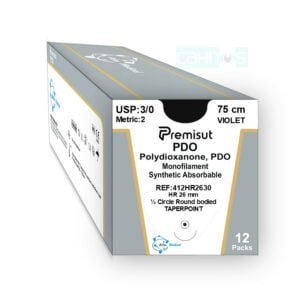
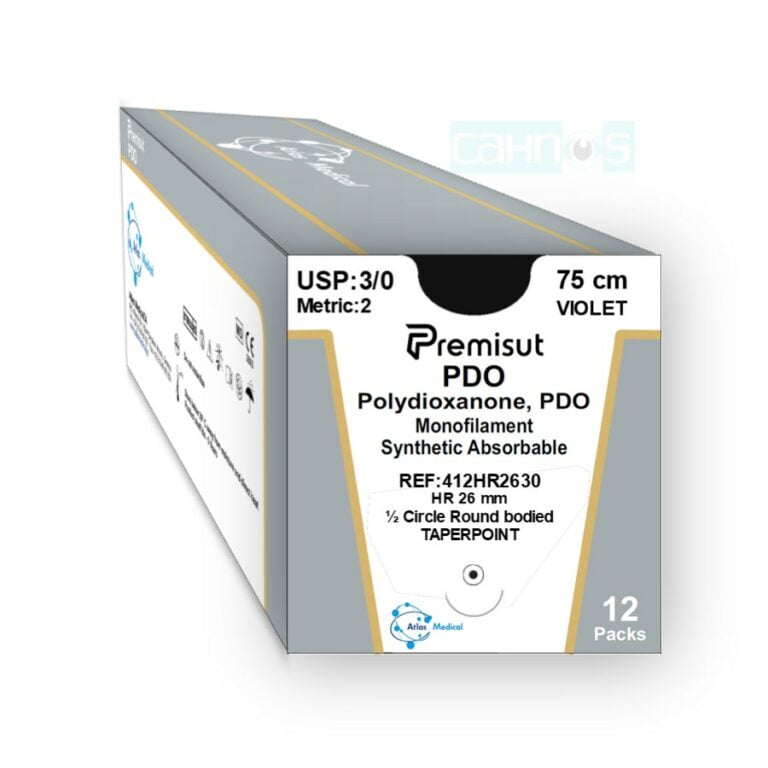
Absorbable Monofilament Polydioxanone PDO/PDS Suture 3/0 – 1/2 Circle Cylindrical Body Conical Taperpoint Needle 26 mm (HR26) – Violet Thread 75 cm – Box of 12 units · Ref. AM412HR2630
34,97 € In stockAdd to basket -
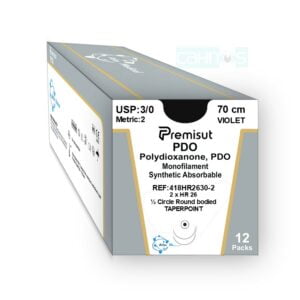
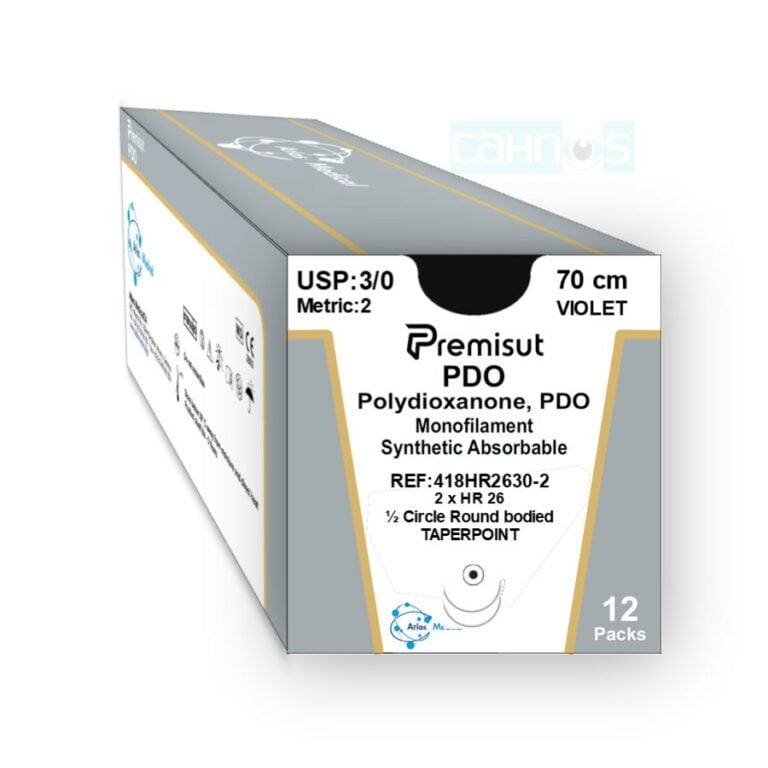
Absorbable Monofilament Polydioxanone Suture PDO/PDS · Double ½ Circle Cylindrical Conical Point Taperpoint Needle 2×HR26 (26 mm) · USP 3/0 (Metric 2) Gauge · Violet Thread 70 cm · Box of 12 units · Ref. AM418HR2630-2
41,48 € In stockAdd to basket -
Sale!
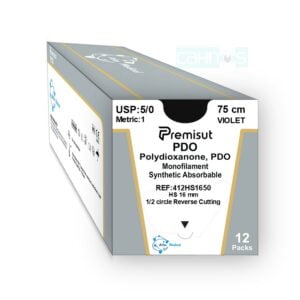
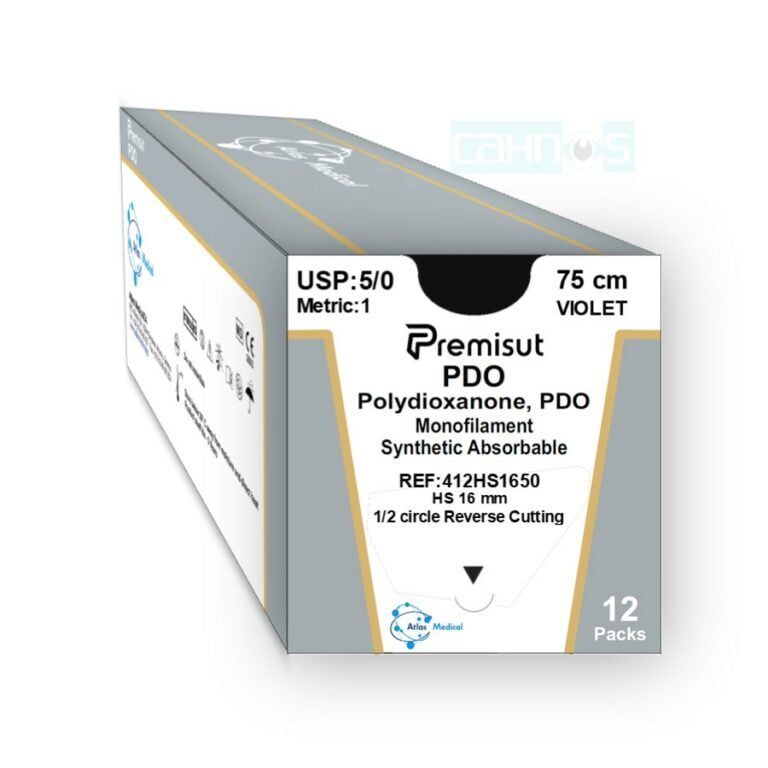
Absorbable Monofilament Polydioxanone Suture PDO/PDS | Needle 1/2 Circle Triangular Reverse Cutting HS16 (16 mm) | USP Gauge 5/0 | Violet Thread 75 cm | Ref. 412HS1650 | Box 12 units
Original price was: 41,48 €.36,95 €Current price is: 36,95 €. In stockAdd to basket -
Sale!
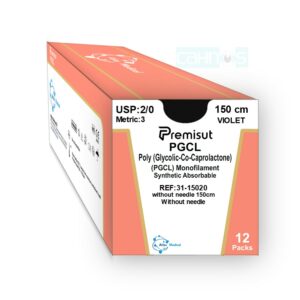
Absorbable Monofilament PGCL Suture (Poliglecaprone 25 / Caprolactone) Without Needle · USP 2/0 (Metric 3) · Violet · 1 Thread of 150 cm · Box of 12 units · PREMISUT (Ref. 31-15020)
Original price was: 64,90 €.47,10 €Current price is: 47,10 €. In stockAdd to basket -
Sale!
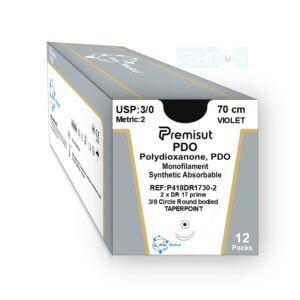
Absorbable Monofilament Polydioxanone PDO/PDS Suture 3/8 Circle Cylindrical – Double Needle 17 mm (2xDR17) Conical Taperpoint Point, USP 3/0, Violet, 70 cm – Box of 12 units · Ref. P418DR1730-2
Original price was: 79,54 €.44,90 €Current price is: 44,90 €. In stockAdd to basket -
Sale!
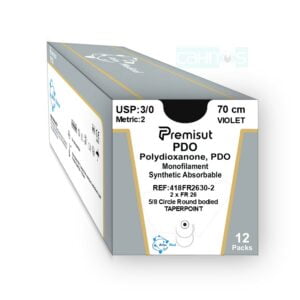
Absorbable Monofilament Polydioxanone (PDO/PDS) Suture · Double Needle 5/8 Circle Cylindrical Taperpoint Conical Tip 2×FR 26 mm · Gauge USP 3/0 · Violet Thread 70 cm · Box 12 units · Ref. AM418FR2630-2
Original price was: 64,90 €.38,40 €Current price is: 38,40 €. In stockAdd to basket
Buying and selection tips
-
Settle the needle shape and point first
The curvature and the point of the needle distinguish one reference from another. The references include 3/8, 1/2 and 5/8 circle and straight needles, with taper, trocar or reverse-cutting triangular points. It is worth deciding both aspects before looking at sizes.
-
Check the USP size against its metric equivalent
The size is stated in USP and in metric, and both must match what was ordered. The references cover sizes such as 6/0, 5/0, 4/0, 2/0, 0, 1 and 2. A different size means a different reference.
-
Choose the thread length
The thread length varies by reference (for example, 30, 45, 70 or 90 cm). It forms part of the reference and cannot be taken for granted: it must be stated in the order.
-
Check the thread finish
Ribbed and non-ribbed thread are distinguished. It is an attribute that changes the reference and should be reflected in the order; it must not be assumed to make no difference.
-
Decide the thread colour
The colour forms part of the product description. Most references are violet, although there is also undyed thread. If the tender specification fixes a colour, you must order the reference that meets it.
-
Define the needle arrangement before ordering
There are presentations with a single needle, with a double needle and without a needle. The arrangement determines how many needles you receive, so it is worth stating it explicitly to avoid receiving a different set-up from the one intended.
Compatibility
- Sutures without a needle
- The references without a needle are only suitable for those who already have the right needle; they are not equivalent to a reference with a swaged needle.
Frequently asked questions
What is the difference between a taper-point needle and a reverse-cutting one when ordering a PDO suture?
They are two different point types and appear in different references. It is worth settling the point type required by the tender specification and verifying it in the description of each reference.
How do I check the USP size and its metric equivalent before confirming the order?
The size is stated in USP and in metric. Both values must be checked against what was requested, because a different size means a different reference.
What thread length should I state when ordering a polydioxanone suture?
The length varies by reference and forms part of it. It must be stated in the order, matched to what your facility's protocol sets.
Is a single-needle presentation the same as a double-needle one?
No. The arrangement changes the number of needles, and there are references with one needle, with two and without a needle. It must be stated explicitly in the request.
What does it mean for the order if the thread is ribbed or non-ribbed?
They are different finishes and give rise to different references. It is worth reflecting the finish in the order so as not to receive a variant that was not requested.
How does the thread colour affect the reference I should order?
The colour forms part of the product description, and there are references in violet and undyed. If the tender specification fixes a colour, you must order the reference that meets it.
Common questions
Believing that any thread suits any needle
The size, curvature, point and arrangement form part of the product. Two references with the same type of thread may not be interchangeable if they differ in any of those attributes.
Looking for the needle size in the reference number
The size and shape of the needle are read from the product description, not from the reference number.
Assuming that all presentations have a single needle
There are references with a double needle and also without a needle. If the arrangement is not specified, you may receive a different set-up from the one intended.
Supposing that ribbed and non-ribbed thread are the same reference
They are different finishes and are identified by different references. Treating them as equivalent in a request is a source of error.
More products in this guide
-
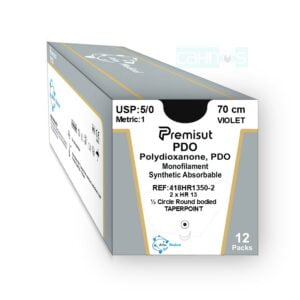
Absorbable Monofilament Polydioxanone Suture PDO/PDS | Double Needle ½ Circle Cylindrical Body Conical Taperpoint Tip 13 mm (2xHR13) | USP 5/0 (Metric 1) | Violet Thread 70 cm | Box of 12 units | Ref. 418HR1350-2
53,34 € In stockAdd to basket -
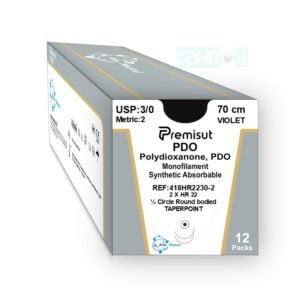
Absorbable Monofilament Polydioxanone PDO/PDS Suture Double Needle ½ Circle Conical Point Taperpoint 22 mm (2xHR22) – USP 3/0 – Violet Thread 70 cm – Box of 12 units · Ref. 418HR2230-2
41,48 € In stockAdd to basket -
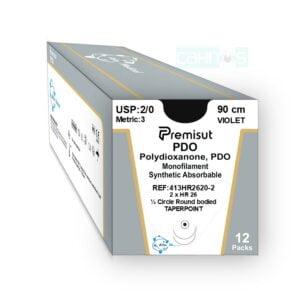
Absorbable Monofilament Polydioxanone PDO/PDS Suture | Double ½ Circle Cylindrical Taper Point Needle Taperpoint 2xHR 26 mm | USP 2/0 Gauge | Violet Thread 90 cm | Box of 12 units | Ref. AM413HR2620-2
43,28 € In stockAdd to basket -
Sale!
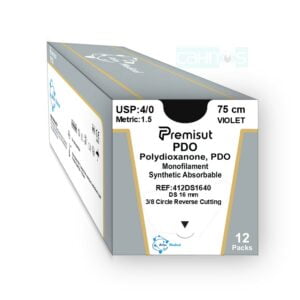
Absorbable Monofilament PDO/PDS Suture · ⅜ Circle Reverse Cutting Triangular Needle DS16 (16 mm) · USP 4/0 · Violet Thread 75 cm · Box of 12 units · Ref. AM412DS1640
Original price was: 44,90 €.34,10 €Current price is: 34,10 €. In stockAdd to basket -
Sale!
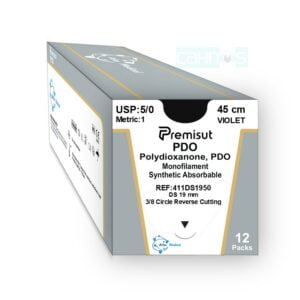
Absorbable Monofilament Polydioxanone PDO/PDS Suture – 3/8 Circle Triangular Reverse Cutting Needle DS19 (19 mm) – USP 5/0 – Violet Thread 45 cm – Box of 12 units · Ref. 411DS1950
Original price was: 44,90 €.36,95 €Current price is: 36,95 €. In stockAdd to basket -
Sale!
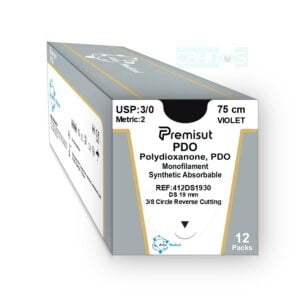
Absorbable Monofilament Polydioxanone Suture PDO/PDS · 3/8 Circle Reverse Cutting Triangular Point DS19 (19 mm) · USP 3/0 · Violet Thread 75 cm · Box of 12 units · Ref. AM412DS1930
Original price was: 44,90 €.36,95 €Current price is: 36,95 €. In stockAdd to basket -
Sale!
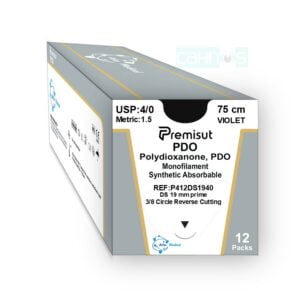
Absorbable Monofilament Polydioxanone Suture PDO/PDS 4/0 – 3/8 Circle Triangular Reverse Cutting Needle 19 mm (DS19) – Violet Thread 75 cm – Box of 12 units · Ref. AMP412DS1940
Original price was: 64,90 €.43,50 €Current price is: 43,50 €. In stockAdd to basket -
Sale!
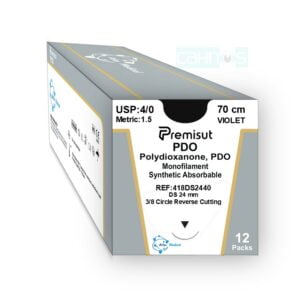
Absorbable Monofilament Polydioxanone Suture PDO/PDS | Needle 3/8 Circle Triangular Reverse Cutting DS24 (24 mm) | USP 4/0 (Metric 1.5) | Violet Grooved Thread 70 cm | Box of 12 units · Ref. 418DS2440
Original price was: 44,90 €.36,95 €Current price is: 36,95 €. In stockAdd to basket