
Sensitive nitrile examination gloves
14 products in the catalogue
The nitrile examination glove is a disposable, ambidextrous, powder-free glove used in examinations, patient care and laboratory tasks that do not require a sterile glove. Being made of nitrile, it contains no natural latex proteins, so it is an alternative for those with latex sensitivity. The range includes gloves in white, blue, black and pink, in sizes from XS to XL.
The sensitive version is described by its finish: a microtextured outer surface on the fingertips, which improves grip, and a chlorinated inner surface, smooth and comfortable, which makes donning easier. The cuff has a reinforced edge that stops the glove from rolling up. In a healthcare setting the purchasing decision rests on four axes: the correct size, colour as an identification code, conformity with the standards for single-use medical gloves and the protection the manufacturer declares in writing. An examination glove does not replace a sterile surgical glove when the procedure requires sterility.
Other related families
Products in this guide
- S 3
- L 2
- XL 2
- M 1
-
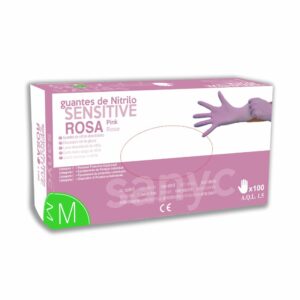
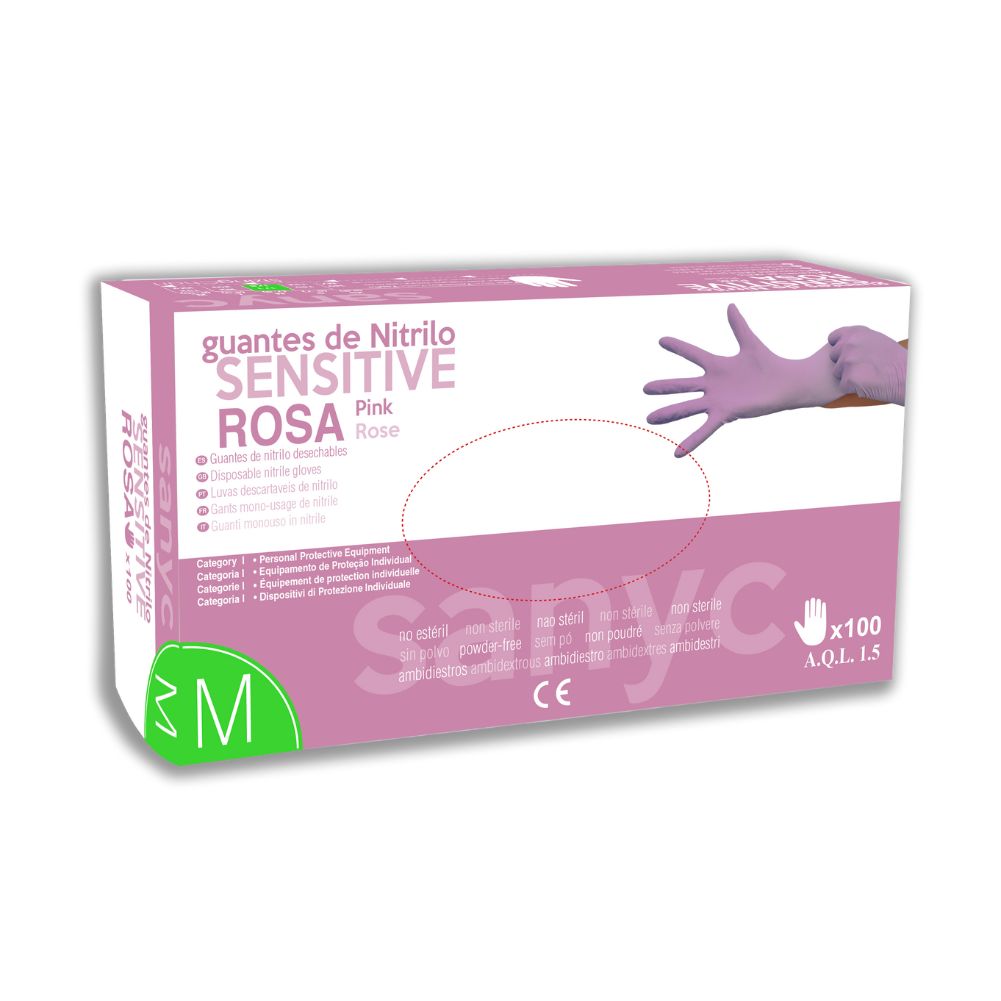
Nitrile Glove SANYC Sensitive Pink Size P (G7271) · Latex-Free · Box of 100 Units
5,16 € In stockAdd to basket -
Nitrile Glove SANYC Sensitive Pink Size M (G7272) – Box of 100 Units · Latex-Free
5,16 € In stockAdd to basket -
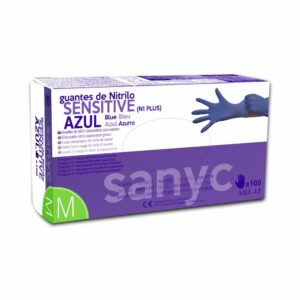
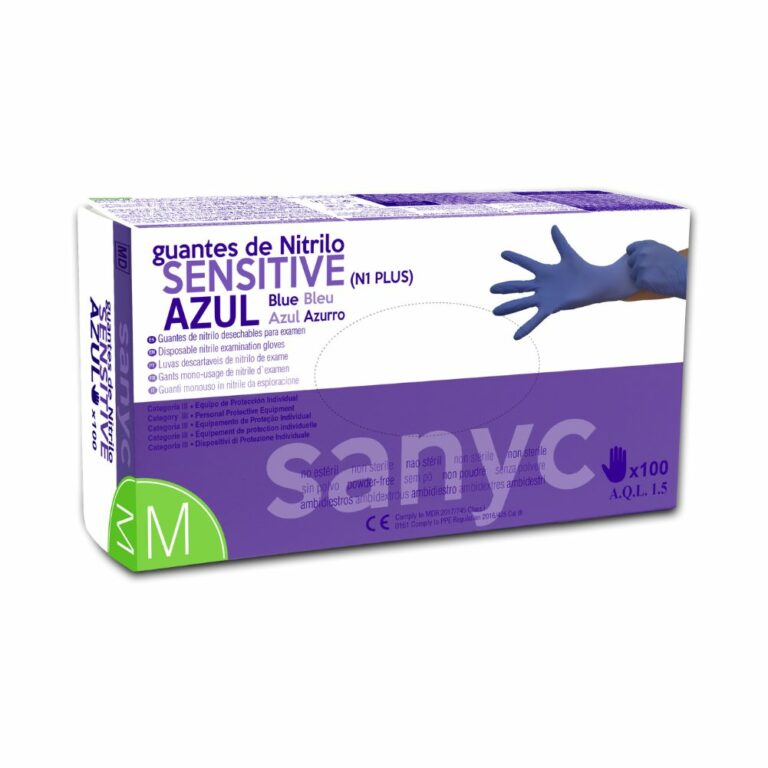
Nitrile Glove SANYC Sensitive Blue Size XP (Extra Small) · Latex-free and Powder-free · Micro-textured and Chlorinated · Box of 100 Units for Medical Examination (SKU G270)
4,48 € In stockAdd to basket -
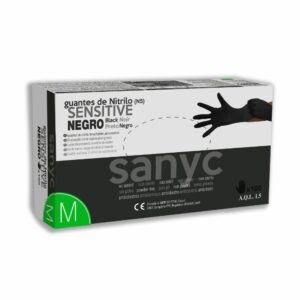
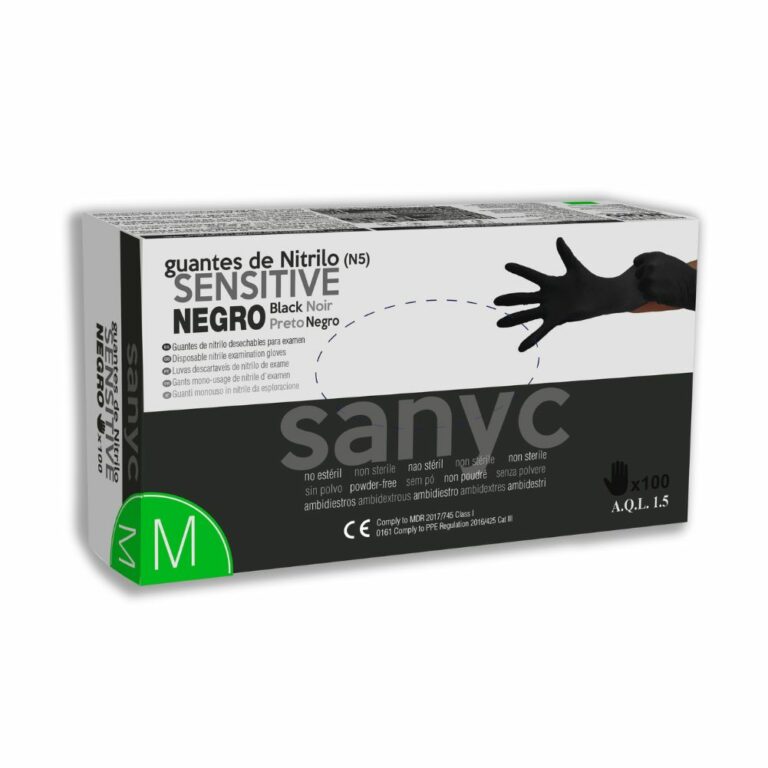
Nitrile Glove SANYC Sensitive Black Size XG for Medical Examination – Box of 100 Units, Latex-Free and High Sensitivity
4,75 € In stockAdd to basket -
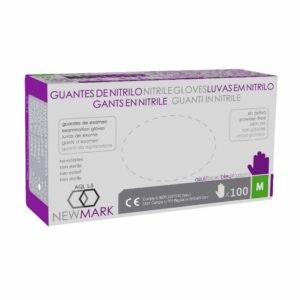
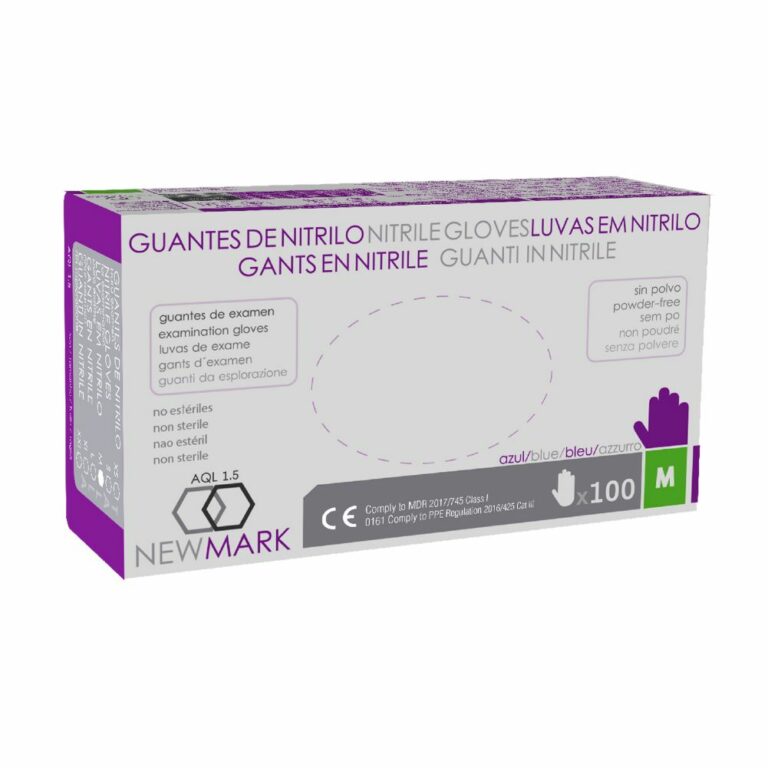
Nitrile Glove New Mark Sensitive Blue Size G (Large) for Medical Examination – Latex-Free and Micro-Textured | Box of 100 Units (Ref. G11002)
6,25 € In stockAdd to basket -
Nitrile Glove New Mark Sensitive Blue Size P (Small) – Medical Examination, Latex-Free and Micro-Textured | Box of 100 Units (Ref. G11003)
6,25 € In stockAdd to basket -
Nitrile Glove New Mark Sensitive Blue Size XG (Extra Large) – Box of 100 Units | Ref. G11004
6,25 € In stockAdd to basket -
Nitrile Glove SANYC Sensitive Blue Size XP (Extra Small) · Latex-Free and Powder-Free · Microtextured and Chlorinated · Box of 100 Units for Medical Examination (SKU G271)
4,48 € In stockAdd to basket
Buying and selection tips
-
Check the declared AQL
The standard for single-use medical gloves (EN 455-1) sets an AQL of 1.5 for the absence of holes. An examination glove with an AQL of 2.5 in accordance with ASTM does not meet that requirement without additional testing. Ask for the declaration of conformity before comparing models, because the figure does not always appear on the box.
-
Measure the thickness at palm and finger, not the weight
The weight per glove is not the thickness: two gloves of the same weight may have very different millimetres at the palm and the finger. Compare the two figures in millimetres. A thinner glove gains tactile sensitivity and may lose mechanical strength.
-
Check for an express mention of viruses
The biohazard pictogram without the word VIRUS only covers bacteria and fungi. If the workplace requires protection against viruses, the glove must declare the corresponding test. It is not enough for the box to show the generic biohazard symbol.
-
Consider the finish of the glove
Some sensitive gloves have a chlorinated interior, smooth and comfortable, and a microtextured outer surface on the fingertips to improve grip. The reinforced edge of the cuff stops the glove from rolling up during work.
-
Confirm food-contact suitability if the glove leaves the consulting room
If the same glove is going to be used for handling food, it must be declared suitable for food contact. This is a detail that cannot be deduced from the colour or the thickness. Ask for it in writing before unifying references across several departments.
Frequently asked questions
Can I use a sterile examination glove as a surgical glove?
No. A sterile examination glove is not a surgical glove: they differ in anatomy, AQL, length and class. If the procedure requires a surgical glove, a surgical glove must be ordered.
Is a latex-free glove the same as a hypoallergenic glove?
No. A latex-free glove may contain accelerators that cause other types of allergic reaction, so the absence of latex does not by itself guarantee skin tolerance.
What size should I order if the user is between two sizes?
Take as a reference the hand circumference and palm width declared for each size, and not the habit from other brands. Check the size chart of the specific reference.
Is the biohazard pictogram enough to cover viruses?
No. Without the word VIRUS the glove has only been tested against bacteria and fungi; for protection against viruses the specific test must be declared.
How do I compare two nitrile gloves of the same weight?
By comparing millimetres at the palm and the finger, not the weight per glove. Weight is not thickness and does not allow you to predict either feel or strength.
Which colours and sizes should I standardise when buying for several departments?
The products are offered in white, blue, black and pink, and in sizes from XS to XL. Standardise one size and one colour code per department and check that all references declare the same conformity.
Common questions
Believing that "latex-free" is equivalent to hypoallergenic
It is not the same: a latex-free glove may contain accelerators that cause allergic reactions. If skin is the problem, the complete formulation must be checked, not just the absence of latex.
Assuming that weight indicates thickness
The weight per glove is not the thickness. To compare two models, look at the millimetres at the palm and the finger.
Supposing that the biohazard pictogram already covers viruses
Without the word VIRUS the glove only covers bacteria and fungi. If protection against viruses is needed, the declaration of the corresponding test must be required.
Thinking that any sterile glove will do as a surgical glove
A sterile examination glove is not a surgical glove: anatomy, AQL, length and class all change. They are two different products.
Interpreting colour as a level of protection
Colour works as a size code or an area identification code, not as an indicator of performance. Protection is read from the declared standard, not from the shade of the glove.
More products in this guide
-
Nitrile Glove SANYC Sensitive Blue Size XP (Extra Small) · Latex-Free and Powder-Free · Micro-Textured and Chlorinated · Box of 100 Units for Medical Examination (SKU G272)
4,48 € In stockAdd to basket -
Nitrile Glove SANYC Sensitive Blue Size XP (Extra Small) · Latex-Free and Powder-Free · Micro-Textured and Chlorinated · Box of 100 Units for Medical Examination (SKU G273)
4,48 € In stockAdd to basket -
Nitrile Glove SANYC Sensitive Blue Size XP (Extra Small) · Latex-Free and Powder-Free · Micro-Textured and Chlorinated · Box of 100 Units for Medical Examination
4,48 € In stockAdd to basket -
Nitrile Glove SANYC Sensitive Black Size P (Small) – Box of 100 Units for Medical Examination Latex-Free
4,75 € In stockAdd to basket -
Nitrile Glove SANYC Sensitive Pink Size XP (G7270) · Latex-Free and Powder-Free · Box of 100 Units for Medical Examination
5,16 € In stockAdd to basket -
Nitrile Glove SANYC Sensitive Pink Size G (G7273) · Latex-Free and Powder-Free · Microtextured and Chlorinated · Box of 100 Units for Medical Examination
5,16 € In stockAdd to basket