
Disposable nitrile gloves: buying guide
40 products in the catalogue
The disposable nitrile glove is a single-use glove made from a synthetic elastomer that contains no natural latex protein. It is used in healthcare settings for examinations, wound care, laboratory work and sample handling. Products in this category come in different colours, sizes and cuff lengths, in powder-free, latex-free versions.
Nitrile does not carry natural latex proteins, which avoids one type of sensitisation, although it does not remove the risk of allergy to vulcanisation accelerators. In healthcare, the status of a medical device and that of personal protective equipment coexist, so the same glove can declare conformity with medical standards and with standards for chemical protection or protection against micro-organisms. Choosing well means paying attention to the size, the thickness at the palm and finger, the acceptable quality level for pinholes, the cuff length and the type of chemical protection declared. This guide sets out these criteria so that the purchase matches the intended use and not just the colour or the presentation.
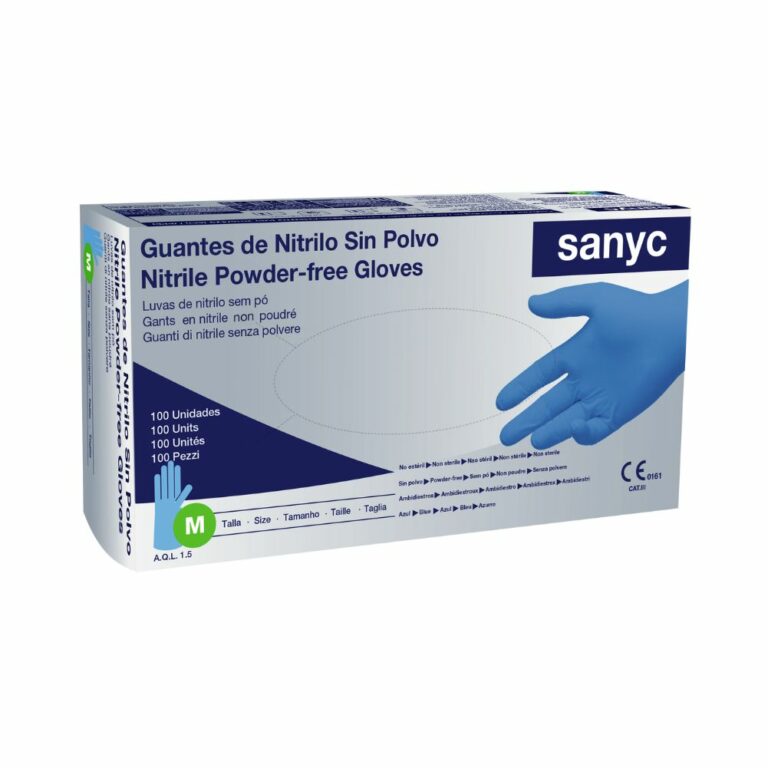
Other related families
Products in this guide
- Nitrile 40
- Rubber 2
- L 16
- S 14
- XL 14
- M 13
- Box OF 100 36
- Box OF 50 3
- Box OF 200 1
- 30 cm 7
- 40 cm 1
-
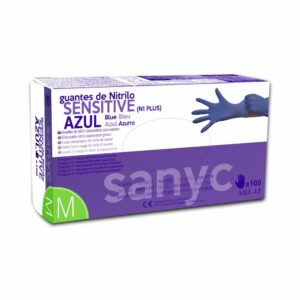
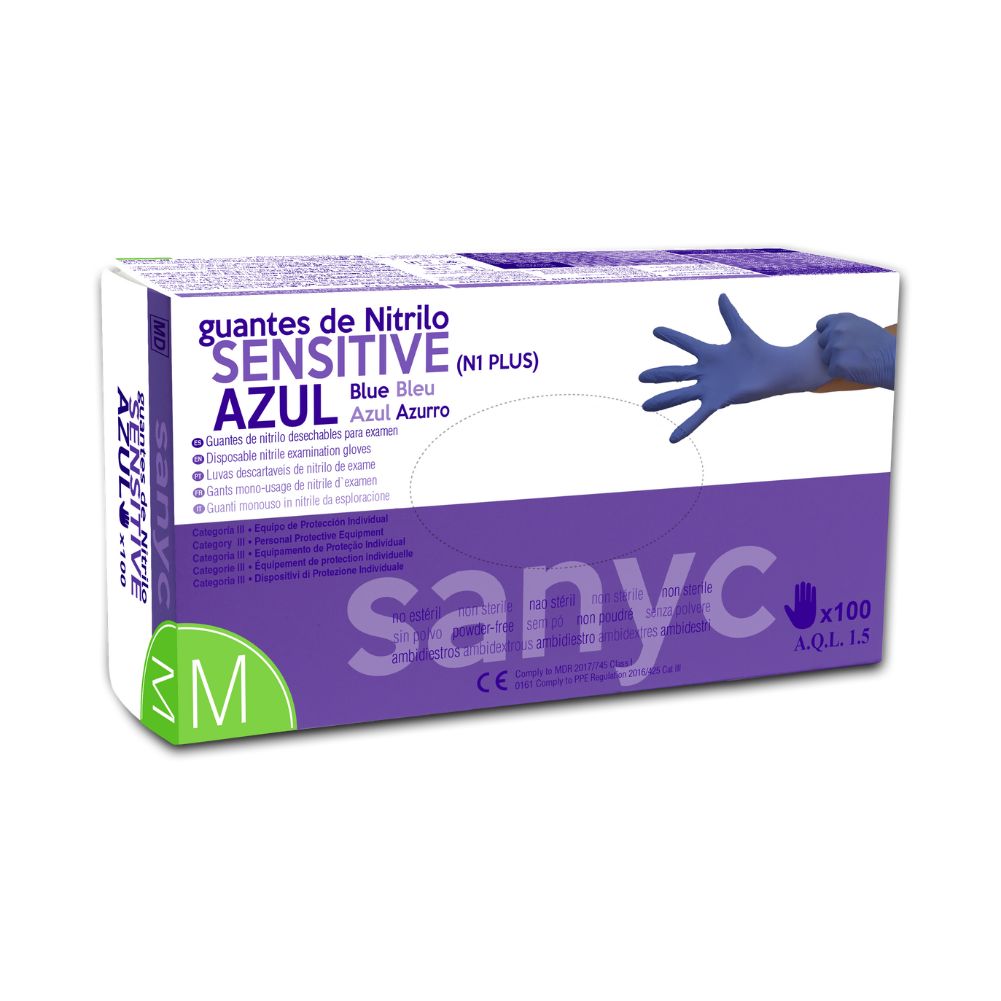
Nitrile Glove SANYC Sensitive Blue Size XP (Extra Small) · Latex-free and Powder-free · Micro-textured and Chlorinated · Box of 100 Units for Medical Examination (SKU G270)
4,48 € In stockAdd to basket -
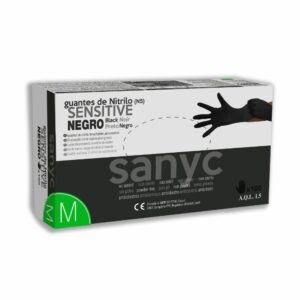
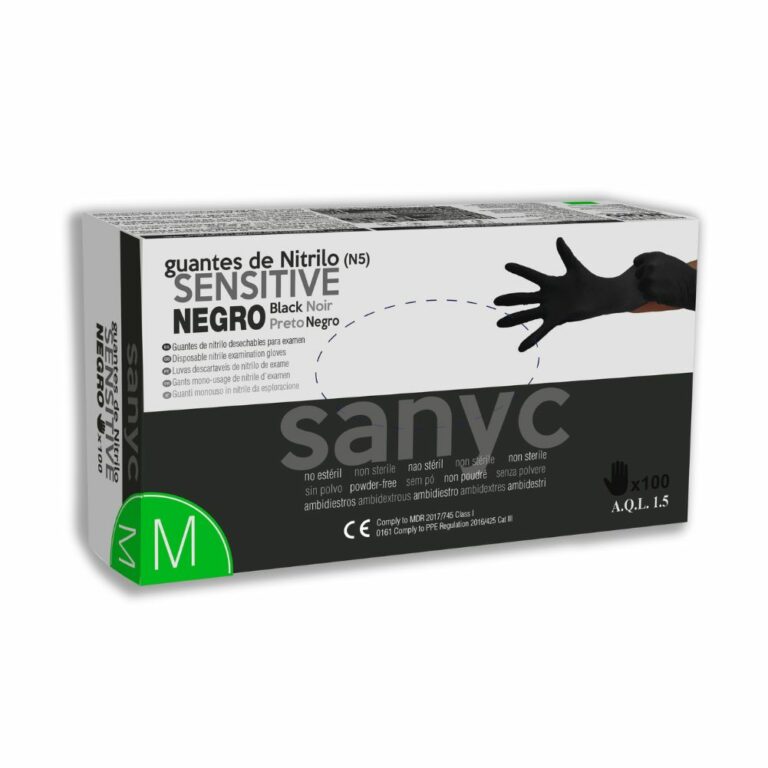
Nitrile Glove SANYC Sensitive Black Size XG for Medical Examination – Box of 100 Units, Latex-Free and High Sensitivity
4,75 € In stockAdd to basket -
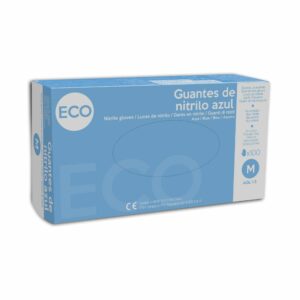
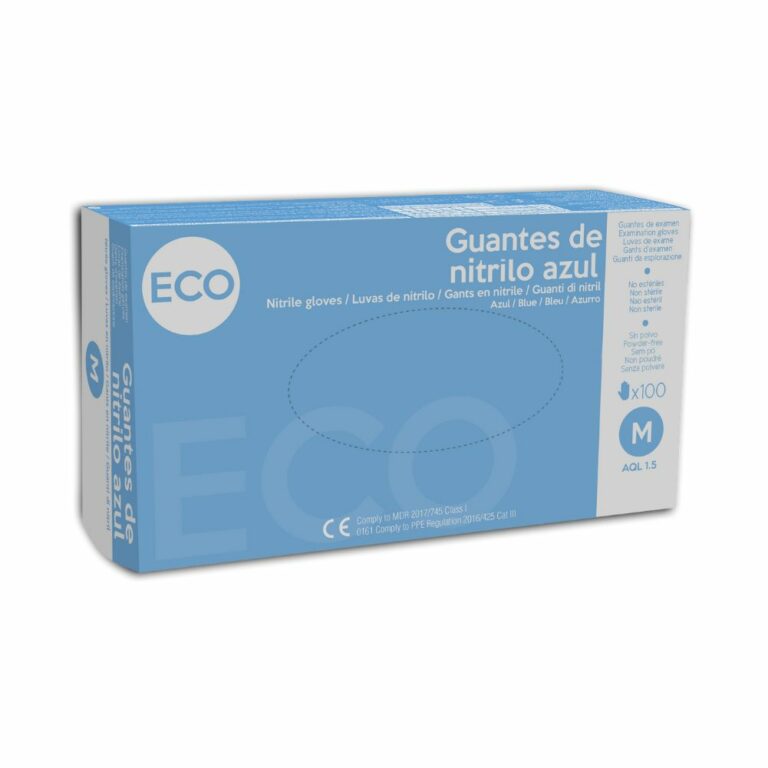
Eco Sanyc Blue Nitrile Examination Glove, Size M – Box of 100 Units, Latex-Free
4,32 € In stockAdd to basket -
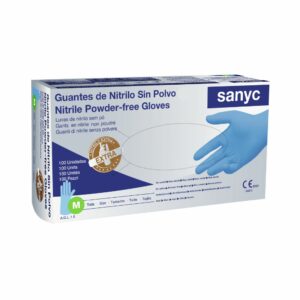
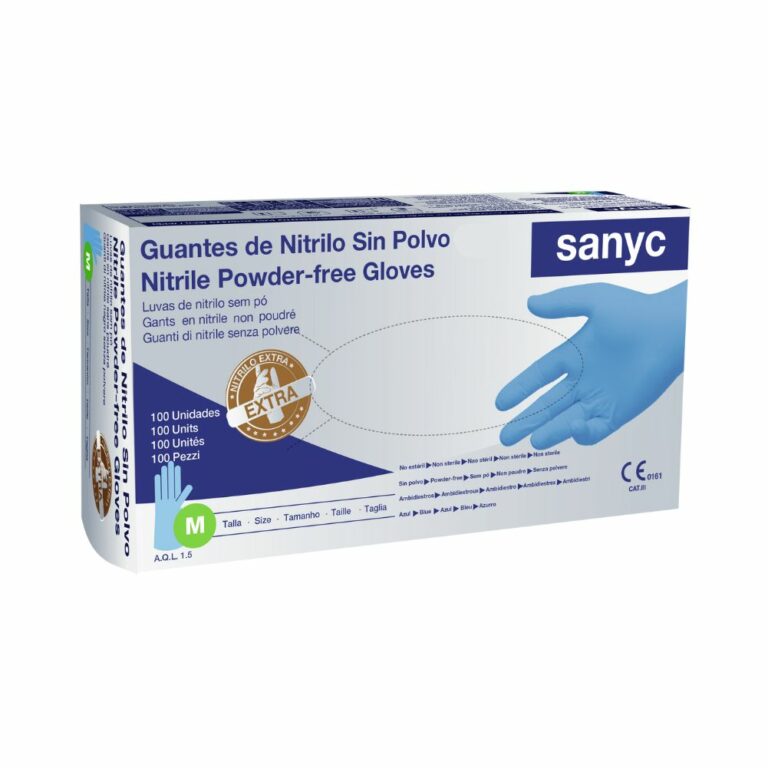
Extra Strong Nitrile Glove SANYC Blue Size G (Large) · Latex-free · Micro-textured and Chlorinated · Box of 100 Units · SKU G10002
9,92 € In stockAdd to basket -
Extra Strong Nitrile Glove SANYC Blue Size P (Small) · Latex-Free · Microtextured and Chlorinated · Box of 100 Units · SKU G10003
9,92 € In stockAdd to basket -
Extra-Strong Nitrile Glove SANYC Blue Size XG (Extra Large) · Latex-free · Micro-textured and Chlorinated · Box of 100 Units · SKU G10004
9,92 € In stockAdd to basket -
Extra Strong Nitrile Glove SANYC Blue Size XXG (Extra Extra Large) – Box of 100 Units for Medical Examination, Latex-Free | Ref. G10006
9,92 € In stockAdd to basket -
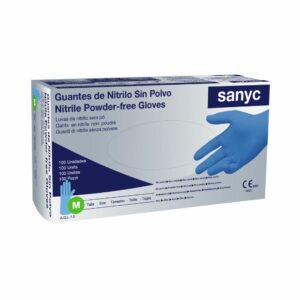
Nitrile Glove SANYC Blue Size M · Latex-Free and Powder-Free · Micro-Textured and Chlorinated · Box of 100 Units for Medical Examination (SKU G1001)
6,58 € In stockAdd to basket
Buying and selection tips
-
Size: the first decision
Products in this category come in sizes from extra small to extra extra large. Measure the hand before fixing the size: a short size leaves the cuff uncovered and an oversized one reduces sensitivity and grip.
-
Real thickness, not weight
Weight per glove is not thickness: the useful comparison is made in millimetres at the palm and finger. The same model can declare different values at the finger, palm and cuff, and that difference determines feel and strength.
-
AQL for pinholes
The standard for single-use medical gloves requires an AQL of 1.5 for the absence of pinholes. An examination glove with an AQL of 2.5 under ASTM does not meet that threshold without additional testing, so check which standard each model declares.
-
Type of chemical protection
If the glove will be used against chemicals, look at the declared type. Type B requires at least three substances from the list with permeation of 30 minutes or more each, type C only one with 10 minutes or more, and type A six or more.
-
Cuff length according to the task
Some models have a long cuff, of about 30 cm, as opposed to the short formats. The extra length gives wrist and forearm coverage when there is a risk of splashing.
Frequently asked questions
How do I choose the size if my hand falls between two sizes?
Measure the hand and rely on the size range declared by the manufacturer. If you are unsure between two, prioritise the fit at the palm, because an oversized glove reduces grip.
Is a latex-free glove enough for a professional with an allergy?
Not necessarily: latex-free does not mean hypoallergenic, because vulcanisation accelerators can cause type IV allergy. If staff are sensitised, check the declared composition and consider accelerator-free formulations.
What should I check before buying nitrile for handling cytostatics?
Check that the model declares the relevant standard and the list of drugs against which permeation has been tested. Without that declaration, handling cytostatics cannot be assumed to be covered.
What is the difference between a sterile examination glove and a surgical one?
A sterile examination glove is not a surgical glove: the anatomy, AQL, length and product class differ. If the purchase is for the operating theatre, the criterion cannot be sterility alone.
What does it mean for a nitrile glove to be type B?
It means it has passed the permeation test with at least three substances from the list for 30 minutes or more each. Type C only requires one substance with 10 minutes or more, and type A, six or more.
Which details should I compare between nitrile gloves from different manufacturers?
Compare the size, the thickness in millimetres at the palm and finger, the AQL and the test standard, the cuff length and the declared chemical or biological protection. Avoid comparing on colour alone.
Common questions
“Latex-free” as a synonym for hypoallergenic
A latex-free glove may contain accelerators that cause type IV allergy, so the absence of latex does not guarantee tolerance.
Confusing weight with thickness
Weight per glove is not thickness; the useful comparison is made in millimetres at the palm and finger.
Taking protection against viruses for granted
The biological hazard pictogram without the word VIRUS only covers bacteria and fungi; protection against viruses requires the specific test.
Believing that every sterile glove is suitable for surgery
A sterile examination glove is not a surgical glove: they differ in anatomy, AQL, length and class.
Mistaking polyisoprene for latex
Polyisoprene is synthetic and contains no natural latex protein, although it shares the elasticity of latex.
More products in this guide
-
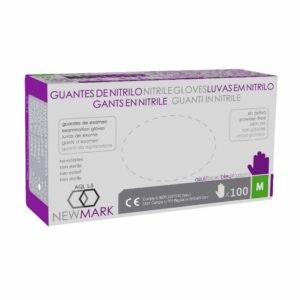
Nitrile Glove New Mark Sensitive Blue Size G (Large) for Medical Examination – Latex-Free and Micro-Textured | Box of 100 Units (Ref. G11002)
6,25 € In stockAdd to basket -
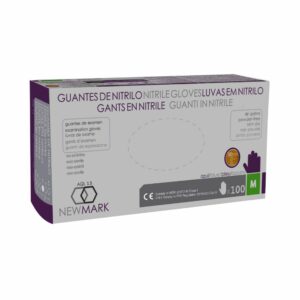
Nitrile Glove New Mark Blue 30 cm Size G (Large) – Box of 100 Units for Medical Examination, Latex-free | Ref. G110021
13,25 € In stockAdd to basket -
Nitrile Glove New Mark Sensitive Blue Size P (Small) – Medical Examination, Latex-Free and Micro-Textured | Box of 100 Units (Ref. G11003)
6,25 € In stockAdd to basket -
Nitrile Glove New Mark Blue 30 cm Size P (Small) – Box of 100 Units | Ref. G110031
13,25 € In stockAdd to basket -
Nitrile Glove New Mark Sensitive Blue Size XG (Extra Large) – Box of 100 Units | Ref. G11004
6,25 € In stockAdd to basket -
Nitrile Glove New Mark Blue 30 cm Size XG (Extra Large) – Box of 100 Units for Medical Examination, Latex-free | Ref. G110041
13,25 € In stockAdd to basket -
Nitrile Examination Glove New Mark Blue 30 cm Size XXG (Extra Extra Large) – Box of 100 Units | Ref. G110051
13,25 € In stockAdd to basket -
Nitrile Glove SANYC Sensitive Blue Size XP (Extra Small) · Latex-Free and Powder-Free · Microtextured and Chlorinated · Box of 100 Units for Medical Examination (SKU G271)
4,48 € In stockAdd to basket
Keep exploring
- Black nitrile gloves: buying guide
- Buying guide: blue nitrile gloves
- Latex and nitrile gloves: buying guide for healthcare use
- Sensitive nitrile examination gloves
- XL nitrile gloves: buying guide for medical examination
- latex-free
- latex-free
- Nitrile Gloves
- blue colour
- blue
- examination gloves
- non-sterile