
Latex and nitrile gloves: buying guide for healthcare use
60 products in the catalogue
Single-use gloves are a critical consumable in any healthcare setting, and the choice between nitrile and latex affects the barrier, comfort and the risk of sensitisation for staff. Nitrile is a synthetic rubber that contains no natural latex protein, whereas latex is natural rubber; both come in powdered and powder-free versions and with different cuff lengths depending on the task.
In practice, buyers face descriptions that mix European and American standards, weights that look like thicknesses, and labels such as “latex-free” that do not mean the same as “hypoallergenic”. A nitrile examination glove is used for examinations, wound care, laboratory work and general handling; its suitability depends on the AQL for pinholes, the thickness at the palm and finger, the size, and whether it carries PPE marking where there is a chemical or biological risk. This guide sets out the criteria worth fixing before you buy (material, size, presentation, colour and level of protection) and clears up the most common false friends, so that references are compared on verifiable data and not on label claims.
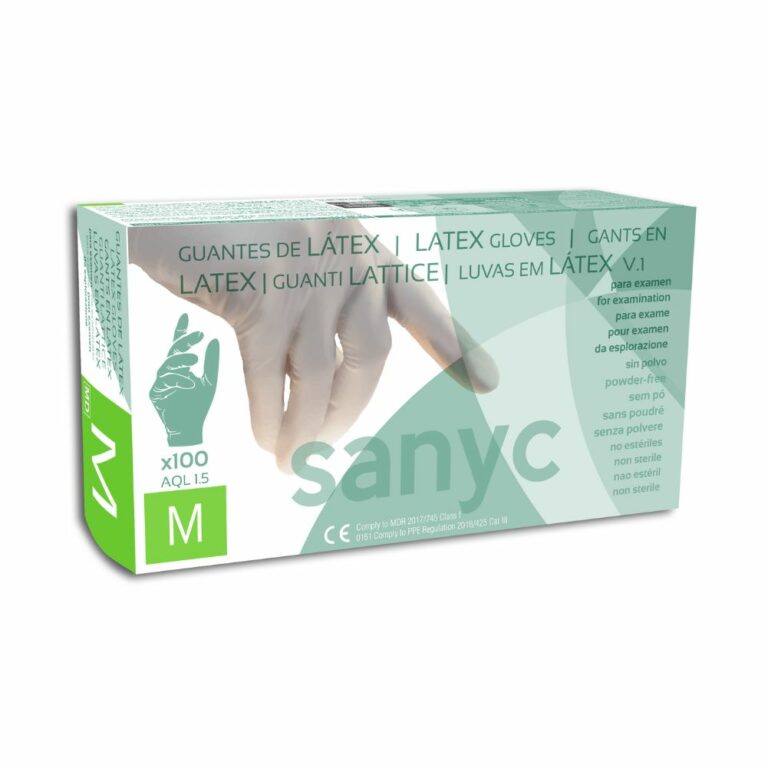
Other related families
-
 Medical Examination Gloves
Reference family for examinations, wound care and laboratory work; it is the starting point when looking for a non-sterile single-use glove.
-
 Latex Gloves
Natural rubber family; useful as a comparison for those weighing nitrile against latex who need to keep the two purchases separate.
Products in this guide
- Nitrile 45
- Rubber 15
- Latex 14
- Plastic 1
- L 23
- M 20
- S 20
- XL 19
- XS 3
- Otros colores 45
- Marrón 1
- Box OF 100 51
- Box OF 50 7
- Box OF 200 1
- Unit 1
-
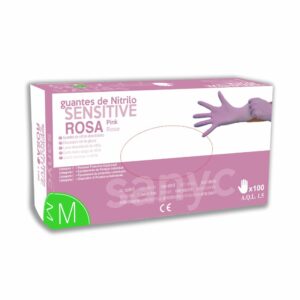
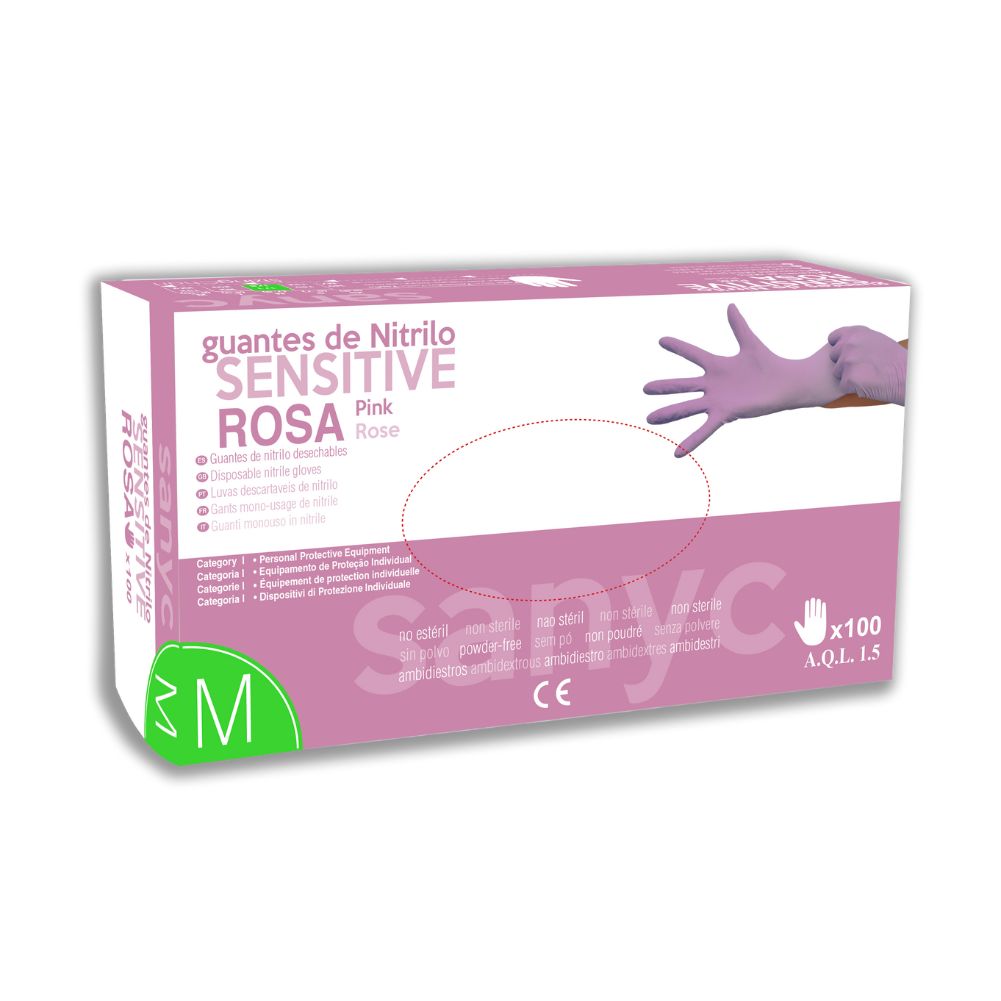
Nitrile Glove SANYC Sensitive Pink Size P (G7271) · Latex-Free · Box of 100 Units
5,16 € In stockAdd to basket -
Nitrile Glove SANYC Sensitive Pink Size M (G7272) – Box of 100 Units · Latex-Free
5,16 € In stockAdd to basket -
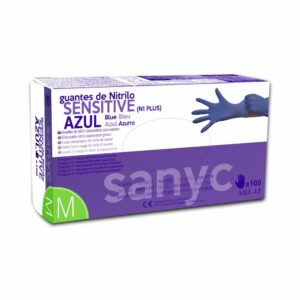
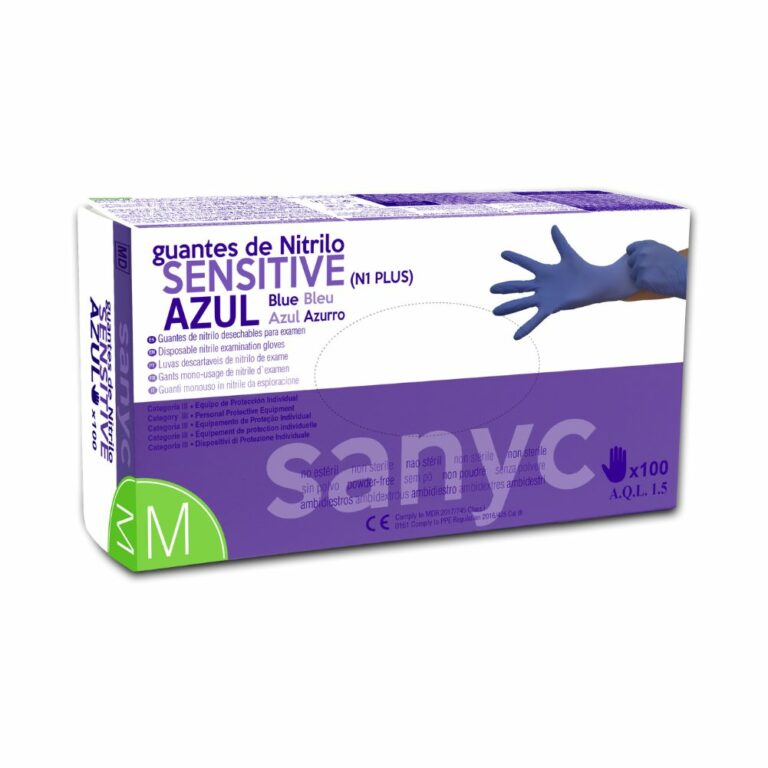
Nitrile Glove SANYC Sensitive Blue Size XP (Extra Small) · Latex-free and Powder-free · Micro-textured and Chlorinated · Box of 100 Units for Medical Examination (SKU G270)
4,48 € In stockAdd to basket -
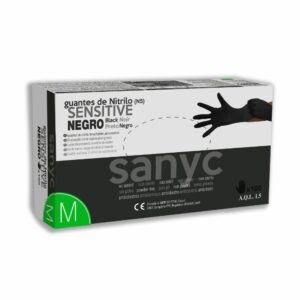
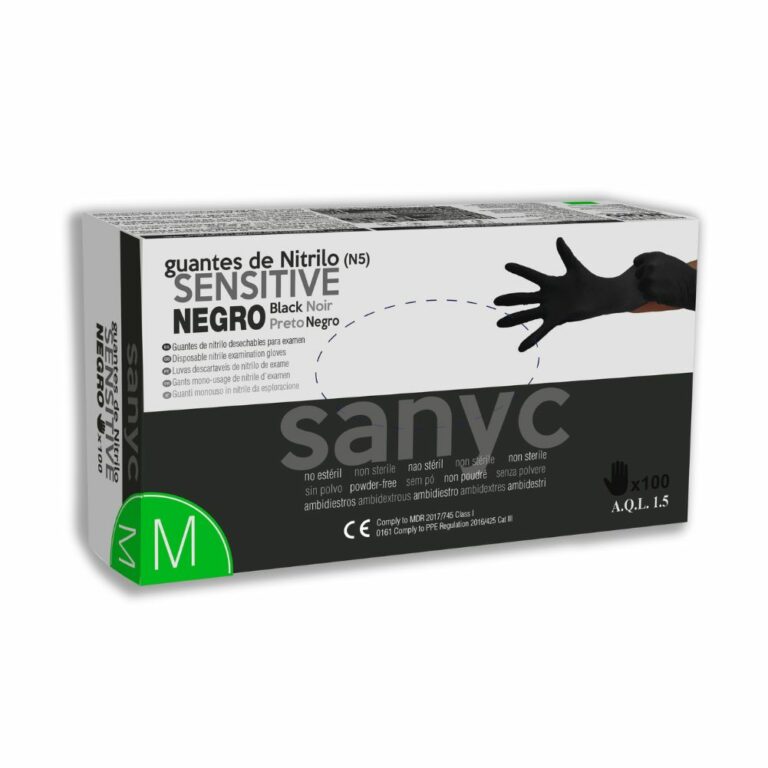
Nitrile Glove SANYC Sensitive Black Size XG for Medical Examination – Box of 100 Units, Latex-Free and High Sensitivity
4,75 € In stockAdd to basket -
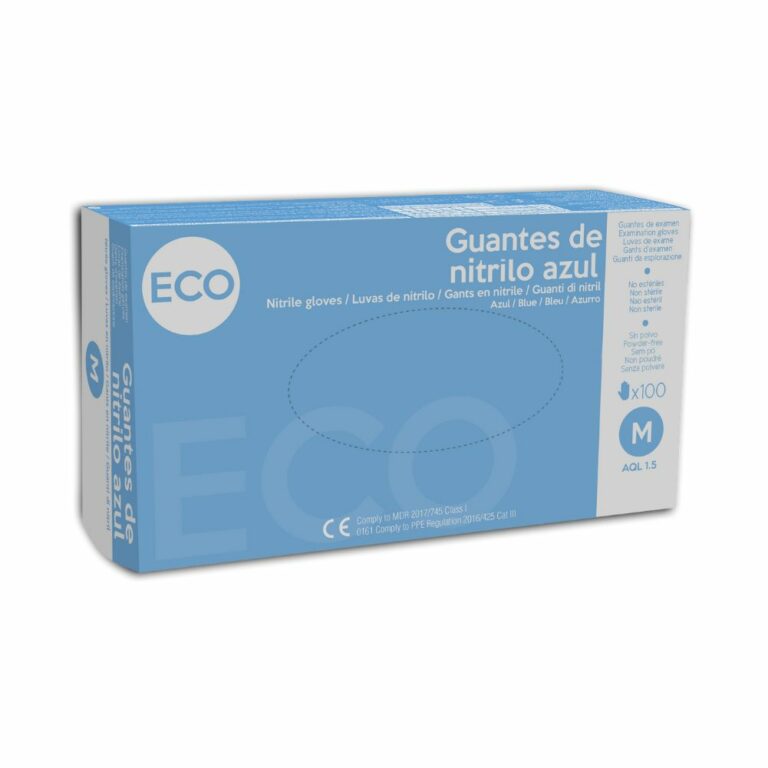
Eco Sanyc Blue Nitrile Examination Glove, Size M – Box of 100 Units, Latex-Free
4,32 € In stockAdd to basket -
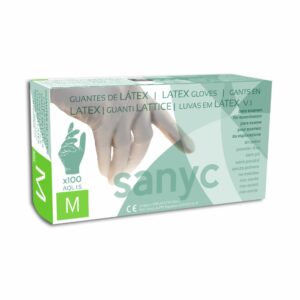
Powder-free Latex Glove SANYC Extra Strong Size S (Small) · Non-Sterile, Ambidextrous and Disposable · Box of 100 Units · SKU G001277T
11,58 € In stockAdd to basket -
Powder-Free Latex Glove SANYC Extra Strong Size G (Large) · Non-sterile, Ambidextrous and Disposable · Box of 100 Units · SKU G001281T
11,58 € In stockAdd to basket -
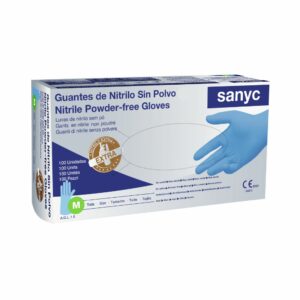
Extra Strong Nitrile Glove SANYC Blue Size G (Large) · Latex-free · Micro-textured and Chlorinated · Box of 100 Units · SKU G10002
9,92 € In stockAdd to basket
Buying and selection tips
-
Fix the material before comparing
Nitrile is a synthetic rubber and latex is natural rubber: they are not interchangeable in terms of allergies or mechanical behaviour. Nitrile contains no natural latex protein, but it may include vulcanisation accelerators: check the declared composition. Comparing references is only valid within the same material.
-
Require AQL 1.5 for healthcare gloves
The EN 455-1 standard sets a pinhole AQL of 1.5 for single-use medical gloves. An examination glove with an AQL of 2.5 under ASTM does not comply with EN 455-1 without further testing, so the product description must state the AQL and the test standard. If the manufacturer only cites the American standard, ask for confirmation of the European test.
-
Do not confuse examination with surgical
A sterile examination glove is not a surgical glove: the anatomy, AQL, length and regulatory class differ. A sterile surgical glove is a class IIa medical device, whereas an examination glove is class I, or Is if sterile. If the purchase is for the operating theatre, the reference must be anatomically shaped and have surgical sizing.
-
Check PPE marking if there is a chemical risk
A nitrile examination glove does not protect against chemicals simply because it is made of nitrile. Chemical protection is declared under EN ISO 374-1 and its type (A, B or C) according to the number of substances and the permeation time, and protection against micro-organisms under EN ISO 374-5. If the task involves cytostatics, the reference must declare ASTM D6978 or EN 16523-1 with the list of drugs.
Frequently asked questions
Is it enough for a glove to be latex-free for it to be considered hypoallergenic?
No. A latex-free glove may contain vulcanisation accelerators that cause type IV allergy, so the absence of natural latex protein does not mean hypoallergenic. If the aim is to reduce sensitisation, check the composition and consider accelerator-free versions.
Can I use a sterile examination glove as a surgical glove?
No. A sterile examination glove is not a surgical glove: they differ in anatomy, AQL, length and regulatory class. For the operating theatre, choose an anatomically shaped reference with surgical sizing and class IIa marking.
How do I check that a nitrile glove protects against viruses?
The biological hazard pictogram only covers bacteria and fungi unless the word VIRUS appears. Protection against viruses requires the ISO 16604 method B test and its declaration in accordance with EN ISO 374-5.
What is the difference between a nitrile examination glove and a dual-use one?
A dual-use glove meets both the medical device framework and the category III PPE framework at the same time, so it adds chemical protection and protection against micro-organisms. An examination glove without PPE marking does not protect against chemicals even if it is made of nitrile.
Can I use the glove weight to compare thicknesses between references?
No. Weight per glove is not thickness; you need to compare the millimetres declared at the palm and finger and take into account the tolerance of each reference. Two references with similar weights can behave differently in feel and in resistance to tearing.
Common questions
“Latex-free” means hypoallergenic
Not necessarily: a latex-free glove may contain accelerators that cause type IV allergy. The label describes the absence of natural latex protein, not the absence of every sensitiser.
A glove's weight is its thickness
Weight per glove is not thickness. To compare, look at the millimetres at the palm and finger, which are what determine feel and strength.
“Type B” means the same on a chemical glove and on a face mask
No. For gloves, type B belongs to EN ISO 374-1 and requires at least three substances with 30 minutes of permeation; for face masks, type II or IIR corresponds to EN 14683. They are different standards and products.
Polyisoprene is latex
Polyisoprene is a synthetic material and contains no natural latex protein, although it shares the elasticity of latex. It should not be presented as equivalent to natural rubber where allergy is concerned.
An AQL of 2.5 under ASTM is fine for an EN 455 glove
Not without further testing: EN 455-1 requires an AQL of 1.5, so a glove with an AQL of 2.5 under ASTM does not meet the European standard until the corresponding test is confirmed.
More products in this guide
-
Extra Strong Nitrile Glove SANYC Blue Size P (Small) · Latex-Free · Microtextured and Chlorinated · Box of 100 Units · SKU G10003
9,92 € In stockAdd to basket -
Extra-Strong Nitrile Glove SANYC Blue Size XG (Extra Large) · Latex-free · Micro-textured and Chlorinated · Box of 100 Units · SKU G10004
9,92 € In stockAdd to basket -
Extra Strong Nitrile Glove SANYC Blue Size XXG (Extra Extra Large) – Box of 100 Units for Medical Examination, Latex-Free | Ref. G10006
9,92 € In stockAdd to basket -
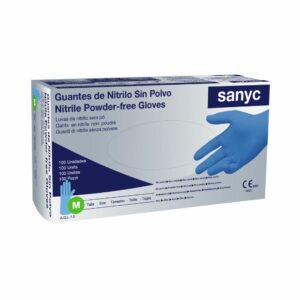
Nitrile Glove SANYC Blue Size M · Latex-Free and Powder-Free · Micro-Textured and Chlorinated · Box of 100 Units for Medical Examination (SKU G1001)
6,58 € In stockAdd to basket -
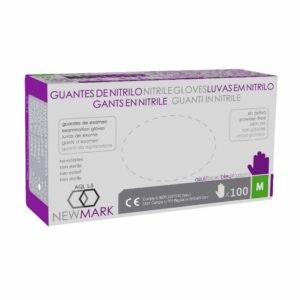
Nitrile Glove New Mark Sensitive Blue Size G (Large) for Medical Examination – Latex-Free and Micro-Textured | Box of 100 Units (Ref. G11002)
6,25 € In stockAdd to basket -
Nitrile Glove New Mark Blue 30 cm Size G (Large) – Box of 100 Units for Medical Examination, Latex-free | Ref. G110021
13,25 € In stockAdd to basket -
Nitrile Glove New Mark Sensitive Blue Size P (Small) – Medical Examination, Latex-Free and Micro-Textured | Box of 100 Units (Ref. G11003)
6,25 € In stockAdd to basket -
Nitrile Glove New Mark Blue 30 cm Size P (Small) – Box of 100 Units | Ref. G110031
13,25 € In stockAdd to basket