
Buying guide: blue nitrile gloves
25 products in the catalogue
The blue nitrile glove is a single-use, non-sterile, ambidextrous glove made from a synthetic compound free of natural latex protein. It is used in examination, in laboratories, in pharmacies and in handling materials. The blue colour makes it possible to tell a nitrile glove from a latex or vinyl one at a glance in shared work areas.
The technical reading of the product concentrates on four details: the thickness at the palm and finger, the acceptable quality level for pinholes (AQL), the cuff length and the finish. Before deciding, you should settle which size you really need, how much cuff length the task requires and whether the format is the box of one hundred, which predominates among the available references.
Other related families
-
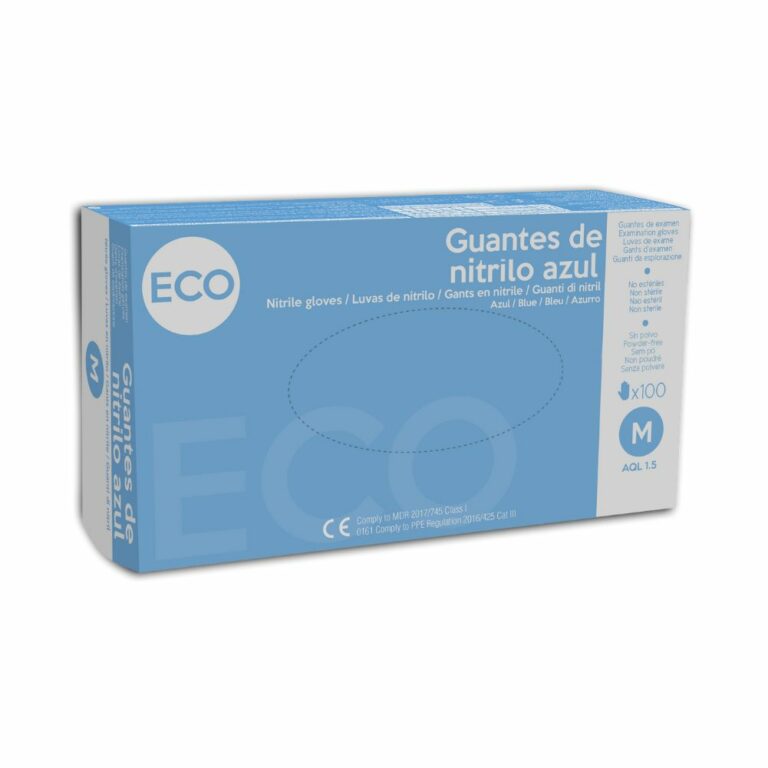
 Medical Examination Gloves
It brings together most of the non-sterile blue nitrile references and is the starting point for comparing AQL, thickness and cuff length between references.
-
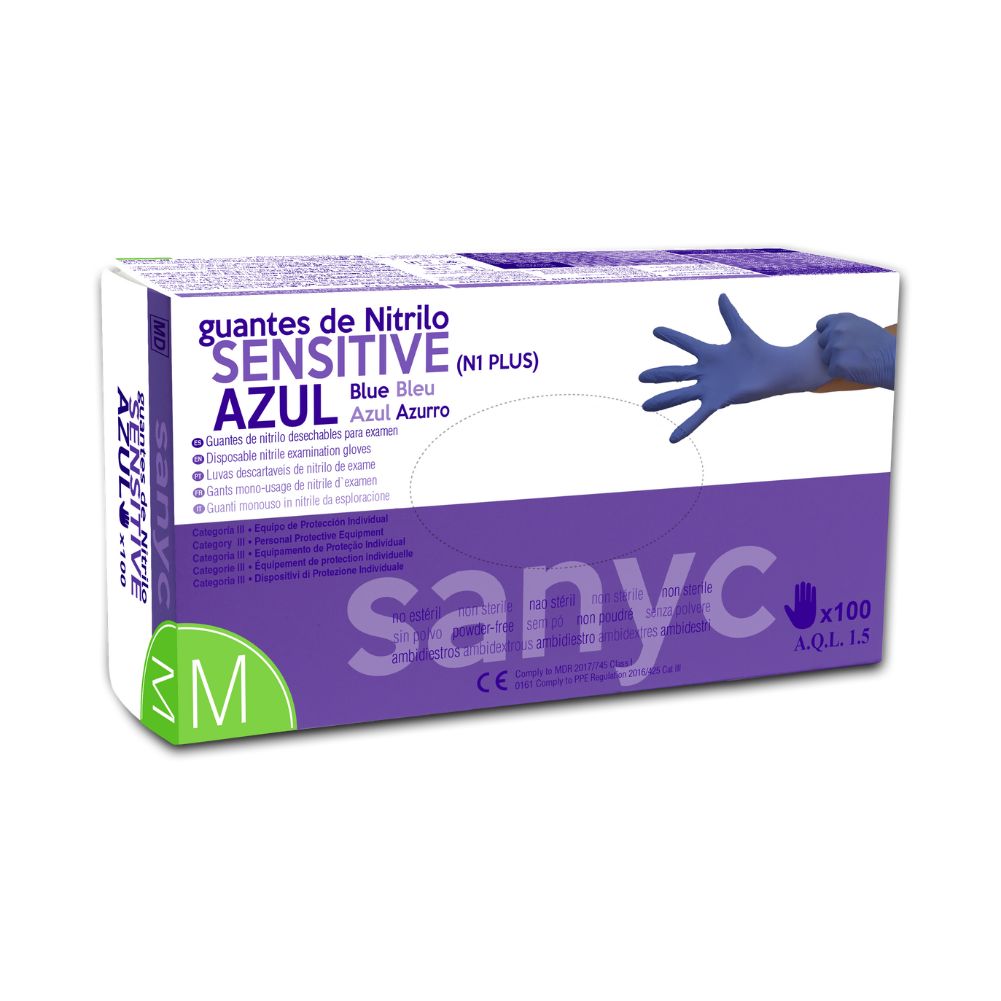
 SANYC Blue
A blue nitrile examination range with a wide size run, useful for a stable reference by size.
-
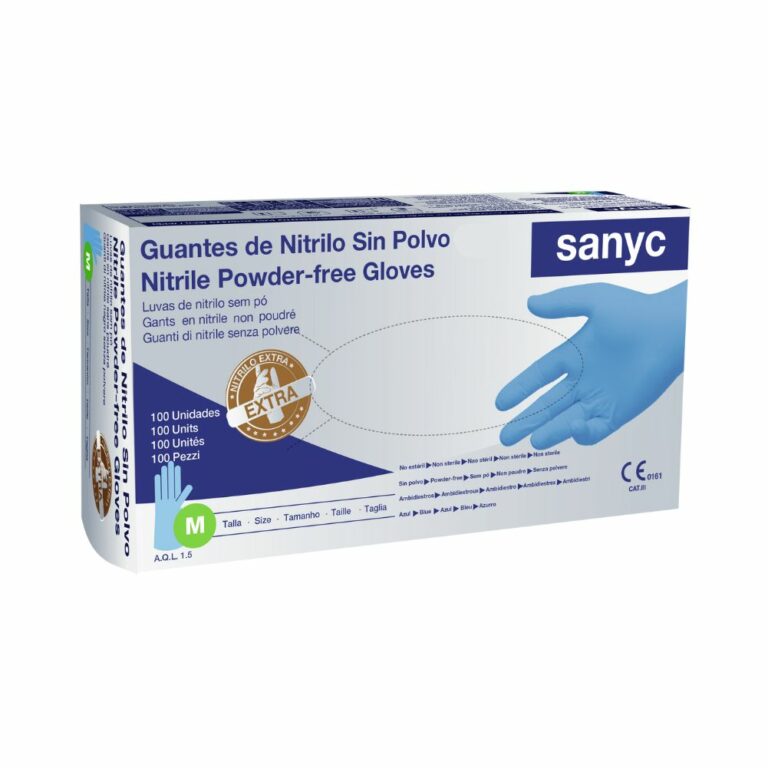
 SANYC Extra Strong Blue
Designed for those who prioritise mechanical strength over a very fine feel.
-
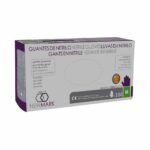 New Marc Azul 30 CM
It offers 30 cm of length, a point to consider when a longer cuff is needed.
-
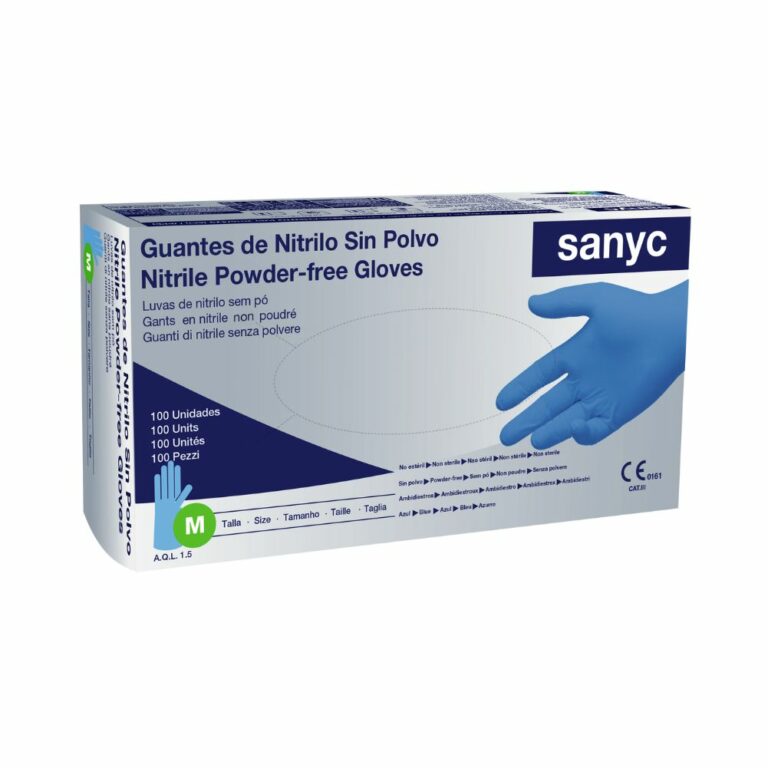
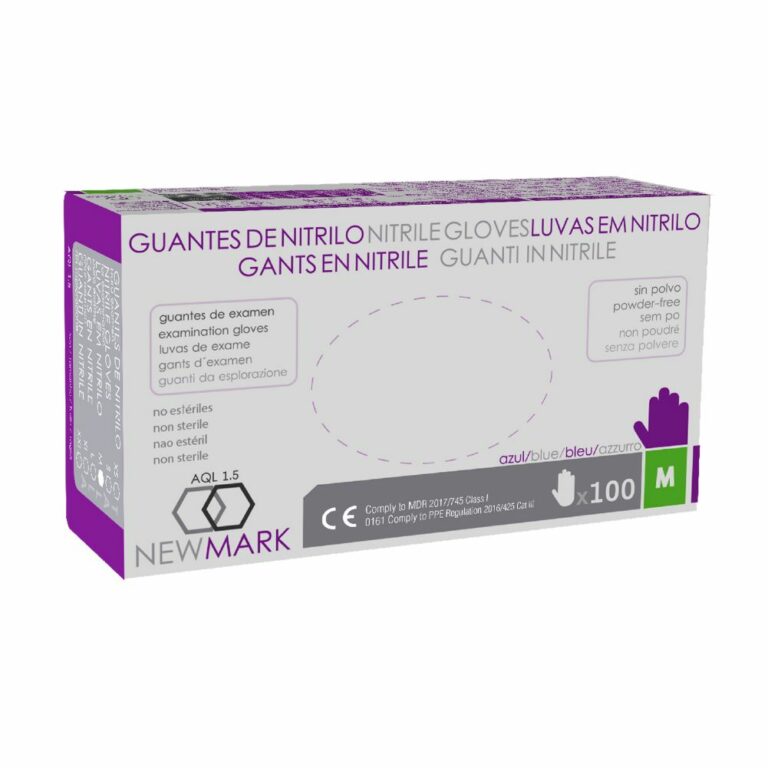
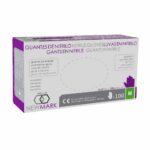 New Marc Azul
An alternative range for comparing finishes and sizing before consolidating the purchase on a single line.
Products in this guide
- Nitrile 25
- Rubber 2
- L 8
- M 8
- S 7
- XL 6
- Box OF 100 23
- Box OF 200 1
- Box OF 50 1
- 30 cm 6
- 40 cm 1
-
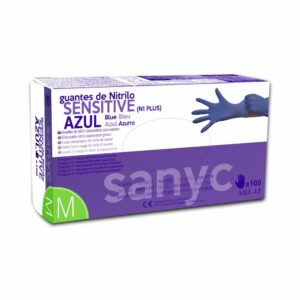
Nitrile Glove SANYC Sensitive Blue Size XP (Extra Small) · Latex-free and Powder-free · Micro-textured and Chlorinated · Box of 100 Units for Medical Examination (SKU G270)
4,48 € In stockAdd to basket -
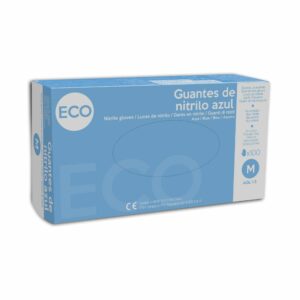
Eco Sanyc Blue Nitrile Examination Glove, Size M – Box of 100 Units, Latex-Free
4,32 € In stockAdd to basket -
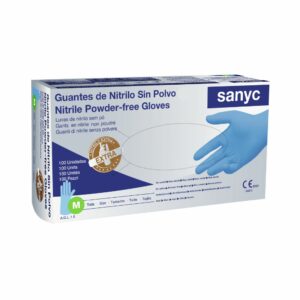
Extra Strong Nitrile Glove SANYC Blue Size G (Large) · Latex-free · Micro-textured and Chlorinated · Box of 100 Units · SKU G10002
9,92 € In stockAdd to basket -
Extra Strong Nitrile Glove SANYC Blue Size P (Small) · Latex-Free · Microtextured and Chlorinated · Box of 100 Units · SKU G10003
9,92 € In stockAdd to basket -
Extra-Strong Nitrile Glove SANYC Blue Size XG (Extra Large) · Latex-free · Micro-textured and Chlorinated · Box of 100 Units · SKU G10004
9,92 € In stockAdd to basket -
Extra Strong Nitrile Glove SANYC Blue Size XXG (Extra Extra Large) – Box of 100 Units for Medical Examination, Latex-Free | Ref. G10006
9,92 € In stockAdd to basket -
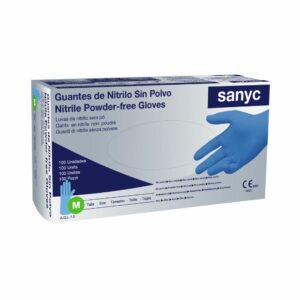
Nitrile Glove SANYC Blue Size M · Latex-Free and Powder-Free · Micro-Textured and Chlorinated · Box of 100 Units for Medical Examination (SKU G1001)
6,58 € In stockAdd to basket -
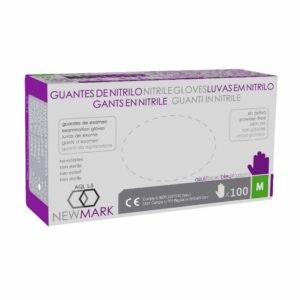
Nitrile Glove New Mark Sensitive Blue Size G (Large) for Medical Examination – Latex-Free and Micro-Textured | Box of 100 Units (Ref. G11002)
6,25 € In stockAdd to basket
Buying and selection tips
-
Compare thickness at three points, not a single figure
The useful figure is the thickness in millimetres measured at the finger, palm and cuff, with its tolerance. Some models declare different values in each zone, and that combination explains the feel and strength better than an isolated figure. Ask for all three values before treating two references as equivalent.
-
Require AQL 1.5 for pinholes
In single-use medical gloves, the criterion for freedom from pinholes is set at an AQL of 1.5 under EN 455-1. A value of 2.5 obtained under another standard is not equivalent to the former without additional testing.
-
Match the cuff length to the task
The cuff length changes between references; some reach 30 cm. A longer cuff covers more of the wrist and forearm. Choose the length according to the task.
-
Consider the inner and outer finish
A powder-free interior makes donning easier, and microtexture on the fingers gives grip. The beaded cuff helps with putting the glove on. These are details that do not always appear in the commercial name but do appear in the technical description.
-
Translate the sizing into your own nomenclature
Sizes are named with letters (XS, S, M, L, XL, XXL). When comparing references, consolidate them in a table to avoid duplicating sizes, and remember that the number of units per box may vary between references.
Frequently asked questions
Is a blue glove with an AQL of 2.5 acceptable as an examination glove under EN 455?
Not automatically. An AQL of 2.5 obtained under ASTM does not demonstrate the 1.5 that the standard requires without additional testing. Ask for the declaration of conformity with 1.5.
How do I compare two blue gloves that state similar weights per glove?
Do not compare weights: weight is not thickness. Ask for the millimetres at the palm and finger and set them against the cuff length and the AQL.
What is the difference between a standard blue nitrile and an extra-strong one?
The extra-strong glove prioritises mechanical strength; the standard or sensitive one prioritises feel. Compare the thickness declared at the palm and finger for each reference.
What box format should I compare when choosing blue gloves?
The available references are mostly supplied in boxes of one hundred. Compare only between references of the same format and with equivalent performance.
Common questions
"Latex-free" means hypoallergenic
No. A latex-free glove may contain vulcanisation accelerators. If sensitisation is a concern, ask for the accelerator-free declaration, not just the latex-free one.
Confusing weight with thickness
The weight per glove does not measure thickness. Two references with similar weights may have different thicknesses at the palm and finger.
Calling any sterile glove surgical
A sterile examination glove is not a surgical glove: the anatomical shape, AQL, length and product class differ. They should not be substituted without checking those criteria.
More products in this guide
-
Nitrile Glove New Mark Blue 30 cm Size G (Large) – Box of 100 Units for Medical Examination, Latex-free | Ref. G110021
13,25 € In stockAdd to basket -
Nitrile Glove New Mark Sensitive Blue Size P (Small) – Medical Examination, Latex-Free and Micro-Textured | Box of 100 Units (Ref. G11003)
6,25 € In stockAdd to basket -
Nitrile Glove New Mark Blue 30 cm Size P (Small) – Box of 100 Units | Ref. G110031
13,25 € In stockAdd to basket -
Nitrile Glove New Mark Sensitive Blue Size XG (Extra Large) – Box of 100 Units | Ref. G11004
6,25 € In stockAdd to basket -
Nitrile Glove New Mark Blue 30 cm Size XG (Extra Large) – Box of 100 Units for Medical Examination, Latex-free | Ref. G110041
13,25 € In stockAdd to basket -
Nitrile Examination Glove New Mark Blue 30 cm Size XXG (Extra Extra Large) – Box of 100 Units | Ref. G110051
13,25 € In stockAdd to basket -
Nitrile Glove SANYC Sensitive Blue Size XP (Extra Small) · Latex-Free and Powder-Free · Microtextured and Chlorinated · Box of 100 Units for Medical Examination (SKU G271)
4,48 € In stockAdd to basket -
Nitrile Glove SANYC Sensitive Blue Size XP (Extra Small) · Latex-Free and Powder-Free · Micro-Textured and Chlorinated · Box of 100 Units for Medical Examination (SKU G272)
4,48 € In stockAdd to basket