
Oxygen therapy: buying guide
40 products in the catalogue
Oxygen therapy covers the devices that channel oxygen from a source to the point of delivery: nasal cannulas, masks, catheters, connecting lines, humidifiers, flowmeters and cylinders. In a healthcare setting these parts are chosen for their format, dimensions and connections, and are combined to form a complete circuit.
The verifiable purchasing criteria are the type of use (single-use or reusable), the material, the tube length, the type of connector, the gauge for catheters, the packaging presentation and whether the item is a medical device. This guide sets out those details so that the choice rests on characteristics that can be checked on each reference, and not on assumptions. Any decision on the use of each device is the responsibility of the healthcare staff in charge.


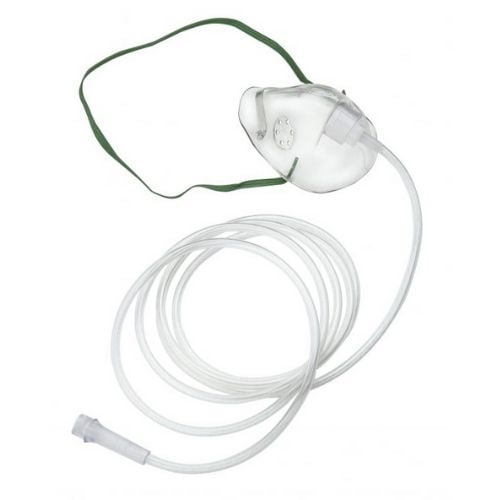

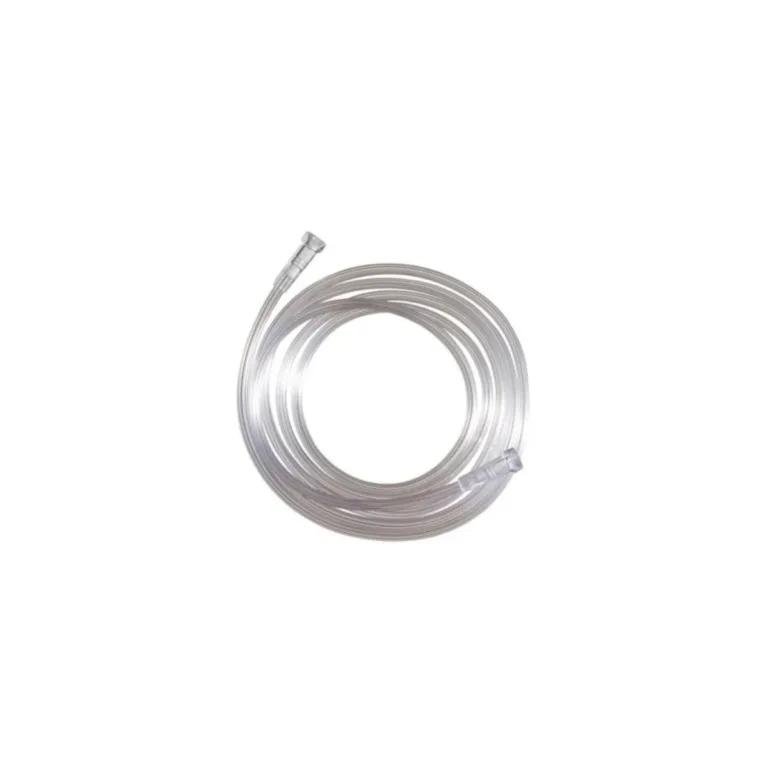
Other related families
-
 Oxygen Therapy Nasal Cannulas
Concentrates oxygen therapy nasal cannulas, with different tube lengths and connector types.
-
 American-Type Nasal Cannulas
Groups American-style cannulas, with tubes of different lengths.
-
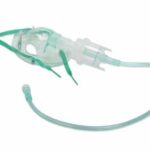 Oxygen Therapy Face Masks
Brings together oxygen therapy masks in different formats and sizes.
-
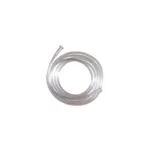 Oxygen Catheters
Oxygen catheters, distinguished by gauge and length.
-
 Oxygen Therapy Humidifiers
Disposable humidifiers and humidification kits with a nasal cannula.
-
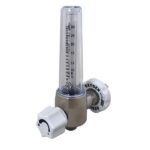 Oxygen Regulators and Humidifiers
Regulators and humidifiers with a threaded connection, to complete the circuit.
Products in this guide
- 1 l 1
- 2 l 1
- 5 l 5
- 10 l 5
- 250 ml 1
- 400 ml 1
- 500 ml 1
- Unit 30
- Box OF 100 5
- Box OF 50 4
- Box OF 200 1
- Stainless steel 4
- PVC 3
- Aluminium 2
- Polyethylene 1
- Medical device 20
- Non-medical 11
-
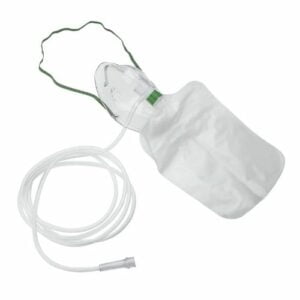
High-Concentration Oxygen Therapy Face Mask for Adults, Non-Rebreathing, with Reservoir Bag and 210 cm Anti-Crush Safe-Flow Tube | Box of 100 units | Ref. OS/50
102,00 € In stockAdd to basket -
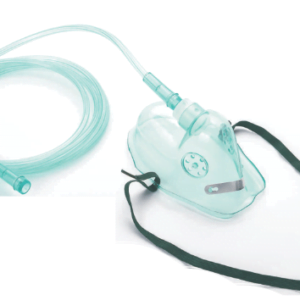
Adult oxygen mask, medical-grade PVC with connector and mouldable nasal bridge | Box of 200 units | Ref. 0102703
126,04 € In stockAdd to basket -
Paediatric non-rebreathing high-concentration oxygen therapy face mask, with reservoir bag, two non-rebreathing valves and 210 cm anti-crush safe flow tube | Box of 100 units | Ref. OS/50P
100,30 € In stockAdd to basket -
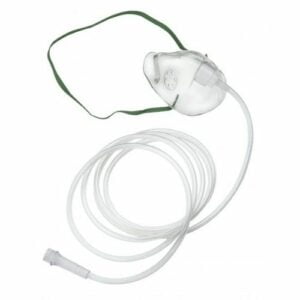
Medium-concentration oxygen therapy face mask for adults, with 1 l reservoir bag and 200 cm anti-crush safety flow tube | Box of 100 units | Ref. OS/100
69,70 € In stockAdd to basket -
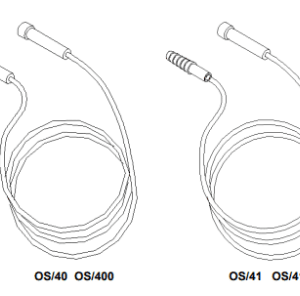
Oxygen Flow Extension Tube 200 cm, Female/Female Connection – Ref. OS/40 (Box of 100 units)
32,30 € In stockAdd to basket -
200 cm oxygen flow extension tube, male/female connection – Ref. OS/41 (box of 100 units)
42,30 € In stockAdd to basket -
Oxygen Flow Extension Tube 500 cm, Female/Female Connection – Ref. OS/400 (Box of 50 units)
28,05 € In stockAdd to basket -
500 cm oxygen flow extension tube, male/female connection – Ref. OS/410 (box of 50 units)
28,05 € In stockAdd to basket
Buying and selection tips
-
Length of the connecting tube
The tube length is fixed on each reference and determines the distance between the oxygen source and the point of delivery. The range includes connecting tubes of 210 cm and 420 cm, and American-style cannulas are offered with tubes of several lengths. It is advisable to measure the actual distance before choosing the reference, because the tube cannot be lengthened afterwards.
-
Type of connector
The connector determines what each part can be joined to: there is a standard connector, a universal screw connector, a stepped connector (male), a funnel coupling (female) and 6 mm and 22 mm connectors on some masks. Before ordering, check that the connector of the device and that of the connecting line match.
-
Material and absence of latex and DEHP
The materials stated in the data sheets are PVC, polyethylene, silicone, polypropylene, aluminium, stainless steel and paper, depending on the type of part. Some lines are declared latex-free and DEHP-free, a detail that should be checked reference by reference when the specification requires it.
-
Gauge of the oxygen catheter
Catheters are identified by gauge and length: in the range described there are Ch 08, Ch 10, Ch 12 and Ch 14, of 40 cm. The gauge is a fixed characteristic of the reference, so it is advisable to decide in advance which gauges will be needed so as not to be left with a single size.
Compatibility
- 210 cm connecting line with standard connector and universal screw connector
- It is the part that links the source to the device; check that the connector of the device is standard or universal screw.
Frequently asked questions
What length of connecting tube should I allow for an adult nasal cannula?
There are connecting tubes of 210 cm and 420 cm, and American-style cannulas are offered with tubes of several lengths. The length is fixed on each reference, so it is advisable to measure the distance between the source and the point of delivery before choosing.
What is the difference between a stepped connector and a funnel coupling?
The stepped connector is male and the funnel coupling is female; both appear on 40 cm oxygen catheters. They are not interchangeable, so you need to check which one the equipment you will connect to accepts.
How do I check whether oxygen therapy products contain latex or DEHP?
Some oxygen lines are declared latex-free and DEHP-free. This is stated per product line, so it is advisable to confirm it on the specific reference when the specification requires it.
What oxygen catheter gauges are there and in what length?
In the range described there are catheters of Ch 08, Ch 10, Ch 12 and Ch 14, 40 cm long, with a straight conical connector and an open distal end. The gauge is fixed per reference.
What is the difference between a mask with a 6 mm connector and one with a 22 mm connector?
They are distinguished by the connector diameter, 6 mm or 22 mm. The choice depends on the connection available on the supply line.
Common questions
Assuming that all references are sterile
In the range's data sheets most references are listed as non-sterile, and only some, such as certain catheters, are marked as sterile. It is advisable to read the sterility column for each reference.
Supposing that the connecting tube can be lengthened or trimmed
The tube length is a fixed characteristic of each reference. If the distance does not fit, you need to change reference, not adapt the tube.
Believing that the standard connector and the universal screw connector are equivalent
They are two different terminations and are described separately on oxygen connecting lines. Before ordering, check which one the destination equipment accepts.
More products in this guide
-
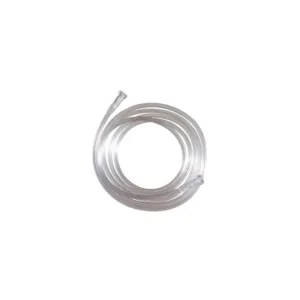
Star Lumen oxygen tubing, 2.1 m, with standard connector (Ref. 41113P) – Box of 50 units
30,03 € In stockAdd to basket -
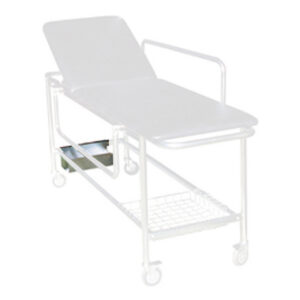
Oxygen Cylinder Holder for Transport and Shower Stretcher (Code 27800/1) | Oxygen Cylinder Support for Stretchers | Ref. 27813
62,70 € In stockAdd to basket -
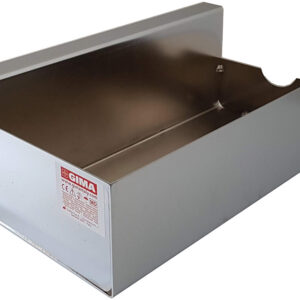
Oxygen Cylinder Holder for Stretcher (Code 27850) | Bottle Support for Transport Stretchers | Ref. 27854
60,80 € In stockAdd to basket -
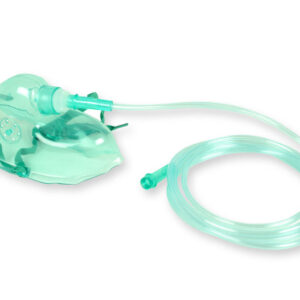
Adult Oxygen Therapy Face Mask with Connection Tube | Ref. 34166
1,81 € In stockSelect options This product has multiple variants. The options may be chosen on the product page -
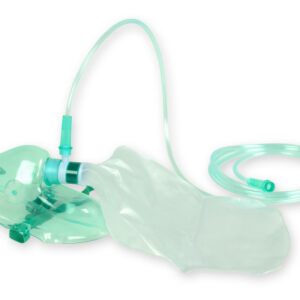
High-flow oxygen therapy face mask for adults with oxygen tube and adjustable nasal clip (Ref. GM34168)
1,90 € In stockSelect options This product has multiple variants. The options may be chosen on the product page -
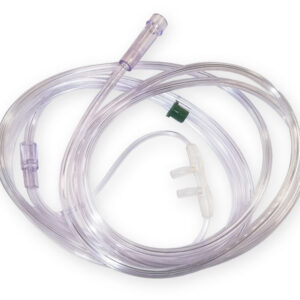
Nasal oxygen cannula ref. 34172 – Oxygen therapy nasal cannula, class IIa medical device (not suitable for ref. 33698)
0,86 € In stockAdd to basket -
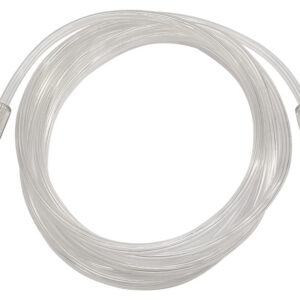
Disposable Oxygen Tube 2 m with Female-Female Connections (Ref. 34276) | Oxygen Therapy
1,14 € In stockAdd to basket -

Oxygen Bottle 0.5 L Aluminium with Pressure Reducer (Empty) — UNI and NF Connection | Ref. 34501 / 34521
172,90 € In stockSelect options This product has multiple variants. The options may be chosen on the product page