
Description
1. Introduction
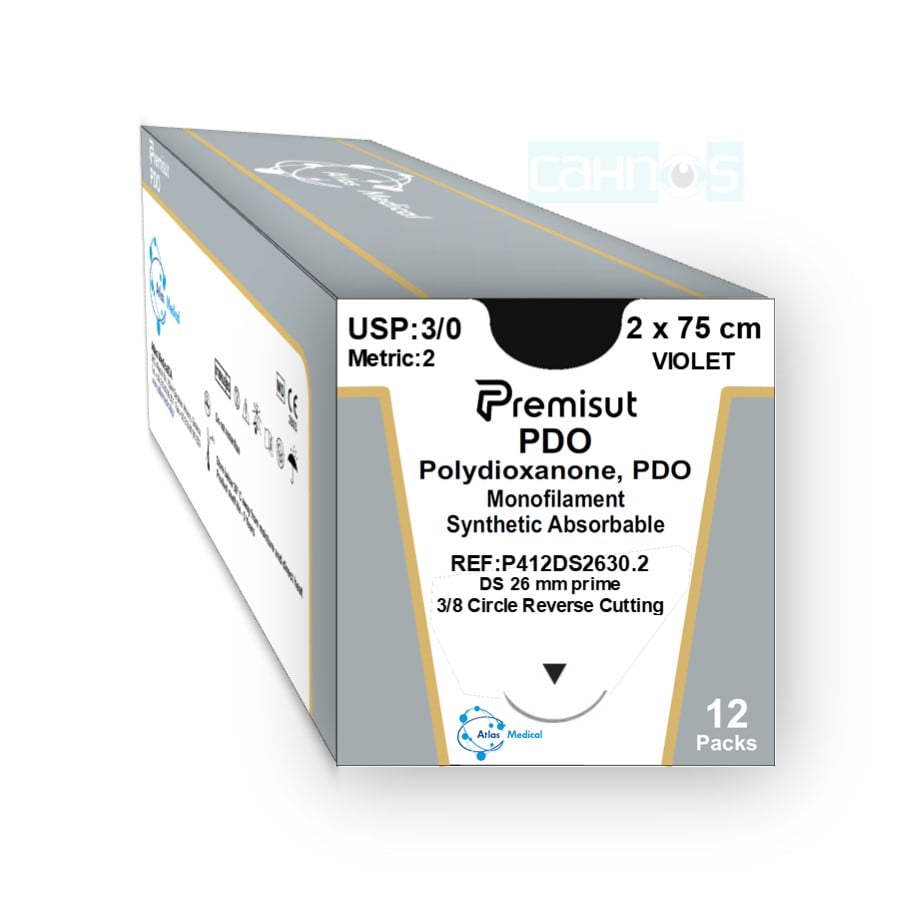
The absorbable monofilament polydioxanone (PDO/PDS) suture is the technical reference for prolonged absorption for the professional who demands prolonged wound support, predictable handling and maximum knot security. This presentation from the Prime range combines a 75 cm violet fluted thread in USP 3/0 gauge with a ⅜ circle needle with reverse cutting triangular body and point of 26 mm (DS26), suitable for penetrating firm tissues with a clean passage and minimal injury.
It is the B2B procurement solution for operating theatres, general surgery departments, paediatric cardiovascular surgery units, ophthalmology services and hospital purchasing centres. Synthetic absorbable medical device, sterile and single-use, presented in a box of 12 units.
2. Technical explanation
Polydioxanone is a synthetic absorbable polymer —poly(p-dioxanone)— with a monofilament structure that degrades by hydrolysis, by cleavage of the polymer chains in contact with organic fluids, over a predictable period of 180 to 210 days, independent of the patient’s enzymatic activity. Being a monofilament, the thread has a smooth surface that reduces friction when passing through tissue, minimises the sawing effect and hinders bacterial adhesion, maintaining high tensile strength and reliable knot tying during the critical phases of wound healing.
The ⅜ circle needle with reverse cutting triangular point is indicated for firm and fibrous tissues: the inverted cutting edge prevents tearing when passing through dermis, fascia and subcutaneous tissue, maintaining a stable suture channel. The double thread format (2×75 cm) allows continuous sutures or multiple stitches without re-threading, optimising performance in high-consumption surgical programmes. The product is sterilised by ethylene oxide, is single-use and does not allow re-sterilisation.
3. Technical Specifications
3.1. General characteristics
| Material | Polydioxanone (PDO/PDS), poly(p-dioxanone) synthetic monofilament |
| Thread structure | Monofilament (not braided), grooved finish |
| Quality | Prime (range PREMISUT) |
| Gauge | USP 3/0 (metric 2) |
| Thread colour | High-visibility violet, fluted |
| Thread length | 2 threads of 75 cm (2×75 cm) |
| Swaged | 1 needle per suture (2 needles and 2 sutures per pack) |
| Needle shape | ⅜ circle |
| Needle body and point | Triangular reverse cutting (reverse cutting), grooved |
| Needle size | DS26 Prime – 26 mm |
| Absorption mechanism | Hydrolysis (180–210 days) |
| Sterilisation | Ethylene oxide (single-use, not re-sterilisable) |
| Tissue reaction | Minimal, with excellent tensile strength and knot tying |
| Indications | Tissue approximation, ligatures, general surgery, fascia, paediatric cardiovascular tissues and ophthalmology |
| Presentation | Box of 12 sterile units |
| Factory reference / SKU | P412DS2630.2 / AMP412DS2630.2 |
3.2. Tensile strength retention profile
| Period after implantation | Tensile strength retention |
| 2 weeks | 75 % |
| 4 weeks | 60–70 % |
| 8 weeks | 45 % |
| Complete absorption | Between 180 and 210 days by hydrolysis, with minimal tissue reaction |
This prolonged force retention profile is maintained during the critical healing phase of slow-healing tissues, therefore its use is recommended in closures of fascia, aponeurosis and structures subjected to sustained tension.
4. Equivalences and Cross-References
Monofilament polydioxanone is the material basis of the market reference lines for long-lasting absorbable sutures (PDS type). There is no equivalence table validated by the manufacturer that officially cross-references this product with the commercial series of other brands; consult the technical department before using in tenders.
As homologous families on the market, to be verified code by code in their official technical data sheet before any substitution, the following are cited: the PDS II® and PDS Plus® lines from Ethicon (the latter with antibacterial triclosan coating, indicated only where its use is approved; the homologous needle geometry of ⅜ circle reverse cutting triangular corresponds to their PC needle series), the MonoPlus® line from B. Braun/Aesculap (violet polydioxanone monofilament), the Surgicryl PDO line from SMI and the Maxon line from Medtronic/Covidien (made of polyglyconate, a different polymer, so its absorption profile must be verified). All must be checked field by field in their official data sheet: USP gauge, thread length, colour, curvature, body, point and needle size, as well as the double-armed configuration (2×75 cm) of this presentation. The brands cited belong to their respective manufacturers and are mentioned only as comparative reference.
5. Selection tips and variants of interest
When choosing a PDO suture, always verify the USP gauge according to the tissue plane: fine gauges (4/0 to 6/0) for skin and subcutaneous tissue, 3/0 and 2/0 for general soft tissue —as is the case with this reference— and USP 0 and above for fascia and tension-bearing planes. The needle shape is also decisive: the taper point (HR/DR) is the most atraumatic in delicate and well-perfused tissues, the trocar point (HRT/DRT) is reserved for firmer tissues and the reverse cutting triangular point (DS/HS) for fibrous tissues such as dermis and fascia.
Within the Cahnos catalogue, the PDO/PDS family of ⅜ circle with reverse cutting triangular point includes variants of interest: AMP412DS2630 (DS26, USP 3/0, 1×75 cm, Prime quality) as a single-thread version; AM412DS2630 (DS26, USP 3/0, 75 cm, standard quality); AMP412DS2430 (DS24, USP 3/0, 75 cm, Prime) and AMP412DS1930 (DS19, USP 3/0, 75 cm, Prime) for smaller access sites; and AMP412DS3630 (DS36, USP 3/0, 75 cm) as a longer needle throw. Always verify the USP gauge, needle size and geometry against your surgical protocol before substituting one reference for another.
As this is sterile single-use material, check the integrity of the packaging before each procedure, respect the expiry date and store the suture in a cool, dry place, protected from sunlight. For special B2B conditions by volume, hospital traceability or equivalents from other commercial houses, contact the technical-commercial team of Cahnos.
Reviews
There are no reviews yet.