


Description
1. Introduction
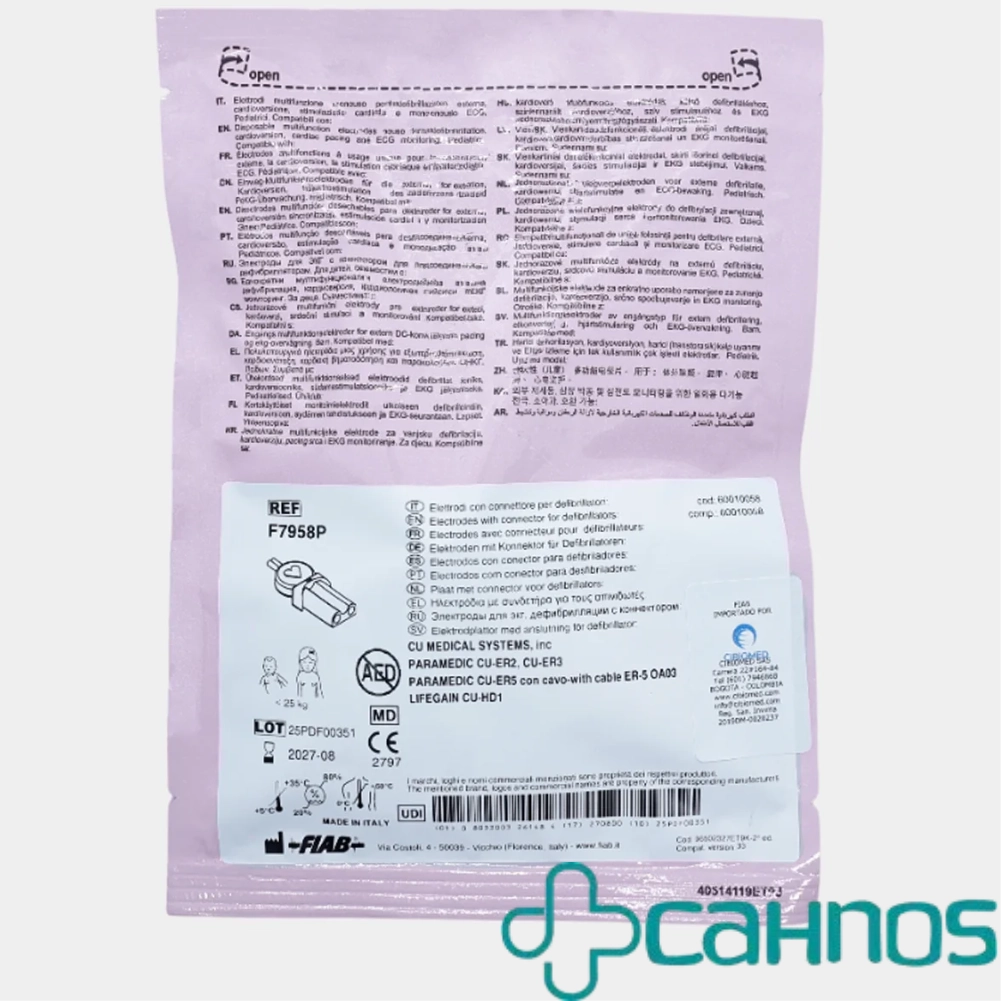
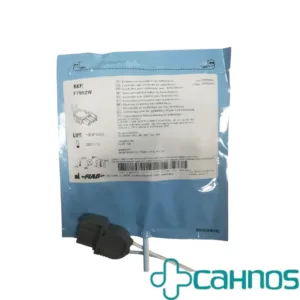
Keep your CU Medical Systems defibrillator ready to also attend to the smallest patients with this pair of standard paediatric defibrillator electrodes with internal cable, reference Cahnos F7958P. It is the clinical spare part indicated for emergency units, ambulances, paediatric practices, schools and any cardioprotected point with a child population: it guarantees rapid and safe care for children under 8 years of age or weighing less than 25 kg (55 lb), with energy adapted to paediatric resuscitation.
Designed to connect to the equipment Paramedic CU-ER2, CU-ER3 and Paramedic CU-ER5 (with cable ER-5 OA03), as well as to the Lifegain CU-HD1, these electrodes are supplied in pairs, are single-use and are delivered in a heat-sealed package that preserves the gel and the expiry date.
2. Technical explanation of the equipment and procedure
The defibrillators of the Paramedic CU-ER series acquire and analyse the electrocardiogram through the multifunction electrodes connected to the patient: they detect shockable rhythms (ventricular fibrillation and ventricular tachycardia) and, in manual or semi-automatic mode, deliver the biphasic shock that reverses the arrhythmia. The integrated internal cable allows a direct, stable connection without loose cables to the electrode socket of the device, which reduces preparation time during resuscitation and ensures efficient current transmission.
For paediatric care with CU-ER series equipment, the corresponding pair of paediatric electrodes must always be used: according to the Paramedic CU-ER2 operator’s manual, infant defibrillation requires selecting 150 joules (AED or Manual mode with energy at 150 J). Depending on the model, the paediatric electrodes may require the paediatric adapter (ER1-OA12 / ER2-OA12 depending on the device) on the ECG-DEFIB port; on the Paramedic CU-ER5 the connection is made with the ER-5 OA03 cable. The pads incorporate low-impedance conductive adhesive gel, which ensures optimal contact with the chest skin and allows, in addition to defibrillation, monitoring of the heart rhythm for up to 24 hours. They are placed following the anatomical diagrams on the package (anterior-posterior position) and, after use or upon reaching the expiry date, must be replaced with a new pair.
3. Technical Specifications
| Parameter | Specification |
| Reference Cahnos (SKU) | F7958P |
| Electrode type | Standard paediatric multifunction with internal cable, 1 pair (2 pieces), disposable |
| Series / family | Standard paediatric series with internal cable |
| Brand / compatible equipment | CU Medical Systems – Paramedic CU-ER2, CU-ER3, Paramedic CU-ER5 with cable ER-5 OA03 and Lifegain CU-HD1 |
| Indicated population | Children under 8 years or weighing less than 25 kg (55 lb) |
| Minimum width of the adhesive ring | 0.7 cm |
| Total area (per electrode) | 75 cm² |
| Active area (per electrode) | 40 cm² |
| Number of shocks supported | 50 shocks at 100 J |
| Conductive gel | Low-impedance conductive adhesive gel |
| Conductive material | Metal foil |
| Backing material | Medical foam (FOAM) 1 mm thick |
| Connection type | Safety anti-shock connector or clip (depending on model) – internal cable |
| Functions | Rhythm analysis, defibrillation and ECG monitoring (max. 24 h) |
| Use | Single-use, disposable |
| Composition | Latex-free and phthalate-free |
| Primary packaging | 1 pair in heat-sealed polyethylene and aluminium bag, with laser pre-cut and easy-open notch |
| Sales format | 5 pairs in cardboard box (paediatric series) |
| Operating temperature | Between 0 °C and +50 °C |
| Storage | Dry place between +5 °C and +35 °C; occasional exposure from −30 °C to +65 °C for a maximum of 7 days |
| Shelf life | 30 months from the date of production |
| Expiry | As indicated on the packaging; do not use after the expiry date |
| Regulatory standard | Medical device Class IIb in accordance with Directive 93/42/EEC (MDD); ANSI/AAMI DF-80; IEC/EN 60601-1 and 60601-2-4; ISO 10993-10 |
Compatibility note: confirm the exact model of your device and the fit of the connector before use. The electrode corresponds to the Paramedic CU-ER and Lifegain CU-HD1 series; it is not interchangeable with consumables from other CU Medical AEDs (i-PAD SP1, SP2, CU-SPR, NFK200 or NF1200/NF1201 series), which use their own electrodes and connectors. The surface values (40/75 cm²), shocks (50–100 J) and adhesive ring (0.7 cm) correspond to the standard paediatric electrode series of this family; confirm them with the technical data sheet of the supplied batch and the device manual before use in tendering.
4. Equivalences and Cross-References
CU Medical Systems documents in Appendix C of the Paramedic series operator manuals its original paediatric electrodes: reference ER2-PP01 (Reduced-energy Pediatric Defibrillator Electrode Pads) for the Paramedic CU-ER2, with its paediatric connection adapter ER2-OA12; for the CU-ER1 it uses reference ER1-PP01 with the adapter ER1-OA12. The distribution code Cahnos F7958P reproduces the function of these standard paediatric electrodes for CU-ER2, CU-ER3, CU-ER5 and Lifegain CU-HD1. CU Medical does not publish an official equivalence table authorising third-party electrodes for these devices: the connector, the analysis algorithm and the energy management are proprietary. Any comparison with other brands must be understood as comparable at the category level, not interchangeable 1:1, verifying connector, energy range and algorithm before any substitution.
| Manufacturer / Brand | Family / Model | Reference code / SKU | Equivalence level | Technical differences / Remarks |
| CU Medical Systems | Standard paediatric electrodes Paramedic CU-ER2 (original factory reference) | ER2-PP01 | Exact reference equivalence (same manufacturer) | Original reference that this data sheet reproduces for the Paramedic CU-ER2, documented in Appendix C of the operator’s manual; requires the paediatric adapter ER2-OA12 depending on the model for connection to the ECG-DEFIB port. |
| ZOLL Medical | Pedi-Padz II (paediatric electrode) | 8900-0810-01 | Comparable by category (not interchangeable 1:1) | Same paediatric range (<8 years / <25 kg) and automatic switching to paediatric energy, but proprietary ZOLL connector and own algorithm; exclusive to AED Plus and AED Pro. Code confirmed on the official ZOLL store and in GUDID (UDI 00847946001438). |
| Philips | Infant/Child Reduced Energy Pads (HeartStart FR2 / FR2+) | M3870A | Comparable by category (not interchangeable 1:1) | Reduces energy from 150 J to 50 J for children <8 years / <25 kg; proprietary connector and algorithm Philips, exclusive to the HeartStart FR2/FR2+ series. Code verified on GUDID (UDI-DI 00884838023734). |
| Defibtech | Lifeline AED Child / Pediatric Electrode Pads | DDP-200P | Comparable by category (not interchangeable 1:1) | Paediatric electrodes with built-in energy attenuator for children under 8 years or under 25 kg; proprietary connector and management electronics for Lifeline equipment. GUDID/FDA registration UDI-DI 00815098020430. |
Other homologous families in the sector with paediatric electrodes for AED (e.g. Philips HeartStart FRx SMART Pads II 989803139261 or Cardiac Science Powerheart G3 Pediatric Pads 9730-002, as well as the Child Pads from Stryker/Physio-Control LIFEPAK) are comparable only by category: verify one by one the equipment connector, the paediatric energy range and the algorithm before considering any alternative. There is no equivalence table validated by the manufacturer (CU Medical) for this electrode; consult with the technical department of Cahnos before use in tenders.
5. Selection tips and variants of interest
- Confirm the equipment model: this electrode is indicated for the Paramedic CU-ER2, CU-ER3 and Paramedic CU-ER5 defibrillators with ER-5 OA03 cable, as well as for the Lifegain CU-HD1. It is not valid for CU Medical i-PAD AEDs (SP1, SP2, CU-SPR, NFK200 or NF1200/NF1201), which use their own consumables.
- Check the expiry date: before installing, check the expiry date on the packaging and do not force the use of an expired electrode: the gel may lose conductivity and compromise the effectiveness of the discharge.
- Paediatric energy setting: on the Paramedic CU-ER2, paediatric defibrillation requires selecting 150 joules (AED or Manual mode) according to the operator’s manual; on other models of the CU-ER series follow the equipment manufacturer’s instructions for paediatric configuration and connection diagram (paediatric adapter or ER-5 OA03 cable).
- Paediatric provision: in centres with a paediatric population always keep a pair of paediatric electrodes next to the defibrillator and periodically check that the equipment remains operational with the in-date pads.
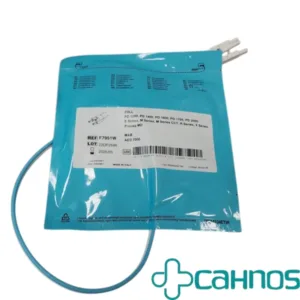
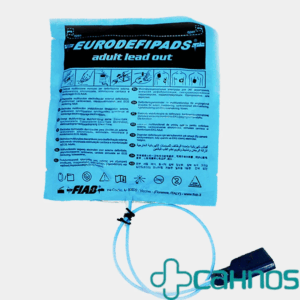
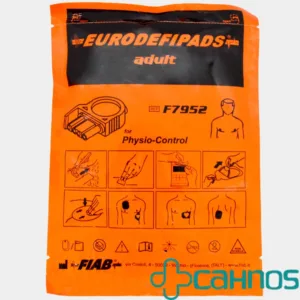
- Variants within the Cahnos catalogue: F7958PW (CU Medical standard paediatric electrode with external cable for the same equipment), F7958PL (reduced energy paediatric electrode for Paramedic CU-ER1, original ref. ER1-PP01) and F7959PL / F7959WPL (limited energy paediatric electrodes for the Saver family i-PAD AEDs NF1200/NF1201, factory ref. CUA0512P). For the same standard series with internal cable in other equipment: F7950P (Philips), F7951P (ZOLL) and F7952P (Physio-Control / Bexen Cardio / Cardioline / Mindray).
- Stock management and tenders: establish FIFO rotation by expiry and always replace the electrode after use or expiration. For volume orders or tenders, contact the technical department of Cahnos indicating the exact model and serial number of the equipment.
Reviews
There are no reviews yet.