
How to choose non-absorbable suture
357 products in the catalogue
A non-absorbable suture is a surgical thread designed to remain in the tissue, unlike absorbable sutures. The purchasing decision depends not on colour or packaging but on the material, the structure of the thread and the needle attached to it.
The references available combine polypropylene, nylon or polyamide, silk and polyester, in monofilament or braided thread, in colours such as blue, black and green. The needle may be 3/8 circle with a reverse-cutting triangular point or 1/2 circle with a taper point, or there may be no needle, and the references come in a box of 12. This guide sets out those criteria so you can order the right combination.

Other related families
-
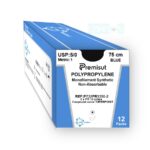 POLYPROPYLENE
Uncoated synthetic monofilament; used in skin closure, abdominal wall, nerves, tendons and vascular suturing.
-
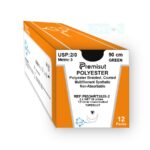 NYLON POLYAMIDE
Polyamide monofilament; used in skin closure and in securing drains and catheters.
-
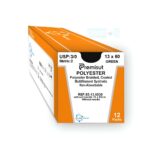 POLYESTER
Braided strand, with or without a silicone coating; used in skin closure and vascular surgery.
-
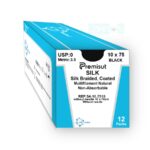 SILK SEDA
Natural braided silk with wax and silicone; used in vascular, orthopaedic and dental surgery.
-
 STEEL ACERO
Twisted surgical steel; used in tendons, ligaments and sternal closure.
Products in this guide
- 3/8 circle 150
- 1/2 circle 143
- Without Needle 47
- Straight Cut 11
- Straight 10
- Silk 141
- Nylon / polyamide 103
- Polypropylene 81
- Silicone 38
- Polyester 26
- Polyethylene 20
- Stainless steel 3
- 10 cm 7
- 12 cm 3
- 13 cm 5
- 17 cm 4
- 38 cm 1
- 45 cm 48
- 60 cm 3
- 70 cm 4
- 6/0 16
- 5/0 27
- 4/0 46
- 3/0 69
- 2/0 80
- 0 55
- 1 52
- 2 21
-
Sale!
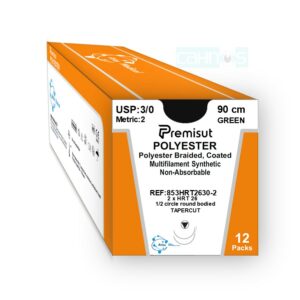
Non-absorbable polyester suture Premisut (Atlas Medical), double needle ½ circle cylindrical trocar point (tapercut) 2xHRT26 mm, USP gauge 3/0, green multifilament thread coated with silicone 90 cm | Box 12 units — Ref. AM853HRT2630-2
Original price was: 28,44 €.20,90 €Current price is: 20,90 €. In stockAdd to basket -
Sale!
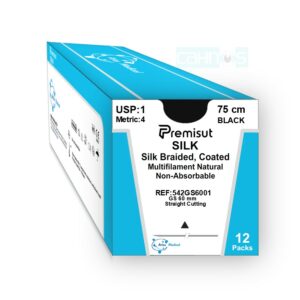
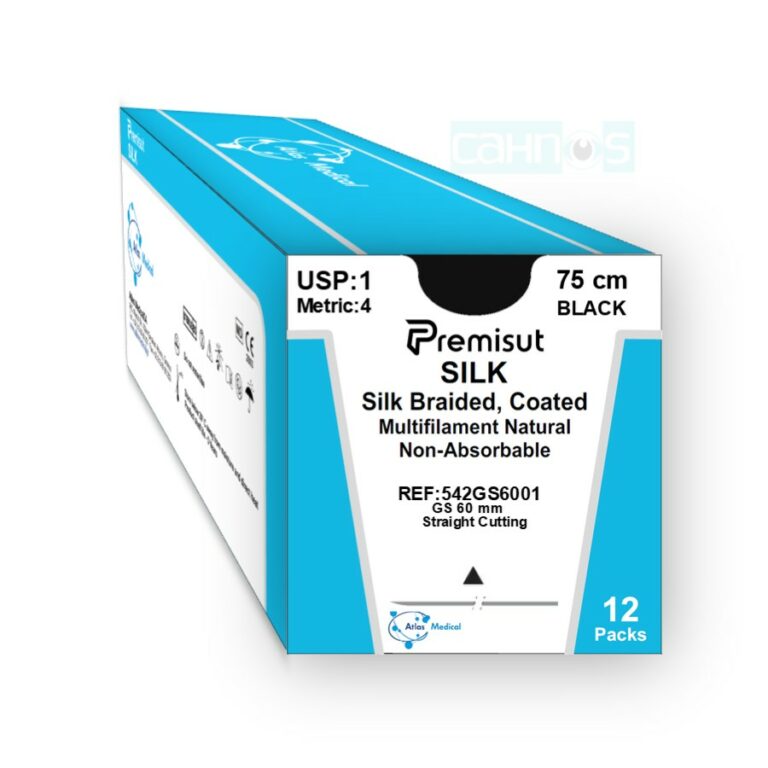
Non-Absorbable SILK Suture PREMISUT – Straight Needle Conventional Cutting GS 60 mm, USP 1 (Metric EP 4), Black Braided, 75 cm | Box of 12 units | Ref. 542GS6001
Original price was: 24,20 €.14,20 €Current price is: 14,20 €. In stockAdd to basket -
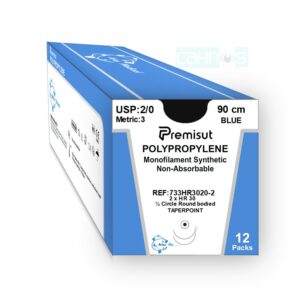
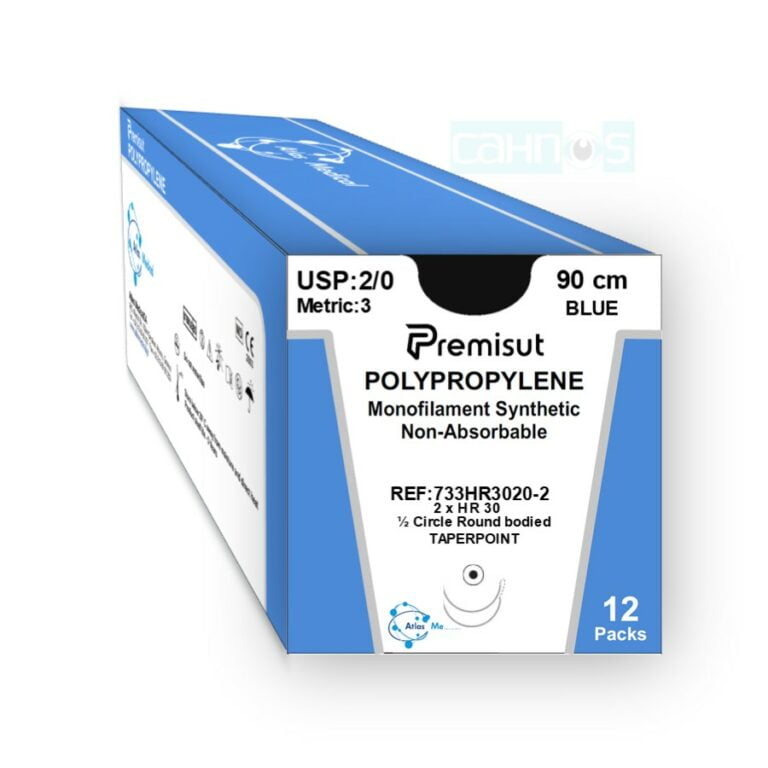
Polypropylene Suture PREMISUT Non-Absorbable – 1/2 Circle Double Needle 2xHR30 Conical Point Taperpoint, USP 2/0 Blue 90 cm – Box of 12 units (Ref. 733HR3020-2)
23,72 € In stockAdd to basket -
Sale!
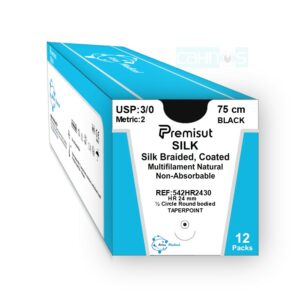
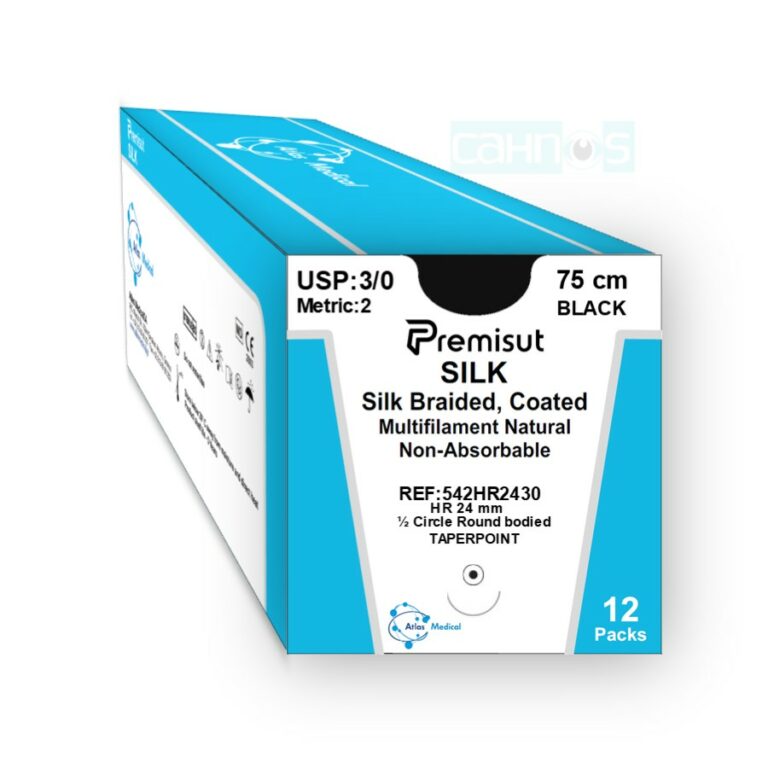
SILK SUTURE PREMISUT · Needle ½ Circle Taperpoint HR24 (24 mm) · USP 3/0 (Metric EP 2) · Black Braided Thread 75 cm · Non-Absorbable · Box 12 units (Ref. 542HR2430)
Original price was: 24,90 €.14,50 €Current price is: 14,50 €. In stockAdd to basket -
Sale!
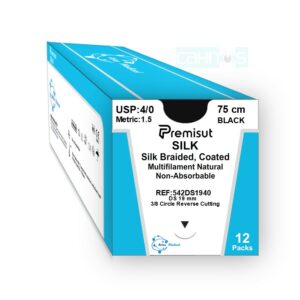
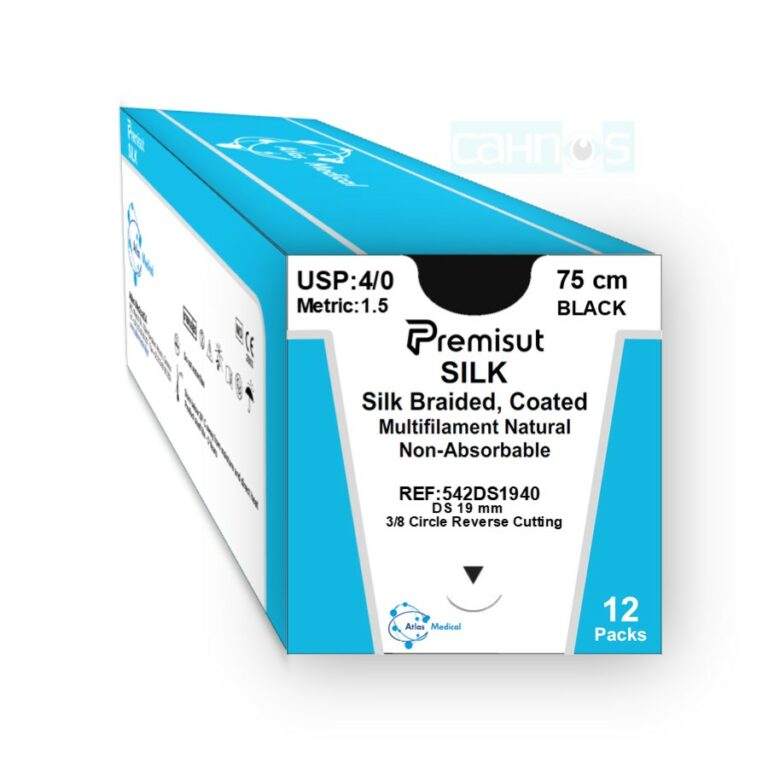
Non-Absorbable Silk Suture PREMISUT 4/0 – ⅜ Circle Triangular Reverse Cutting Needle DS19 (19 mm) – Black Braided Thread 75 cm – Box of 12 units (Ref. 542DS1940 · SKU AM542DS1940)
Original price was: 24,90 €.16,90 €Current price is: 16,90 €. In stockAdd to basket -
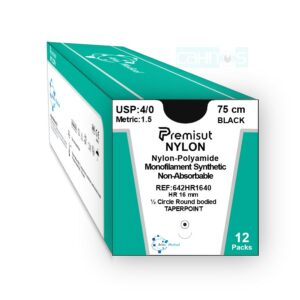
NYLON SUTURE PREMISUT 1/2 Cylindrical Taperpoint Conical Point · HR 16 mm · USP 4/0 (EP 1.5) · Black · 75 cm · Non-Absorbable · Monofilament Polyamide 6/6.6 · Box of 12 units (Ref. 642HR1640)
7,84 € In stockAdd to basket -
Sale!
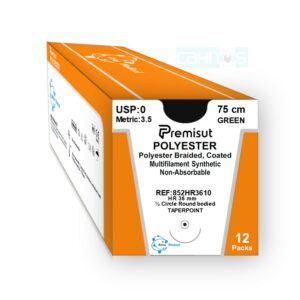
Non-absorbable polyester suture Premisut 1/2 circle – HR36 needle, taperpoint conical point, 36 mm, USP 0, green, 75 cm | Box of 12 units (Ref. 852HR3610)
Original price was: 29,90 €.22,90 €Current price is: 22,90 €. In stockAdd to basket -
Sale!
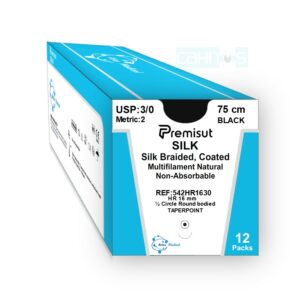
SILK PREMISUT Non-Absorbable Suture · ½ Circle Taper Point Needle Taperpoint HR16 (16 mm) · USP 3/0 (Metric EP 2) · Black Braided Thread 75 cm · Box of 12 units (Ref. 542HR1630)
Original price was: 19,90 €.12,70 €Current price is: 12,70 €. In stockAdd to basket
Buying and selection tips
-
Start with the material
The references are spread across polypropylene, nylon or polyamide, silk and polyester. Each material is a different product, not a variation in presentation, so settle it before comparing sizes.
-
Distinguish monofilament from braided
Nylon and polypropylene are described as monofilament and silk is described as braided. The structure of the thread is part of the reference and must appear in its name.
-
Compare the shape and size of the needle
3/8 circle needles have a reverse-cutting triangular point, with codes such as DS, and 1/2 circle needles have a taper point, with codes such as HR. The size is expressed in millimetres and should not be confused with the thread length.
-
Read the USP size together with the length
The USP size and the thread length, which is given in centimetres, form a combination. There are references of 45, 75 and 90 cm, and some without a needle.
-
Use colour as a support, not as a criterion
There are blue, black and green threads depending on the material, but the colour does not replace the other details. Confirm material, size and needle before ordering.
Frequently asked questions
How does the number of units per box affect the comparison of two suture offers?
The references come in a box of 12, so it is best to compare per unit and not per box. Confirm the presentation of each reference before comparing.
What is the difference between a nylon and a silk suture when buying?
They are different materials with a different structure: nylon is described as monofilament and silk as braided. Choose according to the material the department asks for.
How do I tell a taper-point needle from a reverse-cutting one?
In the names, the taper point appears as taperpoint and the reverse-cutting one as reverse-cutting triangular. In the references in this guide, the taper point is on 1/2 circle needles and the reverse-cutting point on 3/8 needles.
Why are there sutures of the same size with different lengths?
Because the thread length is part of the reference and cannot be deduced from the USP size. Check both details separately before ordering.
Common questions
Thinking that all non-absorbable sutures are equivalent
The material, the structure of the thread and the needle define different references. Compare all of these details before substituting one for another.
Confusing the needle size with the thread length
The needle is expressed in millimetres and the thread in centimetres. A figure such as 75 cm refers to the thread, not the needle.
More products in this guide
-
Sale!
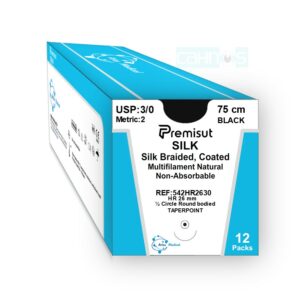
SILK Suture PREMISUT 1/2 Circle Cylindrical Conical Point HR26 (26 mm) · USP 3/0 · Black Braided 75 cm · Non-Absorbable · Box of 12 units (Ref. 542HR2630)
Original price was: 19,90 €.12,70 €Current price is: 12,70 €. In stockAdd to basket -
Sale!
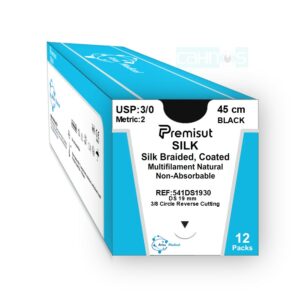
Silk Suture PREMISUT 3/8 Circle Triangular Reverse Cutting Point DS19 (19 mm) · USP 3/0 (metric 2) · Black Braided Thread 45 cm · Non-Absorbable · Box of 12 units (Ref. 541DS1930 · SKU AM541DS1930)
Original price was: 24,90 €.14,50 €Current price is: 14,50 €. In stockAdd to basket -
Sale!
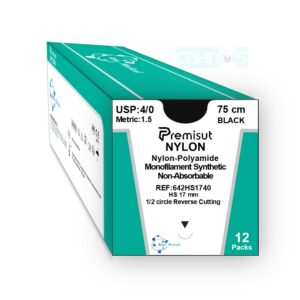
NYLON Suture PREMISUT Non-Absorbable Monofilament 4/0 Black · 1/2 Circle Needle Triangular Point Reverse Cutting 17 mm (HS 17) · Thread 75 cm · Ref. 642HS1740 · Box of 12 units
Original price was: 19,90 €.13,90 €Current price is: 13,90 €. In stockAdd to basket -
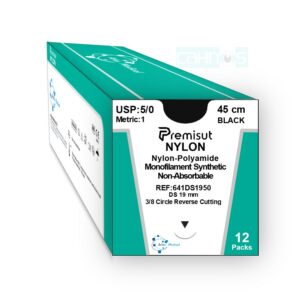
NYLON Non-Absorbable Suture PREMISUT · 3/8 Circle Triangular Reverse Cutting Needle DS19 (19 mm) · USP 5/0 (EP 1) · Black Thread 45 cm · Polyamide Monofilament · Box of 12 units (Ref. 641DS1950)
7,84 € In stockAdd to basket -
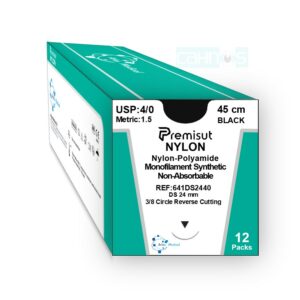
NYLON SUTURE PREMISUT Non-Absorbable · 3/8 Circle Triangular Reverse Cutting Needle DS24 (24 mm) · USP 4/0 (EP 1.5) · Black Thread 45 cm · Polyamide Monofilament · Box of 12 units (Ref. 641DS2440)
7,79 € In stockAdd to basket -
Sale!
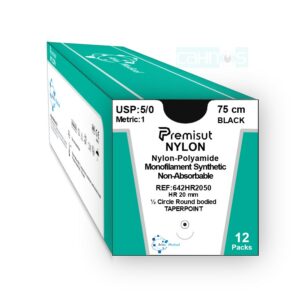
NYLON Suture PREMISUT · ½ Circle Cylindrical Needle Conical Taperpoint 20 mm (HR20) · USP 5/0 (EP 1) · Black Monofilament Thread 75 cm · Non-Absorbable Polyamide · Box of 12 units (Ref. 642HR2050 · SKU AM642HR2050)
Original price was: 19,90 €.12,70 €Current price is: 12,70 €. In stockAdd to basket -
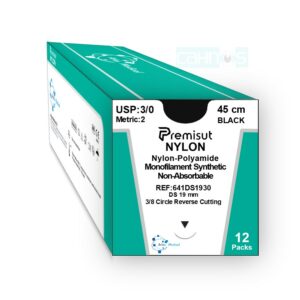
NYLON PREMISUT 3/0 Non-Absorbable Suture · 3/8 Circle Reverse Cutting Triangular Needle 19 mm (DS19) · Black Thread 45 cm · Polyamide Monofilament · Box of 12 units (Ref. 641DS1930)
7,84 € In stockAdd to basket -
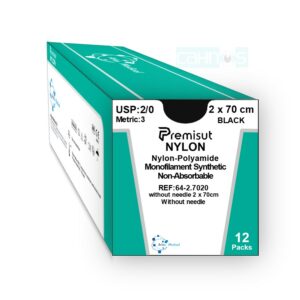
NYLON PREMISUT Suture Without Needle USP 2/0 Black 2×70 cm – Non-Absorbable Polyamide Monofilament (Ref. 64-2.7020)
10,59 € In stockAdd to basket