
Description
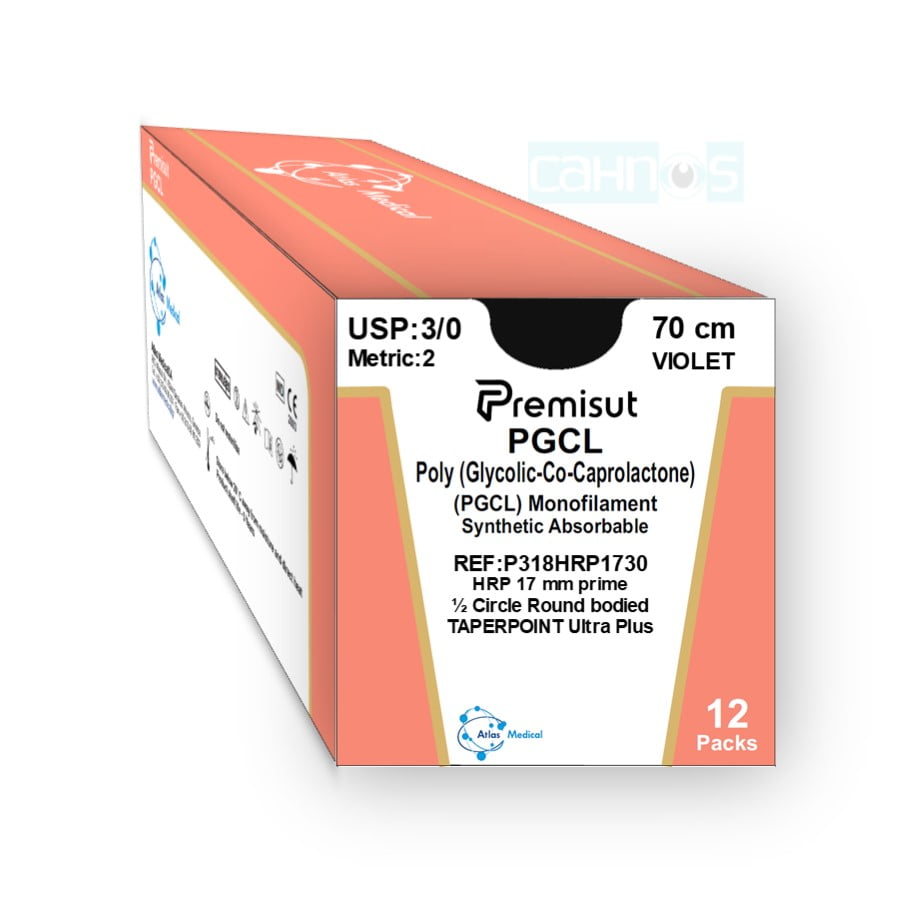
Absorbable monofilament suture of polyglecaprone 25, ready for the operating theatre
The PGCL caprolactone suture presented in this technical data sheet is a synthetic absorbable monofilament designed for the approximation of soft tissues and ligatures in general surgery, gynaecology, urology and paediatric surgery. Its predictable behaviour and smooth handling make it a solid technical alternative in the daily routine of the surgical block, with a very competitive cost-performance ratio for hospital purchasing and contracting centres.
What this suture is and how it behaves
Polyglecaprone 25 (PGCL) is a synthetic copolymer of glycolide and ε-caprolactone that is absorbed by hydrolysis, without depending on enzymatic processes, which guarantees uniform reabsorption and minimal tissue reaction. Being a monofilament, it presents less friction when passing through tissue and reduces the risk of infection compared to braided multifilaments. The needle, with a cylindrical body and conical point Taperpoint Ultra Plus (trocar type), passes through soft tissues with low resistance, minimising trauma and tearing. The 3/0 gauge with a 17 mm needle in a 1/2 circle is a combination commonly used in subcutaneous sutures, subcutaneous tissue, ligatures of small-calibre vessels and superficial muscular planes.
Technical specifications
| Material | Polyglecaprone 25 (PGCL) – glycolide / ε-caprolactone copolymer |
| Structure | Synthetic absorbable monofilament, non-grooved |
| Gauge (USP) | 3/0 (metric 2) |
| Thread length | 70 cm |
| Colour | Violet |
| Needle | 1/2 circle, cylindrical body, conical point Taperpoint Ultra Plus (trocar), 17 mm (HRP17 Prime) |
| Absorption | By hydrolysis, 90-120 days |
| Tensile retention | Approx. 60% at 1 week; 30% at 2 weeks |
| Sterilisation | Ethylene oxide (EO) |
| Presentation | Box of 12 units |
| Reference | P318HRP1730 (SKU: AMP318HRP1730) |
Specifications according to the manufacturer’s technical data sheet and price list; the tension retention percentages correspond to indicative values from the product literature.
Equivalences and cross-references
Polyglecaprone 25 is the same chemical family used by the main brands on the market, so this suture is comparable at category level (same general clinical indication), although it is not interchangeable 1:1 without validating needle, gauge and geometry against the target manufacturer.
| Manufacturer / Brand | Family / Model | Code / SKU | Equivalence level | Technical differences / Remarks |
|---|---|---|---|---|
| Ethicon (Johnson & Johnson) | Monocryl Plus (polyglecaprone 25, violet monofilament) | MCP3435G | Comparable by category (not interchangeable 1:1) | Same chemical family (PGCL) and RB-1 cylindrical needle 1/2 circle 17 mm conical point; the verified reference is USP 4/0 (other gauges upon consultation with the manufacturer) |
| Ethicon (Johnson & Johnson) | Monocryl (polyglecaprone 25, monofilament) | Consult official catalogue by gauge (cylindrical needle RB-1 / SH-1) | Comparable by category (not interchangeable 1:1) | Same chemical composition and absorption profile; verify gauge 3/0, thread length and needle model before substituting |
There is no equivalence table validated by the manufacturer for this reference; consult the technical department before using in tenders. For a safe substitution, the following must be verified in the receiving manufacturer’s technical data sheet: USP/metric gauge, thread length, needle geometry (1/2 circle, 17 mm), point type (conical/trocar) and colour.
Selection tips and variants of interest
The 3/0 gauge with a 17 mm needle is a versatile size: if working with finer tissues (skin, mucosa, paediatrics), consider 4/0 or 5/0 with the same HRP17 needle; if greater support or deeper planes are needed, go up to 2/0 with a larger radius needle. This same family is offered in a colourless version (P328HRP1730), with a VisiBlack 17 mm needle and in gauges 4/0, 5/0 and 6/0, as well as with an HRP13 needle for precision work. Always verify the compatibility of the point (conical/trocar) with the tissue to be sutured: the conical point is the indicated option for soft tissues and minimises tearing in friable planes.
Reviews
There are no reviews yet.