

Description
The absorbable multifilament suture of polyglycolic acid (PGA) without needle is the classic solution for general surgery and ligatures when a secure closure, controlled absorption and excellent handling in the surgical field are required. Its loose-thread format, without needle, makes it especially practical for vascular ligatures, hand tying and tissue approximation, providing versatility and a very competitive cost-benefit ratio for hospital supply and purchasing centres.
Technical explanation
Polyglycolic acid (PGA) is a synthetic polyester absorbable by hydrolysis: the thread loses mass gradually and predictably as tissue fluids break its polymer chains, without the need for enzymatic processes. Being a braided multifilament, it offers great flexibility and a soft feel, with a firm knot and low memory. The coating of polycaprolactone and calcium stearate improves sliding through tissue and facilitates knot seating. The dye D&C Violet No. 2 (violet) ensures high visibility on tissue, allowing precise control of the thread throughout the procedure. Each thread is supplied sterile, processed with ethylene oxide, ready for use in the operating theatre.
Technical specifications
| Composition | 100% polyglycolic acid (PGA), absorbable braided multifilament |
| Coating | Polycaprolactone and calcium stearate (improves sliding) |
| Gauge | USP 2 (EP 5) |
| Configuration | Without needle – 3 threads of 50 cm |
| Colour | Violet (D&C Violet No. 2) |
| Absorption mechanism | Progressive hydrolysis, 60–90 days |
| Strength retention | 75% at 2 weeks / 50% at 3 weeks / 40% at 4 weeks |
| Sterilisation | Ethylene oxide (EO), minimal tissue reaction |
| Use | Ligatures, tissue approximation, general surgery |
| Presentation | Box of 12 units (minimum order 30 boxes) |
| Reference | AM11-3.5002 |
Equivalences and cross-references
The violet multifilament PGA without needle is a standardised category in the absorbable suture market, with equivalent clinical behaviours among the major manufacturers: same polymer (polyglycolic acid), same hydrolysis absorption mechanism (60–90 days) and very similar load retention profiles (approx. 50% strength at 14 days). Reference homologous families in the sector: Bondek Plus (Teleflex), DemeSORB (DemeTECH), Surgicryl PGA (SMI), SERAFIT (Serag-Wiessner) and CARESYN (CPT), all available in violet and in braided versions with polycaprolactone and calcium stearate coating. As a guide, the LuxSutures LUXCRYL family markets verifiable violet PGA ligatures in boxes of 12 with codes such as PG20WN250 (USP 2/0, 250 cm) or PG00WN250 (USP 0, 250 cm), which are considered comparable at category level but not interchangeable 1:1 with this reference (different gauge and length). There is no equivalence table validated by the manufacturer; consult the technical department before use in tenders.
Selection tips and variants
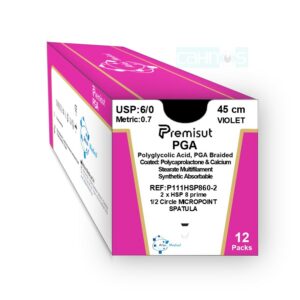
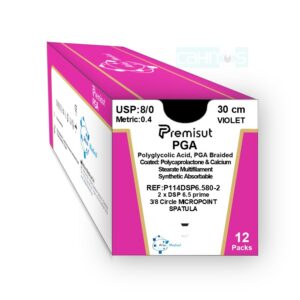
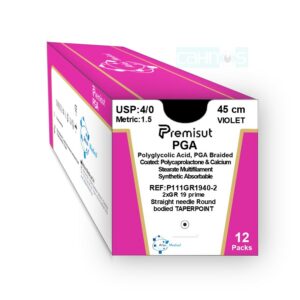
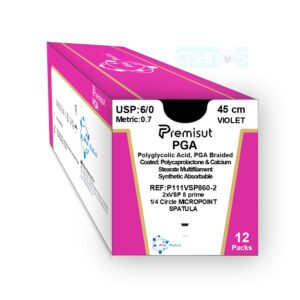
To replace this reference in specifications or operating theatres, always verify three parameters: the USP gauge (here 2, indicated for tissues requiring high tensile strength), the total thread length per package (3 x 50 cm = 150 cm per box) and the needle-free configuration, specific for ligatures and manual tying. In the same Cahnos family, lower gauge variants are offered for finer tissues (USP 3/0 and 4/0 in 2 x 70 cm), medium gauges (USP 1 in 150 cm) and formats with a greater number of threads (USP 2 in 10 x 60 cm and 12 x 45 cm), as well as colourless colour if minimal visibility is preferred. For techniques with atraumatic needle, consult the range of PGA sutures with needle in the catalogue.
Reviews
There are no reviews yet.