

Description
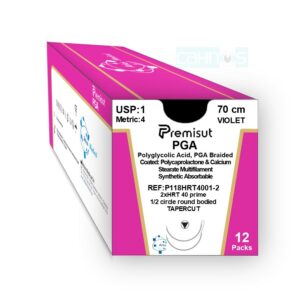
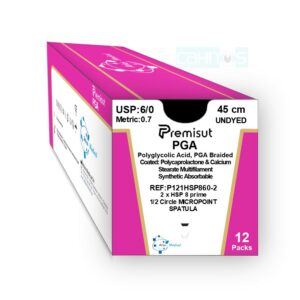
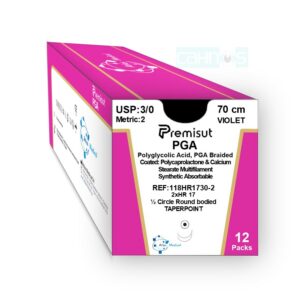
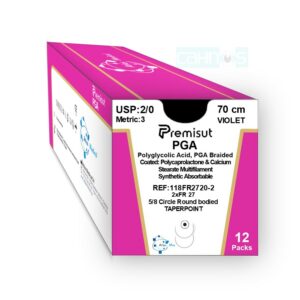
High-quality synthetic suture designed for medical procedures requiring controlled absorption, excellent tissue handling and a very competitive cost-performance ratio in the hospital environment. This presentation combines a ½ circle needle with cylindrical body and conical point (Taperpoint) of 48 mm (HR 48), USP 1 gauge and 90 cm fluted violet thread.
Each unit is supplied sterile and ready to use. Its multifilament design of polyglycolic acid (PGA) guarantees superior performance in tissue approximation, ligatures and general surgery, with a fully predictable resorption rate and minimal tissue reaction. Included in the family of absorbable sutures for professional distribution from Cahnos.
Technical explanation of the product and procedure
Polyglycolic acid (PGA) is an absorbable synthetic polymer presented in a braided multifilament structure with a fluted finish and a coating of polycaprolactone and calcium stearate. This configuration provides a regular surface that facilitates the passage of the thread through tissue, very smooth handling, low memory and firm, secure knot tying, even in medium gauges such as USP 1.
Absorption occurs by hydrolysis, i.e. by degradation of the polymer in contact with organic fluids, over a predictable period of 60 to 90 days, without depending on the patient’s enzymatic activity. The thread retains 75 % of its tensile strength at 2 weeks, 50 % at 3 and 40 % at 4, an ideal profile for tissues requiring support during 2 to 4 weeks of healing.
The ½ circle needle with cylindrical body and conical point (Taperpoint) penetrates by separating the fibres without cutting them, minimising trauma to soft tissues; the violet colouring ensures optimal visibility on the surgical field. Sterilisation by ethylene oxide; sterile single-use product, with no possibility of re-sterilisation.
Technical specifications
| Characteristic | Specification |
| Reference (SKU) | AM113HR4801 (manufacturer ref. 113HR4801) |
| Material | 100% Polyglycolic acid (PGA) with polycaprolactone and calcium stearate coating |
| Thread structure | Braided multifilament with grooved finish |
| Colour | Violet (also available colourless) |
| Gauge | USP 1 (metric 4) |
| Thread length | 90 cm (1 thread) |
| Needle shape | ½ circle |
| Needle body | Cylindrical |
| Needle tip | Conical (Taperpoint) |
| Needle size | 48 mm (HR 48) |
| Absorption mechanism | Hydrolysis |
| Absorption period | 60–90 days |
| Sterilisation | Ethylene oxide (EO), single-use, not for re-sterilisation |
| Tissue reaction | Minimal |
| Indications | Tissue approximation, ligatures and general surgery |
| Presentation | Box of 12 units (individual sterile unit) |
Tensile strength retention profile
| Time after implantation | Retained tensile strength |
| 2 weeks | 75 % |
| 3 weeks | 50 % |
| 4 weeks | 40 % |
| Total absorption | 60–90 days, by hydrolysis |
Minimal tissue reaction, excellent tensile strength and optimal knot tying, with a fully predictable absorption rate.
Equivalences and cross-references
The polyglycolic acid (PGA) suture belongs to the family of braided synthetic absorbable sutures of medium absorption. By polymer composition, absorption profile and tension retention, it is comparable at category level (not 1:1 interchangeable) with the polyglactin 910 and PGA lines on the international market: Ethicon (Johnson & Johnson) with its Coated VICRYL range (coated braided polyglactin 910, violet; differs in PGLA 90/10 copolymer material versus PGA homopolymer and in absorption window of 56–70 days versus 60–90 days), B. Braun with Safil (violet braided PGLA), Medtronic/Covidien with Polysorb, SMI with Surgicryl and Assut with Assucryl 910.
| Manufacturer / Brand | Family / Model | Reference code / SKU | Equivalence level | Technical differences / Remarks |
| Ethicon (J&J MedTech) | Coated VICRYL (polyglactin 910) | J585G | Comparable by category (not interchangeable 1:1) | USP 2, violet thread 90 cm, TP-1 needle conical point 48 mm ½ circle. Differs in gauge (USP 2 versus USP 1), material (PGLA 910 copolymer) and absorption window (56–70 days). |
There is no equivalence table validated by the manufacturer that cross-references these brands; the lines cited are provided as a functional category comparison and must be verified field by field (gauge, thread length, needle radius and coating) before any formal substitution in tendering. For a formal substitution of references in protocol or tendering, please consult our technical-commercial department.
Selection tips and variants of interest
USP 1 gauge (metric 4) is indicated for tissues requiring medium-high strength: deep planes, fascia, aponeurosis, moderate tension closures and ligatures. The conical point (Taperpoint) separates the fibres without cutting them, ideal for soft and friable tissues; if the tissue is very delicate, the most atraumatic option is the blunt point, while for fibrous and dense structures the trocar point is recommended.
Check the needle radius (HR 40, 45 or 48 mm) according to the depth and surgical area to be treated. Within the PGA HR 48 family from Cahnos, variants are offered in USP 2 gauge (ref. AMP113HR4802, 90 cm) and USP 0 (ref. AM112HR4810, 75 cm), as well as higher-demand Prime versions. If you prefer a polyglactin 910 alternative with an absorption window of 56–70 days, consult the Coated VICRYL lines from Ethicon. For longer force retention needs (180–210 days), the polydioxanone (PDO) family is the recommended alternative.
As it is a sterile single-use product, always check the integrity of the packaging before each procedure, respect the expiry date and store the suture in a cool, dry place, protected from sunlight. Consult our technical-commercial team for special volume conditions for hospitals, clinics and purchasing centres.
Reviews
There are no reviews yet.