
Description
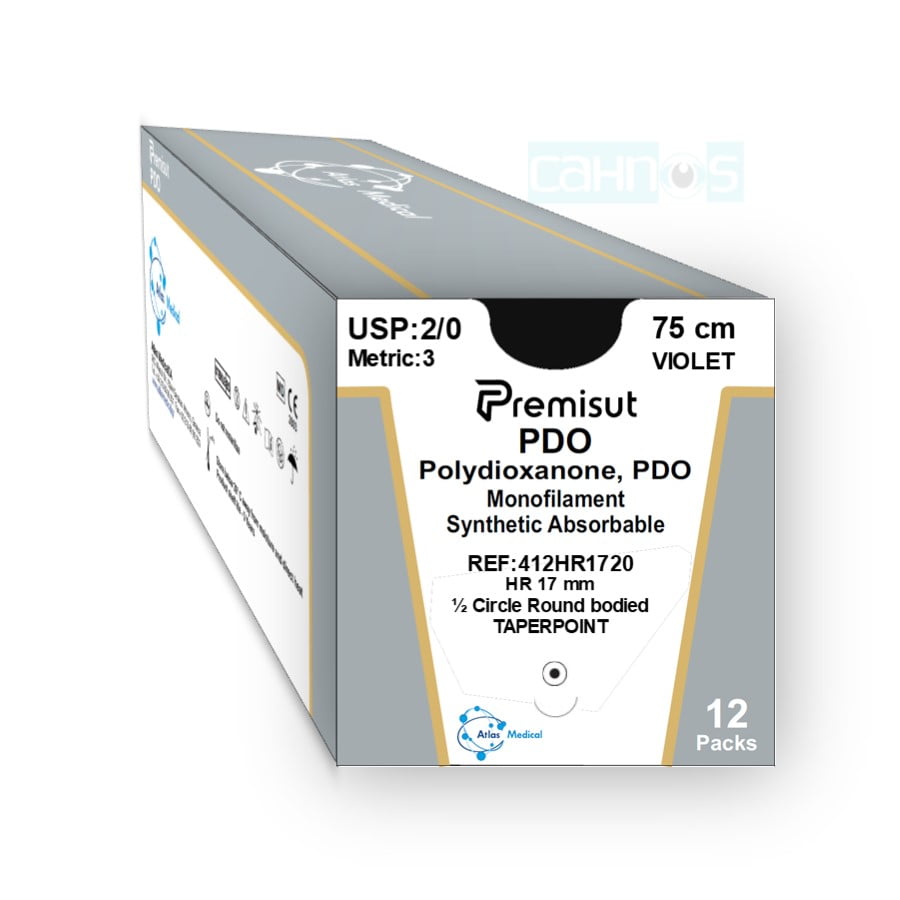
Absorbable monofilament Polydioxanone PDO/PDS suture, ½ circle taper point needle 17 mm
Synthetic monofilament suture of polydioxanone (PDO/PDS), a polymer composed of poly(p-dioxanone) designed to provide prolonged tissue support with controlled, predictable absorption and minimal tissue reactivity. Its ½ circle needle configuration with cylindrical body and taper point (Taperpoint) of only 17 mm makes it an excellent option for paediatric surgery, work on delicate tissues and confined spaces, where precision and minimal trauma are required.
Supplied in a box of 12 sterile units ready for professional use, it is the recommended choice for approximation of soft tissues, ligatures, general surgery, paediatric cardiovascular tissues and ophthalmology.
Technical explanation of the polydioxanone suture
Polydioxanone is an absorbable monofilament polyester that degrades by hydrolysis, i.e., by the action of tissue water, without depending on enzymes. This gives it very predictable absorption and minimal inflammatory reaction, while maintaining sufficient tensile strength during the critical healing period: it retains approximately 75 % of its strength at 2 weeks, 60–70 % at 4 weeks and around 45 % at 8 weeks, with complete absorption between 180 and 210 days.
- Monofilament structure: lower coefficient of friction, smooth passage through tissue and lower infection risk as it does not provide niches for bacteria.
- Excellent handling: good flexibility, secure knot tying and controlled slippage.
- Sterility: processed by ethylene oxide (EO), ensuring optimal aseptic conditions.
Technical specifications
| Thread material | Synthetic polydioxanone (PDO), absorbable monofilament |
| Absorption mechanism | Hydrolysis, 180–210 days |
| Tensile strength retention | 2 weeks: ~75 % · 4 weeks: 60–70 % · 8 weeks: ~45 % |
| Needle shape | ½ circle (1/2 circle) |
| Needle body | Cylindrical (round bodied) |
| Needle tip | Conical / Taperpoint |
| Needle size | HR17 · 17 mm |
| Gauge | USP 2/0 · metric EP 3 |
| Thread length | 75 cm |
| Colour | Violet |
| Sterilisation | Ethylene oxide (EO) |
| Presentation | Box of 12 sterile units |
Equivalences and cross-references
Polydioxanone is a widely standardised material in the sector. The following references from leading manufacturers have been verified in official catalogues and regulatory databases; they are offered as a functional category comparison, not as 1:1 substitutes: always verify needle width, thread length and packaging system before substituting in your tender.
| Manufacturer / Brand | Family / Model | Reference code / SKU | Equivalence level | Technical differences / Remarks |
|---|---|---|---|---|
| B. Braun (Aesculap) — MonoPlus | MonoPlus Violet, polydioxanone monofilament | C0024286 — HRT17 · 2/0 (3) · 70 cm | Comparable by category (not interchangeable 1:1) | Same needle geometry ½ circle 17 mm and trocar point (Tapercut) vs. Taperpoint of the analysed reference; thread 70 cm. |
| Ethicon (J&J MedTech) — PDS II | PDS II (polydioxanone) violet monofilament | Product with cylindrical needle RB-1 17 mm (consult full code Z/X by configuration and market) | Comparable by category (not interchangeable 1:1) | PDS II exhibits slightly different strength retention (80 %/70 %/60 % in gauges ≥ 3/0); the cylindrical needle RB-1 17 mm matches the 17 mm Taperpoint geometry. |
The absorption and strength retention profiles of PDS II (Ethicon) and MonoPlus (B. Braun) differ by up to 5–10 percentage points depending on gauge, so these references are considered comparable by category, not exact substitutes. Complete absorption by hydrolysis is achieved in all cases between 180 and 210 days. There is no equivalence table validated by the manufacturer for this own-brand reference; consult the technical department before using it in a tender.
Selection tips and variants of interest
- Gauge: USP 2/0 (EP 3) is a common choice for medium-resistance tissues such as fascia, musculoaponeurotic and abdominal wall. Evaluate finer gauges (3/0, 4/0) for very delicate tissues or paediatrics.
- Needle size: the 17 mm needle is ideal for reduced access areas and paediatric tissue. For greater penetration in denser tissues, consider 22–26 mm needles or a Tapercut (trocar) point.
- Variants of the same family: there are presentations with ½ circle cylindrical needle in HR17, HR22, HR26, HR30 and HR36, in gauges USP 0, 2/0 and 3/0, with 70 or 75 cm thread and Prime quality.
- Regulation: class IIa medical device. Always verify MDR conformity and traceability data on the labelling before use.
Reviews
There are no reviews yet.