
Description
1. Asthma control with objective peak flow measurement
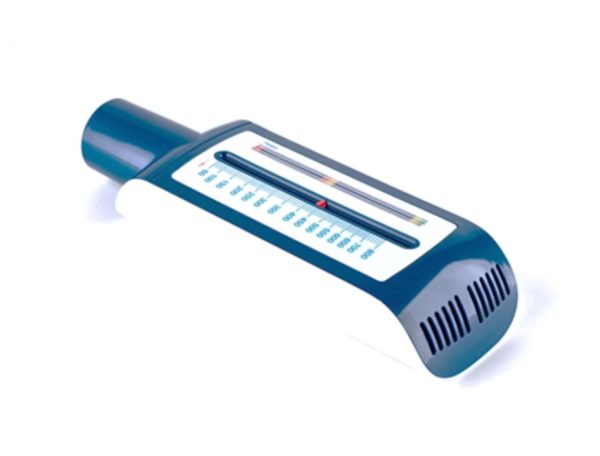
The peak flow meter (PFM) is the reference device for asthmatic patients to control their condition between medical visits. With a lightweight, robust, electronics-free design, this manual meter made of ABS allows the force with which air leaves the lungs to be quantified in seconds, providing an objective and reproducible measurement that complements spirometry performed in the clinic.
Especially indicated for people with moderate to severe and persistent asthma, it helps decide when to seek medical attention, assess the effectiveness of the treatment plan, know when to adjust medication according to the physician’s indications, and identify triggers such as exercise-induced asthma. Its low cost per unit makes it suitable for health education programmes, pharmacies, pulmonology, paediatrics, allergology and primary care clinics, as well as for continuous home monitoring.
2. How does it work and what does it measure?
The device measures the peak expiratory flow (PEF), expressed in litres per minute (L/min). The patient inhales deeply, places the mouthpiece in the mouth sealing the lips and blows as hard and fast as possible for at least one second; the air moves a pointer along a graduated scale that shows the maximum reading achieved.
The value obtained is compared with the colour zone corresponding to their personalised action plan (green zone: adequate control; yellow: caution; red: risk). A fall in PEF relative to the best personal value can reveal narrowing of the airways long before the symptoms of an asthma attack appear, allowing preventive action to be taken. For a reliable reading, it is recommended to perform three manoeuvres and record the highest value, preferably in the morning and in the afternoon; the patient’s symptoms always take priority over the meter readings. The device is for single-patient use and must be used under the supervision of a licensed healthcare professional.
3. Technical Specifications
3.1. General product information
| Product name | Peak flow meter (PFM) / peak expiratory flow meter |
| Reference / SKU | 0992059 |
| Device type | Mechanical peak expiratory flow meter (PEF) |
| Raw material | ABS (acrylonitrile butadiene styrene) |
| Available sizes | Adult and paediatric |
| Intended use | Monitoring of asthma control; measurement of exhaled air when blowing with maximum force |
| Type of use | Reusable, single-patient use |
| Indication for use | Under the supervision of a licensed healthcare professional |
| Regulatory standard | CE marking in accordance with the Medical Devices Directive 93/42/EEC and its amendment MDD 2007/47/EC |
| Presentation | Unit |
3.2. Measurement scales by size
| Size | Scale range | Reference population |
| Adult | 60 – 800 L/min | Adults and adolescents with standard expiratory capacity |
| Paediatric | 50 – 400 L/min | Children, paediatric population, and patients with reduced flows |
3.3. Instructions for use (original data sheet)
- Stand up, unless your doctor tells you otherwise.
- Slide the pointer down to the bottom of the scale, at the end where you blow.
- Hold the meter lightly by its edge in front of you, with the scale away from your hand. Breathe in as deeply as possible and, holding your breath, place the mouthpiece in your mouth, bite it lightly and seal your lips.
- Do not bend your neck downwards.
- Blow as hard and fast as you can for one second or more. Be careful not to block the mouthpiece with your tongue or teeth; a “spitting” action will give falsely high readings.
- Your peak flow is shown on the scale against the pointer. Note where the reading is located (colour band) and slide the pointer back to the bottom of the scale.
- Repeat the manoeuvre three times and use the highest value as a guide for your action plan.
- During the diagnostic phase, record the highest peak flow reading or colour each morning and each evening in the table for your doctor. If you do not stay in the green zone most of the time, review your management plan.
Caution:
- The peak flow meter is recommended for single-patient use.
- It must be used under the supervision of a licensed healthcare professional.
- The patient’s symptoms take priority over the peak flow meter readings.
- If the PFM is used for longer than its specified service life, the accuracy of the device may deteriorate. The patient may experience dizziness or fatigue during the manoeuvre; if this occurs, stop the test.
4. Equivalences and Cross-References
This peak flow meter falls within the family of standard-range mechanical expiratory flow meters. The following references share clinical function (PEF measurement in L/min), operating principle (mechanical scale without electronics), material (ABS plastics) and comparable measurement range, and their codes have been verified against the manufacturer’s official website, official technical brochure or authorised distributor:
| Manufacturer / Brand | Family / Model | Reference code / SKU | Equivalence level | Technical differences / Remarks |
| Clement Clarke (Flexicare) | Mini-Wright Standard, EU scale | 3103387 | Comparable by category (not interchangeable 1:1) | Mechanical PEF meter of 60–880 L/min, individually calibrated at the factory and with a one-way valve; “gold standard” range compared with the economical option analysed. Code verified on the manufacturer’s website and authorised distributors. |
| Clement Clarke (Flexicare) | Mini-Wright AFS Low Range (paediatric) | 3104710 | Comparable by category (not interchangeable 1:1) | Paediatric version with EU scale of 30–400 L/min and AFS aerodynamic system; wider range at the lower end than the paediatric size of 50–400 L/min of the analysed product. Code verified with manufacturer and authorised distributor. |
| Vitalograph | myPEF | 43900 | Comparable by category (not interchangeable 1:1) | Meter of 50–800 L/min for adults and children, with adjustable traffic-light scale and protective cover; includes its own accessories (SafeTway mouthpieces). Code verified in the manufacturer’s official brochure and authorised distributor. |
| Vitalograph | asmaPLAN | 43602 | Comparable by category (not interchangeable 1:1) | Meter of 50–800 L/min with integral mouthpiece, robust and suitable for use with bacterial and viral filters. Code verified in the manufacturer’s PDF catalogue and authorised distributor. |
As a category-level functional comparison, the digital monitors Microlife PF 100 (available at Cahnos as ref. PF100) and PF 200 add FEV1 measurement, record memory and analysis software, but they are electronic devices with different features from this manual meter.
There is no equivalence table validated by the manufacturer that cross-references this generic reference with codes from other brands on a 1:1 interchangeable basis; consult the technical department before using in tendering.
5. Selection tips and variants of interest
- Choose the size according to the patient: use the adult meter (60–800 L/min) for adults and adolescents, and the paediatric one (50–400 L/min) for children, elderly people or patients with reduced expiratory flows.
- Single-patient use: assign one meter to each patient in self-management programmes; for shared use in certain tests, consider disposable mouthpieces and compatible bacterial filters from the Cahnos catalogue (refs. 01554, 01555 and 08269).
- Measurement methodology: perform three manoeuvres and record the highest value, preferably in the morning and in the afternoon, noting the colour band in the follow-up table for the specialist.
- If memory and FEV1 are needed: the digital meter Microlife PF 100 (ref. PF100) complements the manual PFM when the protocol requires historical recording, configurable traffic light and data export.
- For complete spirometry in the consulting room: combine this device with the professional spirometers from the Datospir range (refs. 02072 and 02073) and with exhaled nitric oxide monitors (ref. ANONBA10V1) for a comprehensive assessment of the respiratory patient.

Reviews
There are no reviews yet.