

Description
1. Introduction
The PremisutMesh Lite 30×30 cm surgical mesh (Ref. PPML3030) is a tissue reinforcement implant made of colourless, non-absorbable polypropylene, designed for surgeons and purchasing departments that need a lightweight, macroporous mesh that is easy to handle in the repair of large abdominal wall defects. Its reduced density (45 g/m²) places it in the lightweight mesh range that clinical practice associates with less foreign body sensation, good tissue integration and postoperative comfort, without compromising permanent tensile strength.
A reliable and cost-effective technical solution, with stable supply and preferential volume purchase conditions for hospitals, clinics and distributors.
2. Technical Explanation
The mesh is woven from 100% extruded monofilament polypropylene, a biostable polymer that is neither absorbed nor degraded by the action of tissue enzymes, so the reinforcement remains permanently in the tissue. Its macroporous structure (1.3×1.0 mm) allows fibrous tissue growth through the interstices, incorporating the mesh into the adjacent tissue and reducing the risk of fold formation.
The fabric interlaces each fibre junction and provides bidirectional elasticity, allowing the mesh to adapt to the multidirectional tensions of the body and to be trimmed to the desired shape and size without unravelling. The laser cut seals the edges, provides exceptional tear resistance and prevents loss of mechanical properties during implantation. It is indicated for open and laparoscopic techniques and must be used following the manufacturer’s instructions for use (IFU). This mesh must not be used intraperitoneally (direct contact with viscera).
3. Technical Specifications
| Reference | PPML3030 |
| Dimensions | 30 × 30 cm |
| Material | Extruded monofilament polypropylene, 100% PP, colourless and non-absorbable |
| Structure | Woven synthetic mesh, single-layer, without coating, natural white colour, laser-cut |
| Pore size | 1.3 × 1.0 mm (macroporous) |
| Weight | 45 g/m² |
| Thickness | 0.43 mm |
| Elongation | 77 % |
| Maximum force | 19 kgf |
| Tensile strength | Permanent; not absorbed by the body |
| Sterilisation | Ethylene oxide (EO). Do not resterilise |
| Use | Single-use, individual sterile pouch |
| Indications | Abdominal wall reinforcement and repair of inguinal, femoral, umbilical and ventral hernias |
| Techniques | Open and laparoscopic surgery |
| Presentation | Sterile unit; minimum purchase quantity: 25 units |
4. Equivalences and Cross-References
Important: there is no official cross-reference table validated by the manufacturer for PremisutMesh Lite against other brands. The references indicated below are comparable at category level (non-absorbable monofilament polypropylene macroporous mesh for hernia repair by open or laparoscopic approach), but are not 1:1 interchangeable without verifying the technical data sheet of each manufacturer. Before use in tenders, consult the technical department.
| Manufacturer / Brand | Family / Model | Code / SKU | Equivalence level | Technical differences / Remarks |
| B. Braun | Premilene® Mesh (30×30 cm) | 1064455 | Comparable by category, not interchangeable 1:1 | Non-absorbable monofilament polypropylene; higher-density mesh: 82 g/m², pore 0.8 mm, thickness 0.48 mm |
| Johnson & Johnson MedTech (Ethicon) | PROLENE® Polypropylene Mesh (30×30 cm) | PML1 | Comparable by category, not interchangeable 1:1 | Non-absorbable monofilament polypropylene for inguinal and ventral hernia; standard-weight mesh; verify weight and pore against the official data sheet |
| Medtronic (Covidien) | Parietene™ Macroporous Mesh (30×30 cm) | PPM3030 | Comparable by category, not interchangeable 1:1 | 2-D macroporous polypropylene monofilament mesh for abdominal hernia repair; extraperitoneal placement according to IFU; verify weight, pore and dimensions |
| Cahnos | Premisut Mesh Regular 30×30 cm | PPMR3030 | Comparable by category, not interchangeable 1:1 | Same 30×30 size, but standard density line: 80 g/m², pore 0.5×0.7 mm, thickness 0.50 mm and maximum force 25 kgf |
Fields to check before any substitution: exact dimensions, weight (g/m²), pore size, thickness, structure (monofilament/multifilament), coating, single use, CE/MDR classification and sterilisation method. There is no equivalence table validated by the manufacturer; consult the technical department before use in tenders.
5. Selection tips and variants of interest
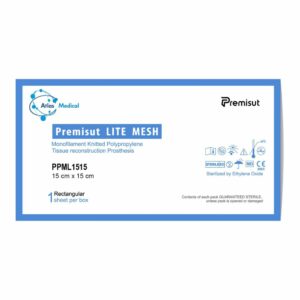
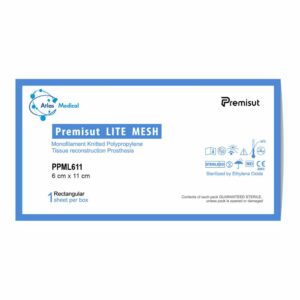
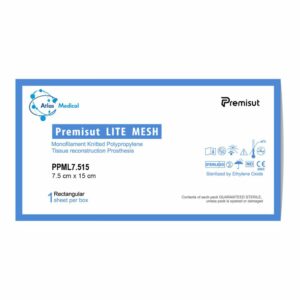
The 30×30 cm format is indicated for large abdominal wall defects, eventrations, incisional hernias and repairs requiring generous overlap over healthy tissue (an overlap of 3 to 5 cm is recommended for ventral or incisional hernia). For smaller defects, the same PremisutMesh Lite line maintains identical technical specifications (45 g/m², pore 1.3×1.0 mm, thickness 0.43 mm, maximum force 19 kgf) in other formats: PPML611 (6×11), PPML7,515 (7.5×15), PPML1015 (10×15), PPML1215 (12×15), PPML1515 (15×15), PPML1520 (15×20), PPML1530 (15×30) and PPML2030 (20×30).
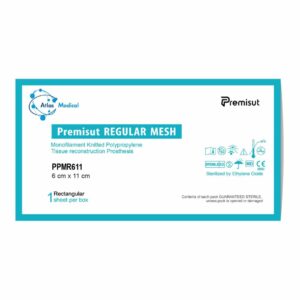
If the centre’s protocol requires a higher-density mesh for defects with high tension or weakened tissue, the alternative within the Cahnos catalogue is the Premisut Mesh Regular line (80 g/m², pore 0.5×0.7 mm, 25 kgf), also available in 30×30 cm (Ref. PPMR3030). All meshes in this range are marketed with a minimum purchase quantity of 25 units, ideal for standardising surgical area stock and optimising cost per procedure. Remember that this mesh must not be used in direct contact with viscera and that fixation will be performed with sutures or staples at the surgeon’s discretion, always following the manufacturer’s IFU.
Reviews
There are no reviews yet.