

Description
1. Introduction
The Surgical Mesh PremisutMesh Lite 6 x 11 cm (Ref. PPML611) is a tissue reinforcement mesh of colourless and non-absorbable polypropylene, designed to offer an optimal balance between mechanical strength, flexibility and minimal implanted material load. It is the usual choice for surgeons seeking a lightweight, macroporous and easy-to-handle implant in the repair of abdominal wall defects.
Its uncoated monofilament presentation, combined with a weight of 45 g/m², places it in the range of lightweight meshes that clinical practice associates with less foreign body sensation, good tissue integration and postoperative comfort, without compromising permanent tensile strength.
2. Technical Explanation
The mesh is woven from 100% extruded monofilament polypropylene, a biostable polymer that is neither absorbed nor degraded by the action of tissue enzymes, so the reinforcement remains permanently in the tissue. Its macroporous structure (1.3 x 1.0 mm) allows the growth of fibrous tissue through the interstices, incorporating the mesh into the adjacent tissue and reducing the risk of fold formation.
The mesh interlaces each fibre junction and provides bidirectional elasticity, allowing the mesh to adapt to the multidirectional tensions of the body and to be cut to the desired shape and size without unravelling. The laser cutting seals the edges and provides exceptional tear resistance. It is indicated for open and laparoscopic techniques and must be used following the manufacturer’s instructions for use (IFU).
3. Technical Specifications
| Material | Extruded monofilament polypropylene, 100% PP, colourless and non-absorbable |
| Structure | Uncoated monofilament mesh, natural white colour |
| Pore size | 1.3 x 1.0 mm (macroporous) |
| Weight | 45 g/m² |
| Thickness | 0.43 mm |
| Elongation | 77 % |
| Maximum force | 19 kgf |
| Dimensions | 6 x 11 cm |
| Sterilisation | Ethylene oxide (EO). Do not resterilise |
| Resistance | Permanent tensile strength; not absorbed by the body |
Indications: abdominal wall reinforcement and repair of inguinal, femoral, umbilical and ventral hernias. Supplied in individual sterile sachet; minimum purchase quantity: 25 units.
Note: this mesh must not be used intraperitoneally (direct contact with viscera) according to the manufacturer’s instructions for use. Always verify the IFU before implantation.
4. Equivalences and Cross-References
There is no official cross-reference table validated by the manufacturer for this mesh. The equivalences indicated below are functional category comparisons (same type of product and general clinical indication, with verifiable technical differences) and are not 1:1 interchangeable: before substituting in a tender or protocol, each technical field must be validated and the technical department consulted.
| Manufacturer / Brand | Family / Model | Code / SKU | Equivalence level | Technical differences |
| B.Braun | Premilene® Mesh | e.g. 1064425 (7.5×15) / 1064495 (10×15) | Comparable by category, not interchangeable 1:1 | Non-absorbable monofilament polypropylene, but heavier standard mesh: 82 g/m², pore 0.8 mm, thickness 0.48 mm |
| Johnson & Johnson MedTech (Ethicon) | PROLENE® Polypropylene Mesh | Consult official catalogue | Comparable by category, not interchangeable 1:1 | Non-absorbable monofilament polypropylene, ventral and inguinal hernia repair; standard weight mesh, without specification of 45 g/m² |
| Medtronic (Covidien) | Parietene™ Macroporous Mesh | Consult official catalogue | Comparable by category, not interchangeable 1:1 | Macroporous polypropylene for hernia repair; verify weight, pore and dimensions against the official technical data sheet |
| Cahnos | Premisut Mesh Regular 6×11 (Ref. PPMR611) | PPMR611 | Comparable by category, not interchangeable 1:1 | Same manufacturer and same size 6×11, but higher density mesh: pore 0.5×0.7 mm, 80 g/m², thickness 0.50 mm, strength 25 kgf |
Fields to check before any substitution: exact dimensions, weight (g/m²), pore size, thickness, structure (monofilament/multifilament), coating, single use, CE/MDR classification and sterilisation method. There is no equivalence table validated by the manufacturer; consult the technical department before use in tenders.
5. Selection tips and variants of interest
For the repair of inguinal hernia in open tension-free or laparoscopic technique, the 6 x 11 cm format covers small and medium defects with adequate overlap; for larger defects or replacement meshes, it is recommended to consider other formats from the same PremisutMesh Lite line, with identical technical specifications (45 g/m², pore 1.3 x 1.0 mm):
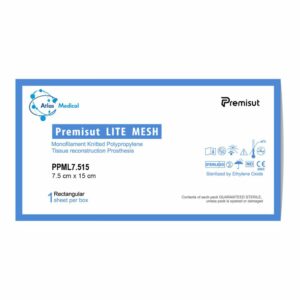
- PremisutMesh Lite 7.5 x 15 cm (Ref. PPML7,515)
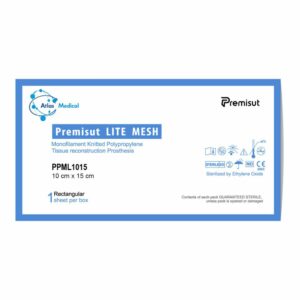
- PremisutMesh Lite 10 x 15 cm (Ref. PPML1015)
- PremisutMesh Lite 12 x 15 cm (Ref. PPML1215)
- PremisutMesh Lite 15 x 15 cm (Ref. PPML1515)
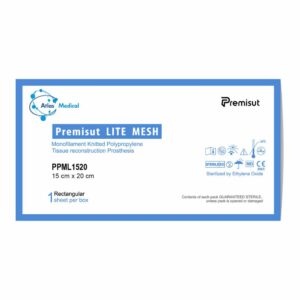
- PremisutMesh Lite 15 x 20 cm (Ref. PPML1520)
- PremisutMesh Lite 15 x 30 cm (Ref. PPML1530), 20 x 30 cm (Ref. PPML2030) and 30 x 30 cm (Ref. PPML3030)
If the centre’s protocol requires a higher density mesh for wall defects with high tension or weakened tissue contingencies, the alternative within the Cahnos catalogue is the Premisut Mesh Regular line (e.g. PPMR611 in 6 x 11 cm), heavier and with a smaller pore. Remember that the mesh must not be used in direct contact with viscera and that the recommended overlap over healthy tissue is 3 to 5 cm in ventral or incisional hernia; fixation will be performed with sutures or staples according to the surgeon’s criteria.
Reviews
There are no reviews yet.