
Description
1. Introduction
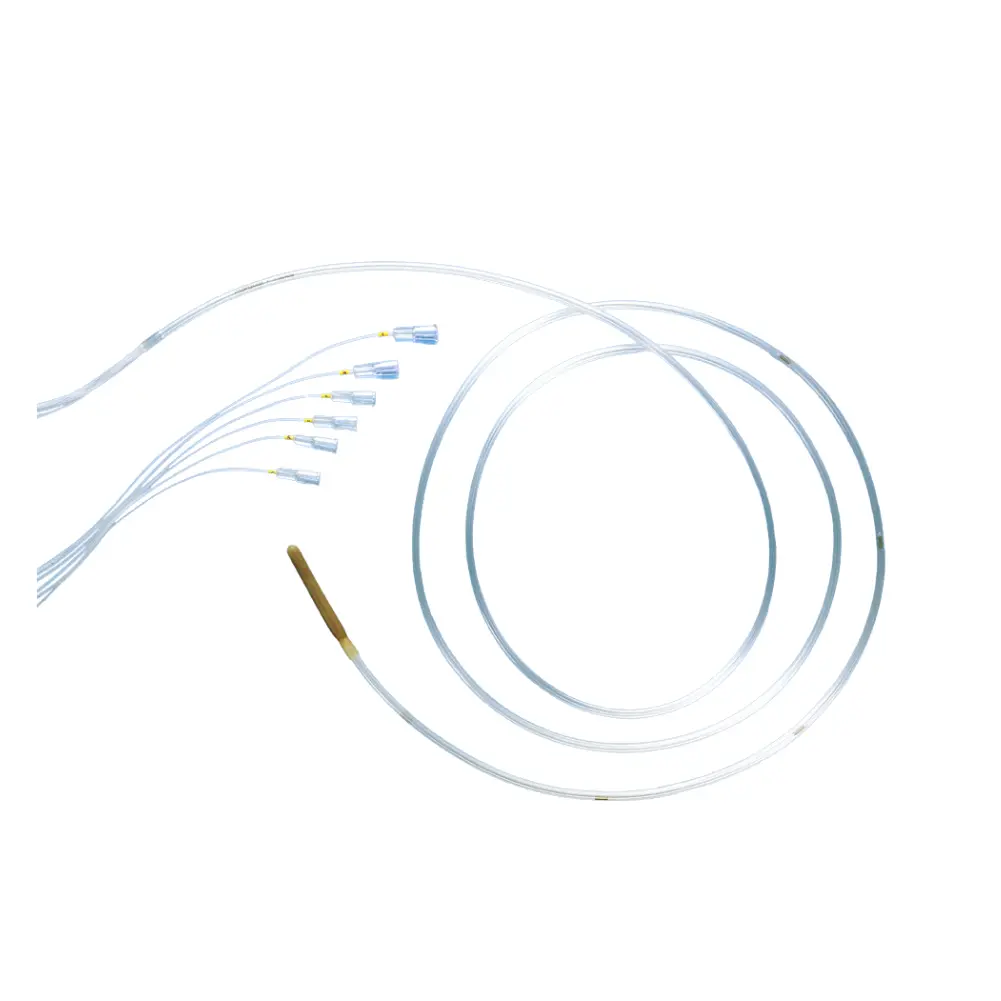
The 6-channel small intestine manometry catheter (ref. C73U) is the technical solution that your gastroenterology department, digestive physiology unit or motility laboratory needs to accurately study the motor activity of the upper digestive tract. Its 6-channel design with distal weight allows simultaneous and successive movements to be recorded from the stomach to the proximal jejunum, obtaining stable, reproducible and clinically reliable pressure curves. A professional reference choice for the functional diagnosis of intestinal motility disorders.
2. Technical explanation of the equipment and procedure
During small intestine manometry, the catheter is introduced orally or nasally and, thanks to the weight at its distal end, moves naturally along the digestive tract until it reaches the proximal jejunum. Once positioned, the six recording channels are connected to the pressure transducers of the manometry system and are perfused with sterile water at a constant flow rate. Each of the six orifices, spaced 10 cm apart, records pressure at a different point of the digestive tract, allowing simultaneous and successive detection of contractions of the stomach, duodenum and jejunum. Each orifice is individually identifiable by X-ray, which facilitates radiographic verification of the exact position of the measurement points during the examination. The independent lumens prevent interference between channels and ensure stable signals throughout the study.
3. Technical Specifications
The main features of the C73U catheter are summarised in the following table:
| Characteristic | Specification |
|---|---|
| Configuration | 6 pressure recording channels |
| Measurement ports | 6 orifices spaced 10 cm apart |
| Radiographic identification | Orifices individually identifiable by X-ray |
| Distal weight | Integrated weight at the distal end to facilitate advancement to the jejunum |
| Total length | L ≈ 250 cm |
| Diameter | Ø 5 mm (15 CV) |
| Measurement system | Sterile water perfusion at constant flow rate (perfused manometry) |
| Recording zone | From the stomach to the proximal jejunum (simultaneous and successive movements) |
| Indication | Small intestine manometry, gastrointestinal motility study and intestinal pressures |
4. Equivalences and Cross-References
The C73U meets the standard of a multi-channel perfusion catheter with distal weight used by the main manufacturers of digestive motility equipment. It is functionally equivalent to the water-perfused catheters from companies such as Laborie, Albyn Medical and MMS/Laborie in 6-channel configurations for antroduodenal and intestinal manometry, as well as to the perfused measurement catheters of the gastrointestinal series from the Rüsch/Teleflex group (colour-coded accessory connections, sterile and latex-free). Within the Cahnos catalogue, its closest equivalent is the 6-channel antroduodenal catheter with distal weight C72U, and it is complemented by the 12-channel colonic manometry catheter C70U for the assessment of colonic motility. For oesophageal studies, the C58U (4-channel) and C59U (6-channel) catheters are available. For the exact validation of an equivalence with your centre’s current purchasing reference, please consult our technical-commercial team.
5. Selection tips and variants of interest
Select the C73U when your protocol requires a 6-channel catheter with distal weight for complete pressure recording from the stomach to the proximal jejunum, with radiographic verification of the measurement points. If you need to specifically study gastric and duodenal motility, consider the antroduodenal catheter C72U; for the evaluation of colonic inertia, the 12-channel colonic manometry catheter C70U; and for oesophageal studies, the C58U or C59U catheters. Always verify the compatibility of connectors and transducers with your manometry system. At Cahnos we supply on request and with a formalised quotation with special conditions for B2B professionals.


Reviews
There are no reviews yet.