


Description
1. Introduction
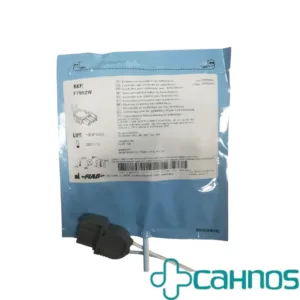
Keep your automated external defibrillator CU Medical Systems Paramedic CU-ER1 ready to also treat the smallest patients with this pair of paediatric reduced-energy electrodes, reference Cahnos F7958PL. It is the clinical spare part indicated for nurseries, schools, sports centres, paediatric practices and any public access defibrillation programme with a child population: it guarantees safe and effective care for children and adolescents, with a discharge level adapted to paediatric resuscitation.
The original factory reference for this electrode is ER1-PP01 (Reduced-energy Pediatric Defibrillator Electrode Pads), documented in Appendix C of the Paramedic CU-ER1 operator’s manual. The Cahnos distribution code is F7958PL; it should not be confused with the manufacturer’s official code, which is the aforementioned ER1-PP01.
2. Technical explanation of the equipment and procedure
The Paramedic CU-ER1 is a semi-automatic AED that, when connected to the patient via the multifunction electrodes, acquires and analyses the electrocardiogram to detect shockable rhythms (ventricular fibrillation and ventricular tachycardia). If a shockable rhythm is detected, the device charges and prompts the rescuer to press the shock button, delivering a impedance-compensated biphasic truncated exponential waveform (e-cube technology).
For paediatric care, the manufacturer prescribes the use of reduced-energy paediatric electrodes: when the patient appears to be under 8 years of age or weigh less than 25 kg (55 lb), these pads should be used together with the paediatric connection adapter ER1-OA12 (Pediatric Pads Connector Adapter), which plugs into the device’s ECG-DEFIB port. In this way, the shock is delivered at a reduced energy level, avoiding applying to a child’s heart the energy intended for adults. The pads are placed following the anatomical diagrams on the packaging (anterior-posterior position) and also allow, in addition to defibrillation, cardiac rhythm monitoring during care. They are single-use: they must be replaced after each intervention or upon reaching the expiry date printed on the packaging.
3. Technical Specifications
| Field | Specification |
|---|---|
| Reference Cahnos (SKU) | F7958PL |
| Original factory reference | ER1-PP01 (reduced-energy paediatric electrodes; Appendix C of the CU-ER1 operator’s manual) |
| Brand / compatible equipment | CU Medical Systems – Semi-automatic AED Paramedic CU-ER1 (CU-ER series; in authorised distribution also documented for CU-ER2 and CU-ER3) |
| Electrode type | Paediatric multifunction reduced-energy, 1 pair (2 pieces), disposable |
| Indicated population | Children under 8 years or weighing less than 25 kg (55 lb) |
| Energy | Reduced energy level for paediatrics via paediatric electrodes + ER1-OA12 adapter |
| Functions | Rhythm analysis, defibrillation and ECG monitoring |
| Connection | Device ECG-DEFIB port via paediatric adapter ER1-OA12 (not included) |
| Conductive gel | Low-impedance conductive adhesive gel |
| Packaging | Heat-sealed pouch that preserves the gel and the expiry date |
| Use | Single-use, disposable |
| Presentation | 1 pair (2 electrodes) |
| Regulatory standard | Medical device with CE marking; certified manufacture in accordance with Directive 93/42/EEC (MDD) and ISO 13485 |
| Expiry | As indicated on the packaging; do not use after the expiry date |
Compatibility note: due to its reduced-energy design and specific connection, this electrode corresponds to the Paramedic CU-ER series. It is not interchangeable with the adult electrodes of the CU-ER1 (reference CUA0508O), nor with the consumables of other CU Medical AEDs such as the i-PAD SP1, SP2, CU-SPR, NFK200 or NF1200/NF1201, which use their own electrodes and connectors.
4. Equivalences and Cross-References
The original factory reference for this electrode is ER1-PP01, identified in Appendix C of the Paramedic CU-ER1 operator’s manual. CU Medical does not publish an official equivalence table authorising third-party electrodes for this device: the connector, analysis algorithm and energy management are proprietary. Any comparison with other brands should be understood as comparable at category level, not 1:1 interchangeable, verifying connector, energy range and algorithm before any replacement.
| Manufacturer / Brand | Family / Model | Reference code / SKU | Equivalence level | Technical differences / Remarks |
|---|---|---|---|---|
| CU Medical Systems (equipment manufacturer) | Reduced-energy paediatric electrodes Paramedic CU-ER1 | ER1-PP01 | Exact reference equivalence (same manufacturer) | It is the original reference reproduced in this datasheet, documented in Appendix C of the CU-ER1 operator’s manual; it requires the paediatric adapter ER1-OA12 for connection to the ECG-DEFIB port. |
| ZOLL Medical | Pedi-Padz II (paediatric electrode) | 8900-0810-01 | Comparable by category (not interchangeable 1:1) | Same paediatric range (<8 years / <25 kg) and automatic switching to paediatric energy, but proprietary ZOLL connector and own algorithm; exclusive to AED Plus and AED Pro. Code confirmed in the official ZOLL store and authorised distributors. |
| Defibtech | Lifeline AED Child / Pediatric Electrode Pads | DDP-200P | Comparable by category (not interchangeable 1:1) | Reduced-energy paediatric electrodes with integrated attenuator for children under 8 years or less than 25 kg; connector, algorithm and management electronics proprietary to Lifeline devices. GUDID/FDA UDI-DI registration 00815098020430. |
| Philips | HeartStart FRx SMART Pads II | 989803139261 | Comparable by category (not interchangeable 1:1) | Universal adult/child electrodes: require the Infant/Child Key to activate paediatric mode; proprietary connector and algorithm Philips. |
| Cardiac Science | Powerheart G3 Pediatric Electrode Pads | 9730-002 | Comparable by category (not interchangeable 1:1) | Reduced energy (≈50 J) for patients under 8 years or less than 25 kg; exclusive to the Powerheart G3 series (9200/9300), with its own connector and attenuation. Code confirmed at authorised distributors. |
Other manufacturers in the sector with pre-connected paediatric electrodes of limited energy (e.g. Stryker/Physio-Control LIFEPAK) are comparable only by category: check one by one the device connector, the paediatric energy range and the algorithm before considering any alternative. There is no equivalence table validated by the manufacturer (CU Medical) for this electrode; consult the technical department of Cahnos before use in tenders.
5. Selection tips and variants of interest
- Confirm the device model: this electrode corresponds to the Paramedic CU-ER1 AED (CU-ER series). It is not valid for CU Medical i-PAD AEDs (SP1, SP2, CU-SPR, NFK200 or NF1200/NF1201), which use their own consumables.
- Check the reference and expiry date: before ordering, check the ER1-PP01 code and the expiry date on the packaging; do not force the installation of an expired electrode (the gel may lose conductivity).
- Paediatric adapter: if your device does not have the ER1-OA12 adapter (Pediatric Pads Connector Adapter), contact us to complete the supply; without it, it is not possible to connect these electrodes to the ECG-DEFIB port.
- Paediatric supply: in centres with a child population, always keep a pair of paediatric electrodes next to the AED and check monthly that the device is operational with the pads in date.
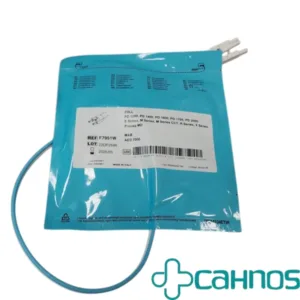
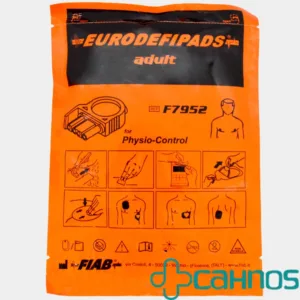
- Variants within the Cahnos catalogue: F7959PL and F7959WPL (limited-energy paediatric electrodes for the i-PAD NF1200/NF1201 AEDs of the Saver family, factory ref. CUA0512P), F7958P / F7958PW (standard CU Medical paediatric electrodes with internal/external cable for CU-ER2, CU-ER3, CU-ER5 and LiFEGAIN CU-HD1) and F7952P (universal paediatric electrode with internal cable for Physio-Control, Bexen Cardio, Cardioline and Mindray).
- Maintenance: manage stock rotation by expiry date and always replace the electrode after use or expiration. For volume orders or tenders, contact the technical department of Cahnos indicating the exact model and serial number of the device.

Reviews
There are no reviews yet.