
Surgical face masks: buying guide
2 products in the catalogue
The surgical face mask is a medical device regulated by the EN 14683 standard, designed for source control: it is used in healthcare settings to reduce the transmission of respiratory droplets between staff and patients. It is routinely found in operating theatres, clinics, treatment rooms and any workstation where direct transmission needs to be limited.
The EN 14683 standard distinguishes three types. Type I requires a bacterial filtration efficiency (BFE) of at least 95%; Type II, at least 98%; and Type IIR, in addition to that 98%, a splash resistance of 16.0 kPa or more. When buying, the factors that matter are the type (II or IIR), the fastening system (ear loops or ties), the presence of a face shield and anti-fog strip, the material of the inner layer, the number of layers and the pack format.
Other related families
-
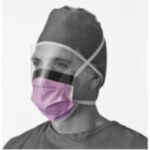 Surgical Mask
This is the family for the product in this guide: it groups the options by type, fastening system and presentation.
- Disposable Protection Brings together the single-use supplies used to restock the workstation daily.
-
 Eyewear and Eye Protectors
A complement for when additional eye protection against splashes is required.
-
 FFP2 face mask
An alternative when you are looking for a respiratory protective mask rather than source control.
Products in this guide
- Glass 1
- Non-woven 1
- Box OF 25 1
- Box OF 50 1
-
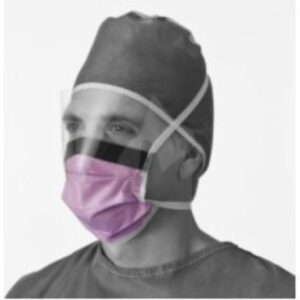
Type IIR Surgical Mask Resistant to Fluids with Polyester Face Shield and Elastic Straps – Box of 25 Units (Ref. NONE27710)
10,50 € In stockAdd to basket -

GISAFE Surgical Mask Type IIR 3-Layer with Ear Loops – BFE 98% Filtration – Adult Size
Price range: 4,56 € through 5,32 € In stockSelect options This product has multiple variants. The options may be chosen on the product page
Buying and selection tips
-
Choose the type according to splash risk
The EN 14683 standard sets three levels: Type I requires a bacterial filtration efficiency of at least 95%, Type II at least 98% and Type IIR, in addition, a splash resistance of 16.0 kPa or more. Type IIR is the one that declares splash resistance, a figure to be fixed in the workstation's specification.
-
Decide the fastening system before the finish
This range includes masks with ear loops and with ties. Ear loops speed up putting on and taking off, and ties allow an individual fit. It is best to fix this criterion before comparing finishes, because it affects comfort over long shifts.
-
Consider the integrated face shield and anti-fog strip
Some models include a face shield and an anti-fog strip, so that a single piece provides both face protection and the mask. Compare the shield material, the anti-fog strip and the type of mask (II or IIR) declared by each reference.
-
Check the inner layer if comfort on long shifts matters
Some models declare a soft, breathable inner layer, and some state that they are latex-free. Check both declarations and the bacterial filtration efficiency on each reference.
-
Compare layers, filtration and the reusable option
This range includes three- and four-layer masks and declared BFE values above 98%. There are also reusable Type II versions; in that case, follow the manufacturer's instructions and compare the cost per use.
-
Check the size and pack format
There are adult and children's versions, and presentations are organised in boxes of different sizes. Matching the format to the department's actual consumption avoids stockpiling and running short at peaks of activity.
Compatibility
- Additional eye protection, such as a shield or goggles
- The surgical face mask can be combined with additional eye protection when there is a risk of splashes.
Frequently asked questions
What is the practical difference between a Type II and a Type IIR mask when ordering?
Both require a bacterial filtration efficiency of at least 98%; the difference is that the IIR adds splash resistance of 16.0 kPa or more. If the workstation requires that resistance, the choice is the IIR.
How do I decide between ear loops and ties for theatre staff?
Ties allow the mask to be adjusted to each person and ear loops speed up putting on and taking off. If the team changes masks many times a day, ear loops are more practical.
When is it worth buying masks with an integrated face shield?
When you want to cover the face and mask with a single piece, with an anti-fog strip. It simplifies preparation and avoids relying on two separate items.
What should I look for if staff have sensitive skin?
Above all the inner layer declared by each reference and whether it is declared latex-free. Also check that the declared bacterial filtration efficiency is the one required by the tender specification.
What is the difference between a surgical mask and a respiratory protective mask?
The surgical mask acts as source control against droplets; the respiratory protective mask protects the wearer against airborne pathogens. They are products with different regulatory frameworks and are not interchangeable.
Which sizes should I plan for in a high-consumption department?
There are adult and children's versions and presentations are organised in boxes of different sizes. Matching the format to actual consumption avoids stockpiling and running short at peaks of activity.
Common questions
Thinking Type IIR filters more than Type II
No: both require at least 98% bacterial filtration efficiency. The “R” only adds splash resistance.
Confusing a surgical mask with a respiratory protective mask
The surgical mask acts as source control and is effective against droplets. The filtering facepiece protects the user against airborne pathogens. They are products with different regulatory frameworks.
Believing any surgical mask is suitable for theatre
Type I is intended for patients and other people, not for operating theatre staff, for whom Type II or IIR is required.
Searching for the product under different names and not finding it
The same mask appears on the market as a three-layer mask, a blue mask with ear loops or a surgical face covering. It is best to standardise the internal name to avoid duplicate orders.