
Buying guide to blue surgical masks
3 products in the catalogue
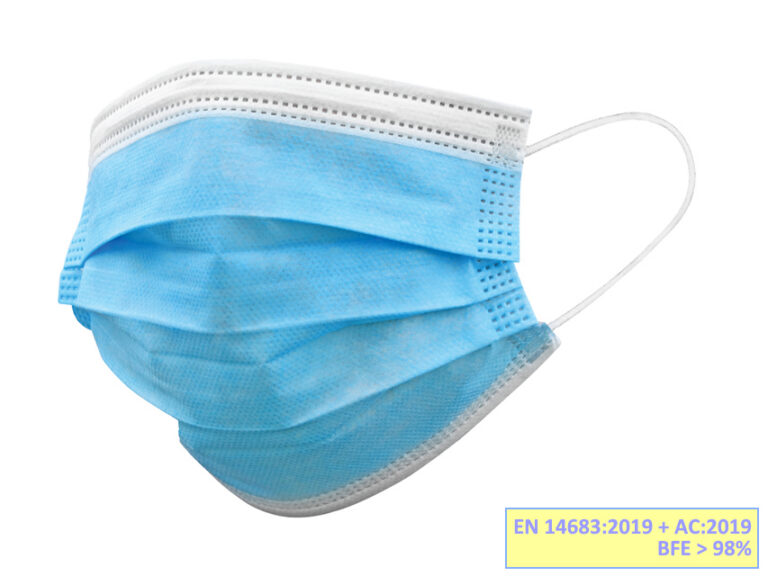
The blue surgical mask is a single-use medical device that acts as a physical barrier. It is used in operating theatres, consulting rooms and treatment rooms, and it is chosen by the standard it meets, the type of fastening and the material of the layers, not by its colour.
The EN 14683:2019 standard distinguishes three types: Type I, with a bacterial filtration efficiency (BFE) of 95% or higher; Type II, with a BFE of 98% or higher; and Type IIR, which adds splash resistance of at least 16.0 kPa. The "R" indicates that splash resistance. The colour of the outer layer serves to identify the reference, not to infer performance.

Other related families
-
 Surgical Mask
This is the central family for the topic: it groups the single-use masks governed by EN 14683, with Types I, II and IIR.
- Disposable Protection It brings together the rest of the disposable clothing that is combined with the mask at the same workstation.
-
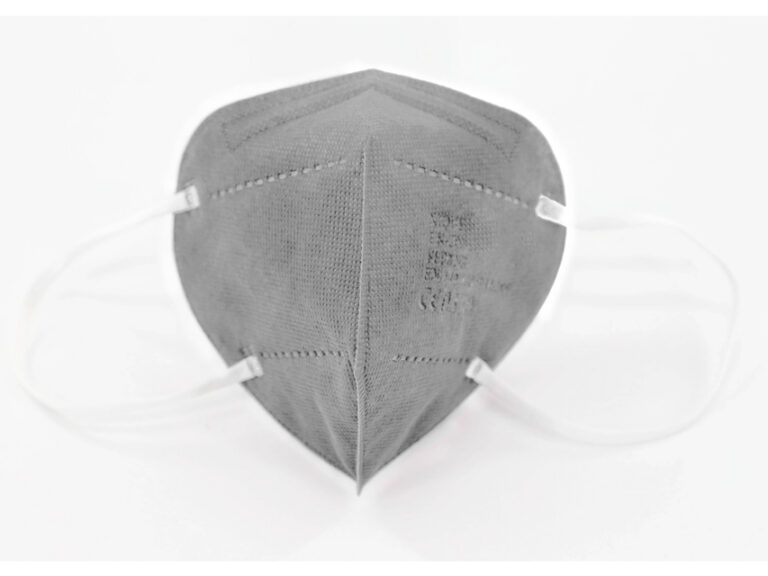
 FFP2 face mask
Worth having to hand, because the respirator covers a different need, that of the wearer, and is governed by EN 149.
Products in this guide
- Glass 2
- Non-woven 2
- Adult 3
- Paediatric 1
- I 2
- III 1
- Medical device 2
- PPE 1
-

GISAFE Surgical Mask Type IIR 3-Layer with Ear Loops – BFE 98% Filtration – Adult Size
Price range: 4,56 € through 5,32 € In stockSelect options This product has multiple variants. The options may be chosen on the product page -

GISAFE Surgical Face Mask Type IIR 3 Layers with Elastic Bands – BFE 98% Filtration
Price range: 0,86 € through 5,42 € In stockSelect options This product has multiple variants. The options may be chosen on the product page -
Value&Safe FFP2 face mask without valve, 5 layers, with ear loops, adult size – Box of 20 units (EN 149:2001+A1:2009)
Price range: 4,28 € through 9,41 € In stockSelect options This product has multiple variants. The options may be chosen on the product page
Buying and selection tips
-
Distinguish Type II from Type IIR according to splash risk
The difference between the two lies not in bacterial filtration, which is 98% or higher in both cases, but in splash resistance, which only Type IIR requires, with a minimum of 16.0 kPa. If there is a risk of splashes, the "R" is the deciding criterion.
-
Confirm the fastening before comparing references
Surgical masks may have ear loops or head ties, and each fastening affects comfort over long shifts. The available models have ear loops; confirm the fastening in the description of each one.
-
Match the size to the end user
There are adult-size and children's versions, with ear loops. Choose according to the end user.
-
Compare the layers and the declared filtration
The models have three to four layers and declare a BFE of 98% or higher, and in some cases 99%. Compare the declared value, not just the number of layers.
-
Require the standard and the declared efficiency
The product description must state the EN 14683 type and the bacterial filtration efficiency. For respirators the reference is EN 149, with three levels of particle filtration: FFP1, FFP2 and FFP3. If you choose a reusable model, follow the manufacturer's instructions.
Compatibility
- FFP2 respirator
- It is governed by EN 149 and does not replace the EN 14683 surgical mask: they are different standards with different purposes.
Frequently asked questions
What is the difference between a Type II and a Type IIR surgical mask?
Both require a bacterial filtration efficiency of 98% or higher, but only Type IIR must meet a splash resistance of at least 16.0 kPa. The "R" is therefore the deciding criterion when there is a risk of splashes.
How do I tell a surgical mask from a respirator when choosing?
The surgical mask is governed by EN 14683 and protects the patient and the environment; the respirator is governed by EN 149 and protects the wearer, with levels FFP1, FFP2 and FFP3.
What fastening do the available surgical masks have?
They may have ear loops or head ties. The available models have ear loops; check the fastening in the description of each one.
What number of layers and what filtration should I compare?
Compare the layers and the declared BFE value: the available models have three or four layers, with a BFE of 98% or higher and some at 99%.
Are there children's-size surgical masks as well as adult ones?
Yes, there are children's-size versions with ear loops and adult-size versions. The choice depends on the end user, not on the colour.
Common questions
Believing that the blue colour alone indicates a higher level of protection
The colour of the outer layer is used to identify the reference and make selection easier; the level of protection is determined by the EN 14683 type and the declared filtration efficiency.
Assuming that every three-layer blue mask is splash resistant
Splash resistance does not come with the number of layers: it is a requirement of Type IIR, with a minimum of 16.0 kPa, and is not required of Type I or Type II.
Thinking that a reusable mask is equivalent to a single-use one
No. A reusable mask is governed by the manufacturer's own instructions and should not be treated as equivalent to a disposable one.
Confusing a surgical mask with a respirator by its outward appearance
They are governed by different standards: the surgical mask by EN 14683 and the respirator by EN 149, with levels FFP1, FFP2 and FFP3 according to the percentage of particles filtered.