
Nylon sutures: buying guide
307 products in the catalogue
Nylon suture is a non-absorbable polyamide monofilament thread. This category includes presentations without a needle and with a needle, straight or curved, with one or two needles, in various sizes and thread lengths.
A reference is defined by several details that travel together: the needle point type and body, its curvature, the USP size with its metric EP equivalent and the thread length. Added to these are the colour and the number of needles per strand. This guide sets out those criteria so that references can be compared consistently and substitutions that look equivalent but are not, because of the point type, curvature or size, can be avoided.

Other related families
-
 NON-ABSORBABLE SUTURES
It groups non-absorbable sutures, useful for separating nylon from the other materials in a mixed purchase.
-
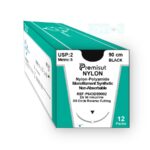 NYLON - 3/8 Circle, Triangular Point and Reverse Cutting
It brings together 3/8 circle curved needles with a triangular body and reverse cutting edge.
-
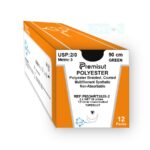 NYLON - 1/2 Circle Body Triangular Point Reverse Cutting
It brings together 1/2 circle curved needles with a triangular body and reverse cutting edge.
-
NYLON - 1/2 Circle Cylindrical Body Conical Point Taperpoint
It groups 1/2 circle needles with a round body and taper point.
-
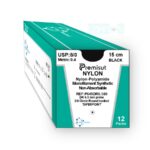 NYLON - 3/8 Circle Cylindrical Body Conical Tip Taperpoint
It groups 3/8 circle needles with a round body and taper point.
-
 NYLON - 3/8 Circle Micropoint Spatula
It concentrates the 3/8 circle spatula needles, designed for fine sizes.
Products in this guide
- Prime 203
- Normal 104
- 3/8 circle 187
- 1/2 circle 100
- Without Needle 10
- Straight 8
- Straight Cut 8
- 1/4 circle 2
- DS 24 23
- DS 19 16
- DS 30 16
- HR 40 15
- HR 26 13
- HR 20 12
- HR 30 12
- DS 16 11
- 10 cm 2
- 12 cm 3
- 15 cm 12
- 30 cm 8
- 45 cm 59
- 75 cm 139
- 90 cm 29
- 100 cm 7
-
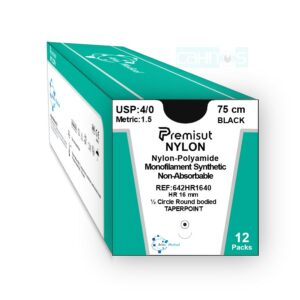
NYLON SUTURE PREMISUT 1/2 Cylindrical Taperpoint Conical Point · HR 16 mm · USP 4/0 (EP 1.5) · Black · 75 cm · Non-Absorbable · Monofilament Polyamide 6/6.6 · Box of 12 units (Ref. 642HR1640)
7,84 € In stockAdd to basket -
Sale!
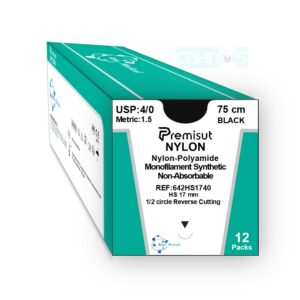
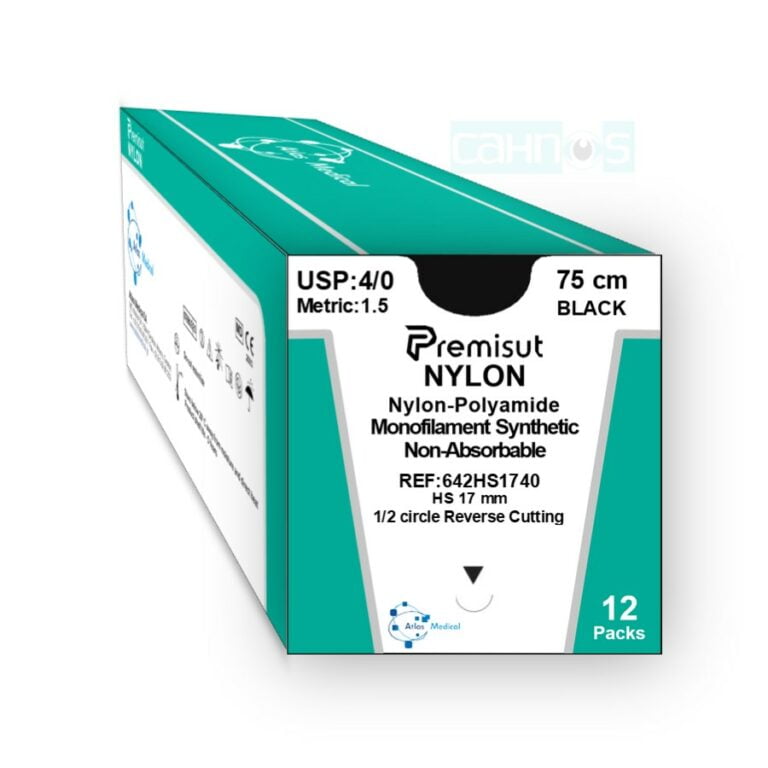
NYLON Suture PREMISUT Non-Absorbable Monofilament 4/0 Black · 1/2 Circle Needle Triangular Point Reverse Cutting 17 mm (HS 17) · Thread 75 cm · Ref. 642HS1740 · Box of 12 units
Original price was: 19,90 €.13,90 €Current price is: 13,90 €. In stockAdd to basket -
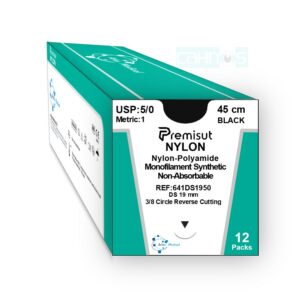
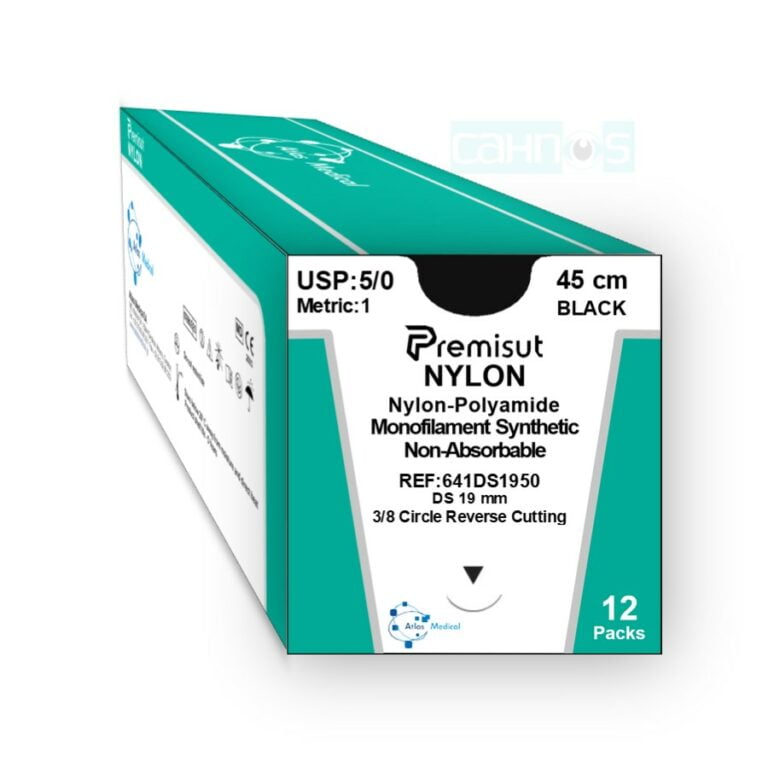
NYLON Non-Absorbable Suture PREMISUT · 3/8 Circle Triangular Reverse Cutting Needle DS19 (19 mm) · USP 5/0 (EP 1) · Black Thread 45 cm · Polyamide Monofilament · Box of 12 units (Ref. 641DS1950)
7,84 € In stockAdd to basket -
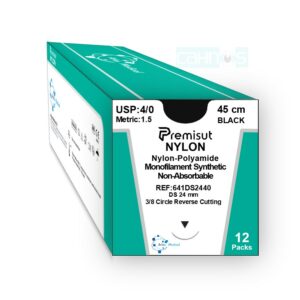
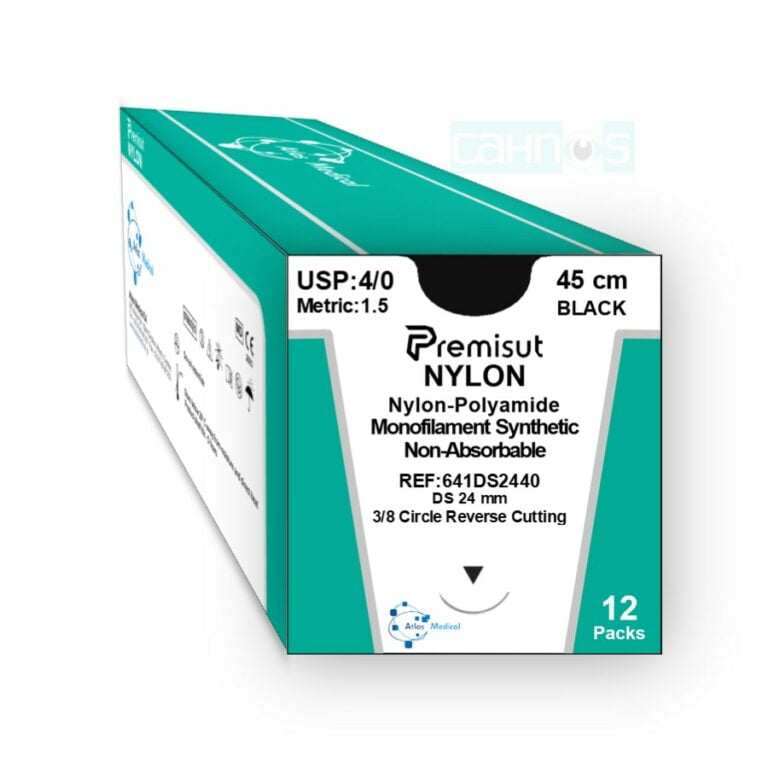
NYLON SUTURE PREMISUT Non-Absorbable · 3/8 Circle Triangular Reverse Cutting Needle DS24 (24 mm) · USP 4/0 (EP 1.5) · Black Thread 45 cm · Polyamide Monofilament · Box of 12 units (Ref. 641DS2440)
7,79 € In stockAdd to basket -
Sale!
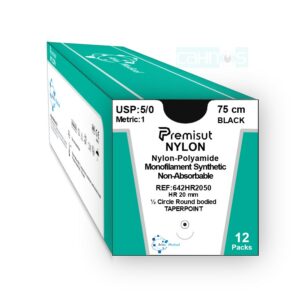
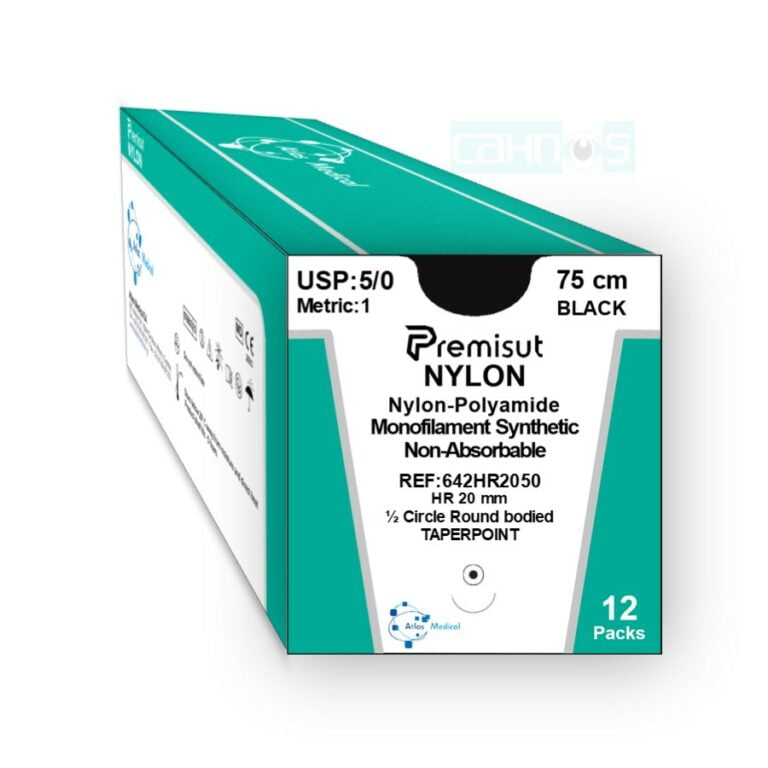
NYLON Suture PREMISUT · ½ Circle Cylindrical Needle Conical Taperpoint 20 mm (HR20) · USP 5/0 (EP 1) · Black Monofilament Thread 75 cm · Non-Absorbable Polyamide · Box of 12 units (Ref. 642HR2050 · SKU AM642HR2050)
Original price was: 19,90 €.12,70 €Current price is: 12,70 €. In stockAdd to basket -
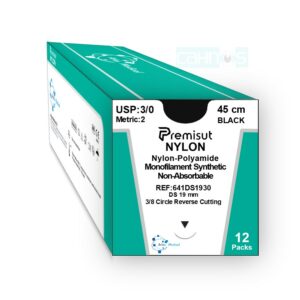
NYLON PREMISUT 3/0 Non-Absorbable Suture · 3/8 Circle Reverse Cutting Triangular Needle 19 mm (DS19) · Black Thread 45 cm · Polyamide Monofilament · Box of 12 units (Ref. 641DS1930)
7,84 € In stockAdd to basket -
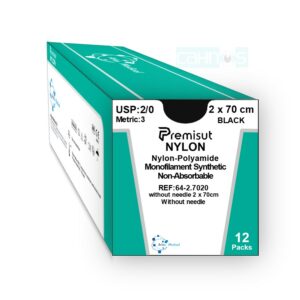
NYLON PREMISUT Suture Without Needle USP 2/0 Black 2×70 cm – Non-Absorbable Polyamide Monofilament (Ref. 64-2.7020)
10,59 € In stockAdd to basket -
Sale!
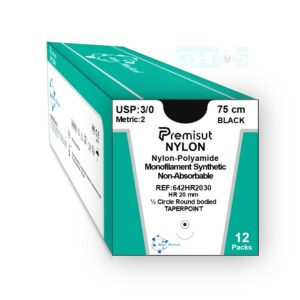
NYLON Suture PREMISUT 1/2 Circle Cylindrical Conical Taperpoint 20 mm (HR20) · USP 3/0 (EP 2) · Black Monofilament Thread 75 cm · Non-Absorbable Polyamide · Box of 12 units (Ref. 642HR2030 · SKU AM642HR2030)
Original price was: 19,90 €.13,90 €Current price is: 13,90 €. In stockAdd to basket
Buying and selection tips
-
Start with the needle point type
Before looking at lengths, settle whether the needle is round-bodied with a taper point, triangular reverse cutting, conventional cutting or spatula. Each point type defines a different product and affects all the comparison that follows.
-
Read the size on both scales
Each reference declares the USP size alongside its metric EP equivalent: 4/0 corresponds to 1.5, 3/0 to 2 and 2/0 to 3. Check that both scales match on the same order line and not just the commercial number.
-
Specify the thread length
The thread length varies between references and the same needle may appear with different lengths. It must form part of the order line description and not be taken for granted.
-
Check how many needles the strand has
There are single-needle and double-needle references. The double needle is a different configuration, not a variant of the same reference, and must be stated expressly on the order.
-
Confirm that the thread is a non-absorbable monofilament
Check in the description that it is a non-absorbable polyamide monofilament thread, so as not to confuse it with other sutures in the category.
-
Ribbed or non-ribbed changes the reference
On some sizes and needles there are ribbed and non-ribbed versions, and the finish is part of the reference name. When reordering, state it together with the curvature.
Frequently asked questions
How do I tell a reverse cutting needle from a conventional cutting one when checking an order?
They are declared in the description as different point types. They are not substituted for one another even if they share size and thread length, so check the point type on each line.
What is the relationship between the USP size and the metric EP size of the same nylon suture?
They are two scales for the same size: 4/0 with 1.5, 3/0 with 2 and 2/0 with 3. When comparing two references, check that both scales match and not just the USP figure.
When does it make sense to order a double-needle reference instead of a single needle?
When the service expressly requests that configuration. It is not interchangeable with the single-needle one, so it must appear in the description of the line.
Why does the same needle appear with 45 and 75 cm threads?
Because the thread length varies between references and the same needle may exist in several formats. Specify it in the line description.
Can I replace a taper point needle with a triangular one of the same length?
No: they are different bodies and points, round-bodied with a taper point as against triangular. Matching on needle length and size does not make one reference equivalent to the other.
Common questions
Assuming that all nylon comes with a 75 cm thread
This is not so: there are references with other lengths, such as 45 or 70 cm, tied to each needle and size. The length must be read on each reference and not extrapolated.
Confusing the needle length with the thread size
The needle length is expressed in millimetres and the thread size is declared separately, in USP and metric EP. They are independent details.
Treating a spatula needle as equivalent to a triangular reverse cutting one
The spatula needle has its own geometry and is declared separately. One cannot simply be swapped for the other.
Thinking that polyamide thread is absorbed over time
The polyamide of these sutures is a non-absorbable monofilament, and that condition must appear in the description of the line.
More products in this guide
-
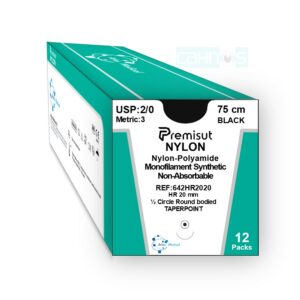
Non-Absorbable NYLON Suture PREMISUT · ½ Circle Needle Cylindrical Body Taperpoint Conical Point 20 mm (HR20) · USP 2/0 (EP 3) · Black Monofilament Thread 75 cm · Polyamide 6/6.6 · Box of 12 units (Ref. 642HR2020 · SKU AM642HR2020)
7,84 € In stockAdd to basket -
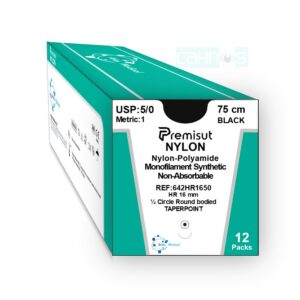
NYLON PREMISUT Non-Absorbable Suture · ½ Circle Needle Cylindrical Body Taperpoint Conical Point 16 mm (HR16) · USP 5/0 (EP 1) · Black · Polyamide 6/6.6 Monofilament · 75 cm · Box of 12 units (Ref. 642HR1650)
8,32 € In stockAdd to basket -
Sale!
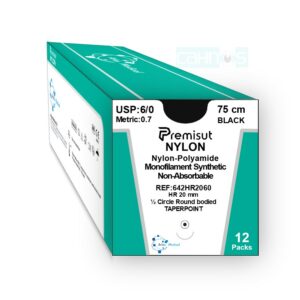
Non-Absorbable NYLON Suture PREMISUT · ½ Circle Cylindrical Body Taperpoint Conical Point Needle 20 mm (HR20) · USP 6/0 (EP 0.7) · Black Monofilament Thread 75 cm · Polyamide 6/6.6 · Box of 12 units (Ref. 642HR2060 · SKU AM642HR2060)
Original price was: 30,90 €.20,90 €Current price is: 20,90 €. In stockAdd to basket -
Sale!
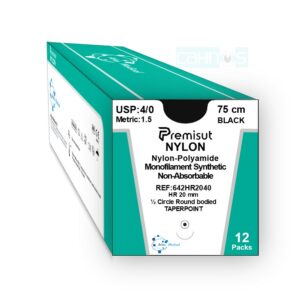
Non-Absorbable NYLON Suture PREMISUT · Needle ½ Circle Cylindrical Body Taperpoint Conical Point 20 mm (HR20) · USP 4/0 (EP 1.5) · Black Monofilament Thread 75 cm · Polyamide 6/6.6 · Box of 12 units (Ref. 642HR2040)
Original price was: 24,90 €.13,90 €Current price is: 13,90 €. In stockAdd to basket -
Sale!
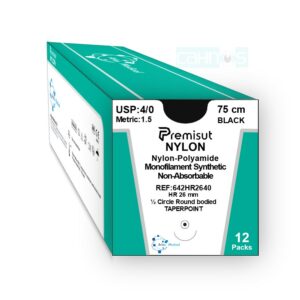
Non-Absorbable NYLON Suture PREMISUT · Needle ½ Circle Cylindrical Body Conical Taperpoint 26 mm (HR26) · USP 4/0 (EP 1.5) · Black Monofilament Thread 75 cm · Polyamide 6/6.6 · Box of 12 units (Ref. 642HR2640)
Original price was: 19,90 €.12,70 €Current price is: 12,70 €. In stockAdd to basket -
Sale!
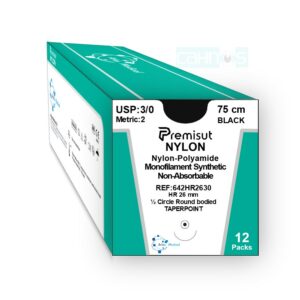
NYLON Suture PREMISUT Non-Absorbable · Needle ½ Circle Cylindrical Body Taperpoint Conical Point 26 mm (HR26) · USP 3/0 (EP 2) · Black Monofilament Thread 75 cm · Polyamide 6/6.6 · Sterile · Box of 12 units (Ref. 642HR2630 · SKU AM642HR2630)
Original price was: 19,90 €.13,90 €Current price is: 13,90 €. In stockAdd to basket -
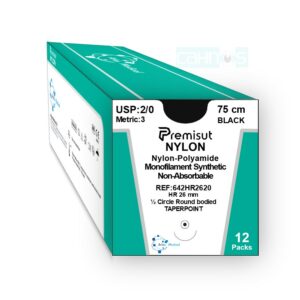
NYLON Non-Absorbable Suture PREMISUT · ½ Circle Needle Cylindrical Body Taperpoint Conical Point 26 mm (HR26) · USP 2/0 (EP 3) · Black Monofilament Thread 75 cm · Polyamide 6/6.6 · Box of 12 units (Ref. 642HR2620) · SKU AM642HR2620
7,84 € In stockAdd to basket -
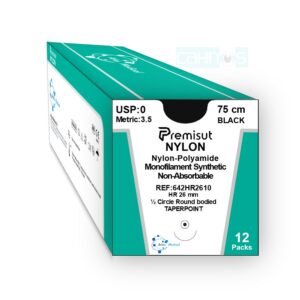
NYLON Non-Absorbable Suture PREMISUT · ½ Circle Cylindrical Taperpoint Conical Point Needle 26 mm (HR26) · USP 0 (EP 3.5) · Black Monofilament Thread 75 cm · Box of 12 units · Ref. 642HR2610
7,79 € In stockAdd to basket