
Description
1. Commercial Introduction
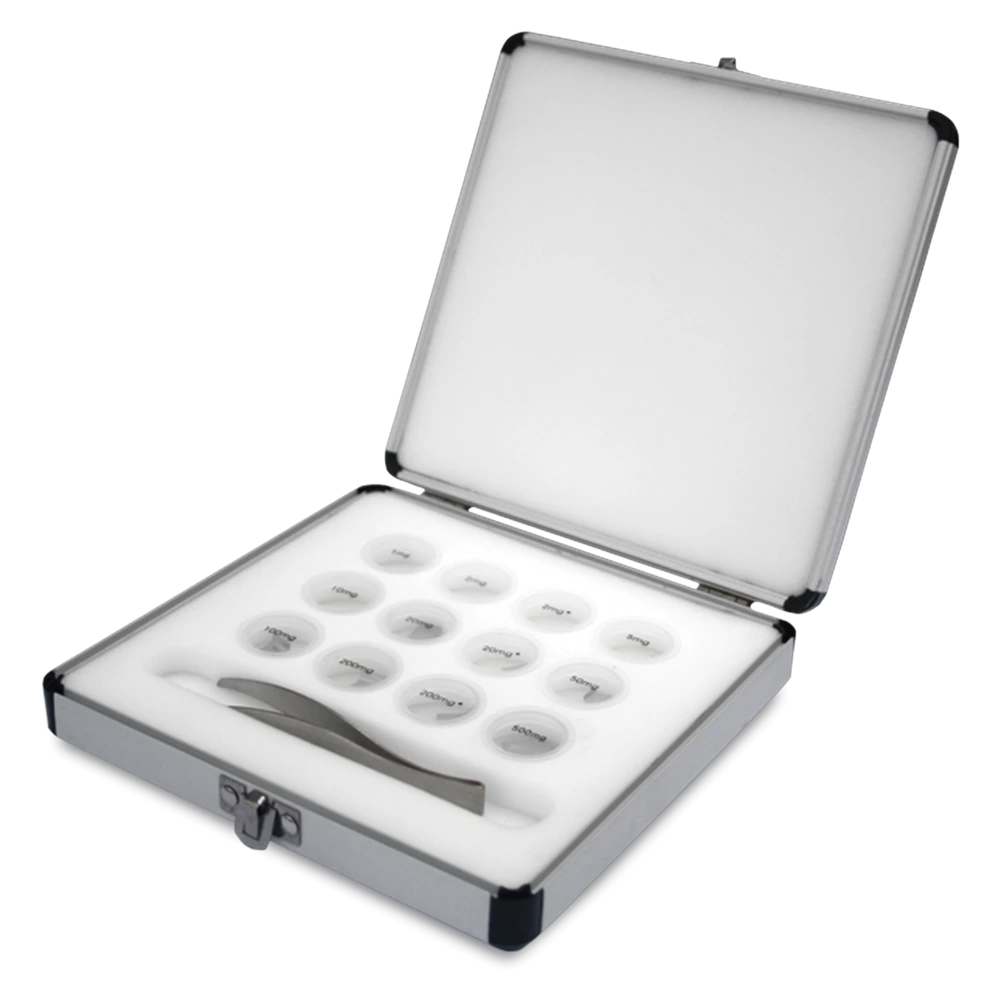
Complete your metrological equipment with the set of class E2 standard weight fractions, the second most precise class on the OIML scale (only surpassed by E1). This set of 12 units, with values from 1 mg to 500 mg, allows you to achieve sub-milligram weight combinations essential for calibrating analytical balances, microbalances and high-sensitivity weighing equipment in laboratories, the pharmaceutical industry, metrology centres and quality control.
At Cahnos we supply it as a complete set, with the option to add an ENAC calibration certificate to ensure the official traceability of your process and facilitate compliance with quality standards such as ISO 9001, ISO 17025, GLP or GMP.
2. Technical explanation
Standard weight fractions are reference masses with nominal values below 1 gram, designed to complete weight combinations together with whole-value weights. Their function is critical in verifying low calibration points on the scale, where the tolerances of weighing equipment are more demanding and any deviation compromises the accuracy of analytical results.
Class E2 is characterised by extremely strict maximum permissible errors, defined in the international recommendation OIML R111. Its high mass stability makes it the natural reference for balances with a readability of 0.01 mg to 0.1 mg. To preserve its class, it is essential to handle the fractions with forceps or gloves, avoiding manual contact that would alter the mass, and to keep them protected from dust, humidity and surface contamination.
3. Technical Specifications
| Field | Detail |
|---|---|
| Description | Set of precision fractions, class E2, range 1 mg – 500 mg. |
| Family | Precision fractions |
| Class | E2 |
| Range | Class | Presentation |
|---|---|---|
| 1–500 mg | E2 | Set of 12 units |
Maximum permissible tolerances class E2 (OIML R111)
| Nominal value | Maximum permissible error (±) |
|---|---|
| 1 mg | ± 0.020 mg |
| 2 mg | ± 0.020 mg |
| 5 mg | ± 0.020 mg |
| 10 mg | ± 0.025 mg |
| 20 mg | ± 0.03 mg |
| 50 mg | ± 0.04 mg |
| 100 mg | ± 0.05 mg |
| 200 mg | ± 0.06 mg |
| 500 mg | ± 0.08 mg |
| Aspect | Detail |
|---|---|
| Reference standards | OIML R111 |
| Optional documentation | ENAC calibration certificate |
4. Equivalences and Cross-References
Class E2 in accordance with OIML R111 is a recognised international standard, so this set of fractions is directly comparable to the special precision standard mass series of the main weighing instrument manufacturers on the market (Kern, Sartorius, Ohaus, Adam Equipment, Radwag, PCE, Troemner and similar), as well as to the specifications of the ASTM E617 standard in applications where the customer works with that regulation.
Within the Cahnos catalogue, this set of fractions is complemented by the class E2 standard weight in stainless steel (PESA-E2INOX) for whole values from 1 g to 10 kg, and with lower classes as needed: F1 in stainless steel or chrome-plated brass (PESA-F1INOX, PESA-F1LATON) for precision balances, M1 (PESA-M1LATON, PESA-M1HIERRO) and M2 (PESA-M2LATON, JX-M2-LATON-SF) for verification of scales and industrial control.
5. Selection tips and variants of interest
- Combine this set of fractions with the class E2 standard weights of whole values (PESA-E2INOX) to cover the entire calibration range of your analytical balance, from 1 mg up to the capacity of the equipment.
- Select the verification points according to the capacity of the instrument: it is recommended to calibrate at least at 10 %, 50 % and 100 % of the load, and to check the low values with these fractions.
- If your process requires audits or official traceability, request the optional ENAC calibration certificate: each piece is issued with its conventional mass value, expanded uncertainty (k=2) and corrections.
- Always handle the fractions with forceps, gloves or a technical cloth and keep them in their case, in a dry and protected place, to preserve their precision class.
- For readings of 0.01 mg or lower, class E1 may be required (check availability on request); for general precision use, class F1 is a more economical alternative.
Reviews
There are no reviews yet.