
Description
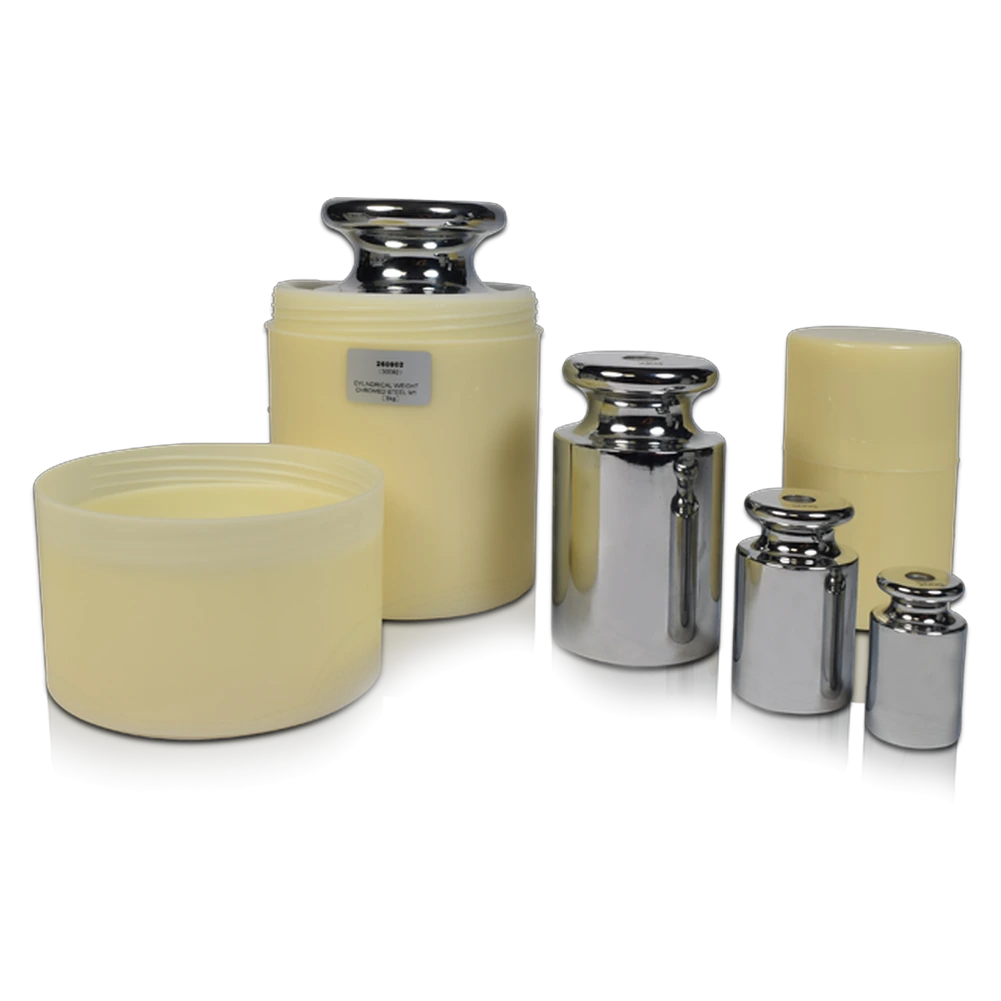
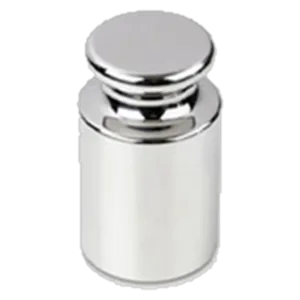
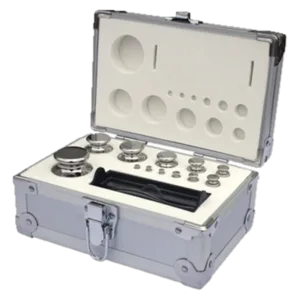
Class F1 standard weight in chrome-plated brass
Do you need a reliable metrological reference at a reasonable cost to check your precision balances? The class F1 standard weight in chrome-plated brass is the recommended solution for laboratories, industry, pharmacy and quality control centres that require accurate and repeatable weighing results without resorting to the higher, more expensive classes.
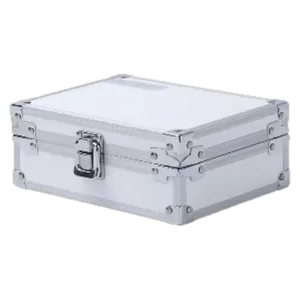
At Cahnos we supply it as an individual weight with case in the nominal value you need, from 1 g to 20 kg, with the option of adding an ENAC calibration certificate to ensure official traceability of your weighing process.
Technical explanation
Standard weights are reference masses used to calibrate and verify weighing instruments. Class F1 occupies the third step of precision on the OIML R111 scale (behind E1 and E2) and offers tolerances approximately five times stricter than class M1, making it the most commercially balanced choice for precision balances with a readability of 0.1 g to 0.01 g.
Chrome-plated brass provides good mass stability and corrosion resistance at a reduced cost, ideal conditions for frequent use in laboratory and production environments. Each weight has its nominal value marked and conforms to the maximum permissible errors set by the international recommendation OIML R111 for class F1. To preserve its class, it is recommended to handle it with gloves, forceps or a technical cloth and keep it in its case when not in use.
Technical specifications
| Field | Detail |
|---|---|
| Description | Individual class F1 weight, in chrome-plated brass. |
| Family | Standard weights — Class F1 |
| Typical use | Precision balances |
| Usual material | chrome-plated brass |
| Case | Yes |
| Class | Description | Available nominal values |
|---|---|---|
| F1 | High precision | 1 mg – 10 kg (references available up to 20 kg) |
| Nominal value | Maximum permissible error (±) |
|---|---|
| 1 g | ± 0.5 mg |
| 2 g | ± 0.6 mg |
| 5 g | ± 0.8 mg |
| 10 g | ± 1.0 mg |
| 20 g | ± 1.2 mg |
| 50 g | ± 1.6 mg |
| 100 g | ± 2.0 mg |
| 200 g | ± 2.5 mg |
| 500 g | ± 4.0 mg |
| 1 kg | ± 5.0 mg |
| 2 kg | ± 10 mg |
| 5 kg | ± 25 mg |
| 10 kg | ± 50 mg |
| 20 kg | ± 100 mg |
| Capacity | Case | Description |
|---|---|---|
| 1 g | Yes | Individual weight |
| 2 g | Yes | Individual weight |
| 5 g | Yes | Individual weight |
| 10 g | Yes | Individual weight |
| 20 g | Yes | Individual weight |
| 50 g | Yes | Individual weight |
| 100 g | Yes | Individual weight |
| 200 g | Yes | Individual weight |
| 500 g | Yes | Individual weight |
| 1 kg | Yes | Individual weight |
| 2 kg | Yes | Individual weight |
| 5 kg | Yes | Individual weight |
| 10 kg | Yes | Individual weight |
| 20 kg | Yes | Individual weight |
Regulations and documentation
| Aspect | Detail |
|---|---|
| Reference standards | OIML R111 |
| Optional documentation | ENAC calibration certificate |
Equivalences and cross-references
The OIML R111 class scale orders standard weights from highest to lowest precision: E1, E2, F1, F2, M1, M1-2, M2, M2-3 and M3. Class F1 is directly comparable to the class F1 standard mass series of the main weighing instrument manufacturers on the market (Kern, Sartorius, Ohaus, Adam Equipment, Radwag, PCE, Troemner and similar), as well as to the specifications of the ASTM E617 standard when the customer works with that standard.
Within the Cahnos catalogue, this chrome-plated brass reference (PESA-F1LATON) is the most economical alternative to the F1 version in stainless steel (PESA-F1INOX), recommended when lower magnetic susceptibility and greater corrosion resistance are required. For higher metrological demands in analytical balances, the E2 class in stainless steel (PESA-E2INOX) is available; for verification of scales, the M1 classes in chrome-plated brass and cast iron (PESA-M1LATON, PESA-M1HIERRO) and the M2 class in chrome-plated brass (PESA-M2LATON) for frequent industrial control.
Selection tips and variants of interest
- Select the nominal value according to the usual calibration points of your balance: it is recommended to verify at least with weights close to 10%, 50% and 100% of the equipment’s capacity.
- A precision balance with a readability of 0.1 g or 0.01 g is correctly calibrated with class F1 weights; for analytical balances of 0.1 mg or less, consider class E2 or E1.
- If your process requires audits or official traceability to national standards, request the weight with an ENAC calibration certificate: each piece is issued with its conventional mass value, expanded uncertainty (k=2) and corrections.
- Always handle the weight with gloves, forceps or a technical cloth, avoid manual contact and keep it in its case when not in use to preserve its precision class.
- For complete control, combine several individual weights of this same reference or complete your purchase with the precision balance suitable for your workload.
Reviews
There are no reviews yet.