
Description
1. Introduction
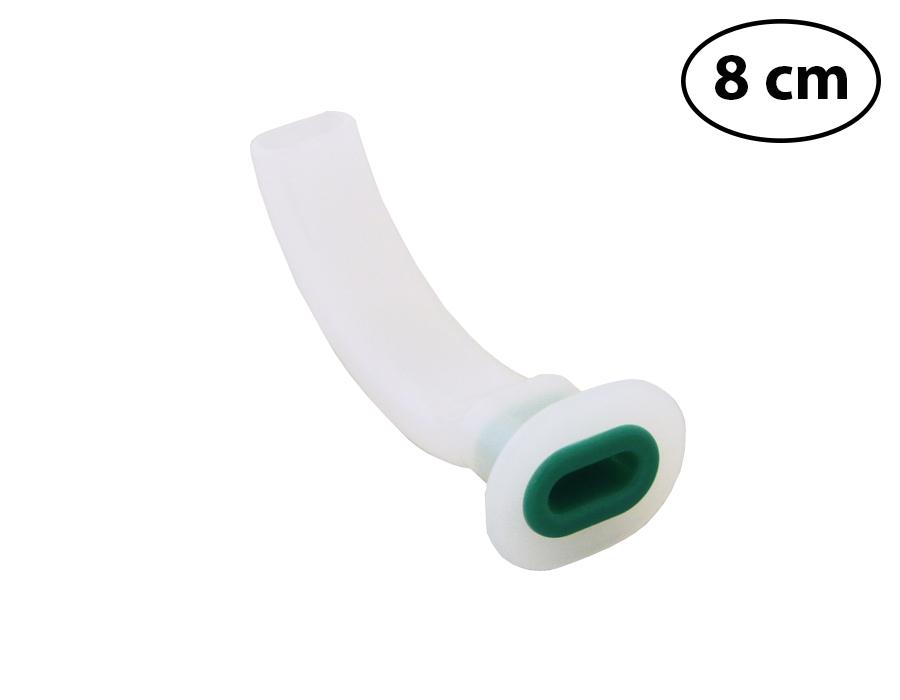
The 8 cm Guedel oropharyngeal cannula (ref. 5002 / BRL5002) is an essential airway device for basic respiratory management in adult patients with loss of consciousness, deep sedation or general anaesthesia. Thanks to its anatomical design in semi-rigid polyethylene, sterile, single-use and latex- and phthalate-free, it prevents the tongue and soft tissues from collapsing against the pharyngeal wall, ensuring a patent airway throughout the procedure. It is the ideal solution for emergency departments, intensive care, anaesthesia, cardiopulmonary resuscitation and medical transport.
2. Technical explanation of the device
The Guedel oropharyngeal cannula (also known as a Mayo tube) is a curved semi-rigid tube inserted through the mouth into the oropharynx. Its anatomical curvature mirrors the morphology of the palate and pharynx, separating the tongue from the posterior pharyngeal wall and keeping the upper airway open in patients who cannot maintain it themselves. The central channel with lateral reinforcements ensures a continuous and stable airflow, while also allowing suction of secretions, and the integrated bite block protects the device from occlusion by bite pressure.
Being a sterile, single-use product, it prevents cross-contamination between patients. It should only be used in unconscious patients or those with a depressed level of consciousness, and never in conscious patients with a gag reflex. The 8 cm (80 mm) size corresponds to the adult airway range, usually indicated for adult patients of medium build.
3. Technical Specifications
| Parameter | Specification |
| Designation | Guedel oropharyngeal cannula (oropharyngeal airway) |
| Available references | 5002 / BRL5002 |
| Manufacturer | Boscarol |
| Length / size | 8 cm (80 mm) |
| Minimum internal diameter (I.D.) | 4.5 mm |
| Material | Polyethylene (PE), latex- and phthalate-free |
| Sterility | Yes, sterile single-use device |
| Function | Maintain the patency of the oropharyngeal cavity |
| Use | Single-use (disposable), prevents cross-contamination |
| Indication | Oropharyngeal airway in adult patients |
| Applications | Emergency care, anaesthesia, ICU, CPR and medical transport |
| Regulatory standard | Medical device with CE marking |
Range of available sizes (oropharyngeal cannulas):
| Reference | Length | Minimum I.D. |
| BRL5000 | 6 cm | 4.0 mm |
| BRL5001 | 7 cm | 4.0 mm |
| BRL5002 | 8 cm | 4.5 mm |
| BRL5003 | 9 cm | 4.5 mm |
| BRL5004 | 10 cm | 5.0 mm |
| BRL5005 | 11 cm | 5.5 mm |
4. Equivalences and Cross-References
The references 5002 (original manufacturer code and BRL5002 (SKU Cahnos) correspond to the same product, thus constituting a direct equivalence, without transcriptions or modifications. There is no official equivalence table validated by the manufacturer against other commercial brands for this reference; consult our technical department before use in tenders or direct substitution.
In terms of functional comparison by length, the 8 cm (80 mm) size follows the length coding system used by most manufacturers of Guedel-type oropharyngeal cannulas, making it comparable (not interchangeable 1:1) with equivalent adult-size cannulas from other manufacturers, provided that the length in millimetres, material, sterility and bite block design are verified. The Cahnos catalogue also offers the adjacent sizes of the sterile oropharyngeal cannula family (refs. BRL5000, BRL5001, BRL5003, BRL5004 and BRL5005) to complete the airway trolley stock.
5. Selection tips and variants of interest
To choose the correct oropharyngeal cannula size, measure the distance between the corner of the mouth and the angle of the patient’s mandible: the cannula length should approximate this distance without exceeding it. The 8 cm (80 mm) size fits oropharyngeal airways of adult patients of medium build; for smaller patients consider the lower sizes in the range (6 and 7 cm, refs. BRL5000 and BRL5001) and for larger patients the higher sizes (9 to 11 cm, refs. BRL5003 to BRL5005).
It is recommended to lubricate the cannula before insertion and place it with a 180-degree rotation to minimise trauma; the device should only be used in unconscious patients or those with a depressed level of consciousness, never in conscious patients with a gag reflex. Consult our technical-commercial team for volumes, supply conditions and configuration of airway kits adapted to your anaesthesia, emergency, ICU or medical transport service. For large orders you can request a quote.

Reviews
There are no reviews yet.