

Description
1. Introduction
The Premisut Mesh Regular surgical mesh of 15 x 30 cm (Ref. PPMR1530) is a tissue reinforcement implant made of non-absorbable colourless polypropylene, designed for surgeons and purchasing departments that need a standard-density mesh (80 g/m²), reliable and with an excellent price-quality ratio for abdominal wall repair and hernia treatment.
Its monofilament woven structure, laser cutting and multidirectional mechanical properties make it a robust solution for both open and laparoscopic techniques, with the guarantee of a sterile single-use product and the specialised technical support of Cahnos.
2. Technical Explanation
The mesh is manufactured from 100% monofilament extruded polypropylene, a biostable polymer that is neither absorbed nor degraded by the enzymatic action of tissue: the reinforcement remains permanently in the body, offering permanent tensile strength.
The fabric interlaces the fibres in multiple directions, providing bidirectional elasticity and a balanced distribution of loads over the abdominal wall. This construction allows the mesh to be cut and adapted to the shape and size of the defect without unravelling. The laser cut seals the edges and prevents fraying, ensuring a precise shape. Its pore size of 0.5 x 0.7 mm favours controlled tissue integration, allowing fibrous tissue growth through the interstices.
It is mainly indicated for abdominal wall reinforcement and the treatment of inguinal, femoral, umbilical and ventral hernias, in both open and laparoscopic surgery. It is supplied sterile by ethylene oxide; do not re-sterilise and always consult the instructions for use (IFU) before implantation.
3. Technical Specifications
| Reference | PPMR1530 |
| Dimensions | 15 x 30 cm |
| Material | Extruded monofilament polypropylene, colourless and non-absorbable |
| Structure | Uncoated fabric, natural white colour, laser cut |
| Pore size | 0.5 x 0.7 mm |
| Weight | 80 g/m² |
| Elongation | 89 % |
| Thickness | 0.50 mm |
| Maximum force | 25 kgf |
| Tensile strength | Permanent, non-absorbable due to its technical characteristics |
| Sterilisation | Ethylene oxide (EO). Do not resterilise |
| Use | Single-use, individual sterile pouch |
Indications: abdominal wall reinforcement and treatment of inguinal, femoral, umbilical and ventral hernias. Suitable for open and laparoscopic techniques.
4. Equivalences and Cross-References
There is no official cross-reference table validated by the manufacturer for this mesh. The references indicated below are functional category comparisons (same product type and general clinical indication, with verifiable technical differences) and are not interchangeable 1:1: before substituting in a tender or protocol, they must be validated field by field and the official technical data sheets of each manufacturer must be consulted.
| Manufacturer / Brand | Family / Model | Code / SKU | Equivalence level | Technical differences / Remarks |
| B. Braun | Premilene® Mesh | 1064435 (15×15) / 1064455 (30×30) / 1064495 (10×15) | Comparable by category, not interchangeable 1:1 | Non-absorbable monofilament polypropylene for hernia repair; higher density: 82 g/m², pore 0.8 mm, thickness 0.48 mm. No 15×30 format in the standard catalogue. |
| Johnson & Johnson MedTech (Ethicon) | PROLENE® Polypropylene Mesh | PML (30×30) / PMI (8×15); 15×30 code pending confirmation | Comparable by category, not interchangeable 1:1 | Non-absorbable monofilament polypropylene for inguinal and ventral hernia; weight above 95 g/m²; verify weight, pore and format in official technical data sheet |
| Medtronic (Covidien) | Parietene™ Macroporous Mesh | PPM1515 (15×15) / PPM1510 (15×10); 15×30 code pending confirmation | Comparable by category, not interchangeable 1:1 | Two-dimensional macroporous monofilament polypropylene mesh, extraperitoneal placement according to IFU; verify weight, pore and dimensions in the official technical data sheet |
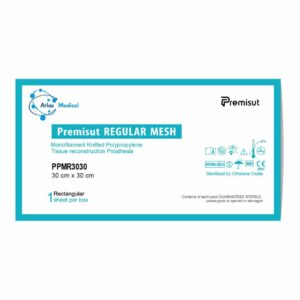
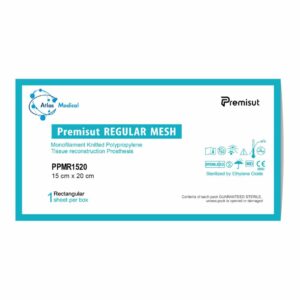
| Cahnos | Premisut Mesh Regular (same range, other sizes) | PPMR1520 / PPMR2030 / PPMR3030 | Range equivalence with identical specifications, different size | Same line: 80 g/m², pore 0.5 x 0.7 mm, thickness 0.50 mm and maximum force 25 kgf; only the dimensions change |
| Cahnos | PremisutMesh Lite 15×30 | PPML1530 | Comparable by category, not interchangeable 1:1 | Same 15×30 size, but light line: 45 g/m², pore 1.3 x 1.0 mm, thickness 0.43 mm and maximum force 19 kgf |
Fields to check before any substitution: exact dimensions, weight (g/m²), pore size, thickness, structure (monofilament/multifilament), coating, single-use, CE/MDR classification and sterilisation method. There is no equivalence table validated by the manufacturer; consult the technical department before use in a tender.
5. Selection tips and variants of interest
The 15 x 30 cm format is a versatile size that covers bilateral inguinal hernias, medium-sized abdominal wall defects and repairs requiring generous overlap over healthy tissue (an overlap of 3 to 5 cm is recommended for ventral or incisional hernia). For smaller defects, the same Premisut Mesh Regular line maintains identical specifications (80 g/m², pore 0.5 x 0.7 mm, thickness 0.50 mm, maximum force 25 kgf) in other formats: PPMR611 (6×11), PPMR7,515 (7.5×15), PPMR1015 (10×15), PPMR1215 (12×15), PPMR1515 (15×15) and PPMR1520 (15×20).
If the centre’s protocol prefers a lighter, macroporous mesh to reduce the sensation of a foreign body, the alternative within the Cahnos catalogue is the PremisutMesh Lite line (45 g/m², pore 1.3 x 1.0 mm), also available in 15 x 30 cm (Ref. PPML1530). Remember that this mesh must not be used in direct contact with viscera (intraperitoneal route) and that fixation will be performed with sutures or staples at the surgeon’s discretion, always following the manufacturer’s IFU.
Reviews
There are no reviews yet.