
Polyglactin 910 sutures for ophthalmic surgery
In this category we bring together polyglactin 910 (PGLA) sutures specifically designed for ophthalmic surgery and microsurgery procedures where precision, thread manageability and minimal tissue reaction are decisive factors. These are synthetic absorbable multifilament sutures with predictable absorption by hydrolysis — generally between 56 and 72 days — and a tensile strength retention profile perfectly studied to accompany the healing of delicate tissues without compromising the safety of the closure. The professional buyer will find here a curated selection of references oriented to ophthalmology, with needle geometries adapted to the eye and adjacent structures, fine USP gauges and different thread lengths, designed for both hospital operating theatres and private clinics and ophthalmology services that demand a regular, traceable supply with consistent quality across batches.Main applications and variety:PGLA sutures with Micropoint spatula needle (¼ circle): double-needle references and very fine gauge (USP 5/0 and similar), designed for anterior segment surgery, conjunctiva, eyelid and microsurgery where the flat needle facilitates passage through low-resistance tissues.PGLA sutures with cylindrical Taperpoint needle (½ circle): presentations of HR 36 mm and HR 48 mm, in USP 0 and USP 1 gauges, indicated for closure of tissue planes, ligatures and tissue approximation in ophthalmic and periocular procedures.Variety of gauges and thread lengths: options in violet and colourless thread, with lengths of 45 cm, 70 cm, 75 cm and 90 cm, to suit the surgical technique and the depth of the operative field.Institutional supply formats: box of 12 units with a minimum order aimed at hospital procurement, facilitating stock planning, batch rotation and recurring purchase management.
Products
Showing all 4 results
-
Sale!
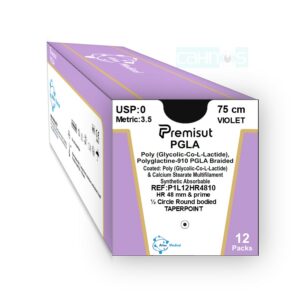
Absorbable Multifilament PGLA (Polyglactin 910) Prime Suture | 1/2 Circle Cylindrical Taperpoint Needle HR 48 mm | USP 0 Gauge | Violet Thread 75 cm | Ref. P1L12HR4810 – Box of 12 units
Original price was: 34,90 €.29,80 €Current price is: 29,80 €. In stockAdd to basket -
Sale!
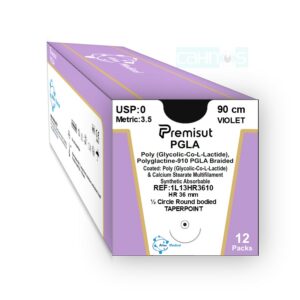
Absorbable Multifilament Suture PGLA (Polyglactin 910) | Needle ½ Circle Cylindrical Body Taper Point Taperpoint HR 36 mm | USP Gauge 0 (Metric 3.5) | Violet Thread 90 cm | Ref. 1L13HR3610 – Box of 12 units
Original price was: 34,90 €.26,10 €Current price is: 26,10 €. In stockAdd to basket -
Sale!
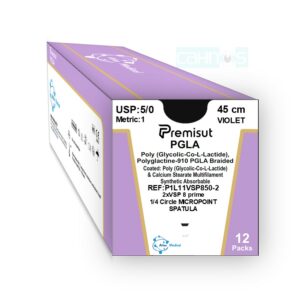
Absorbable Multifilament Suture PGLA (Polyglactin 910) PREMISUT Prime USP 5/0 · Double Needle 1/4 Circle Spatula Micropoint 8 mm · Violet 45 cm · Ref. P1L11VSP850-2
Original price was: 229,90 €.173,20 €Current price is: 173,20 €. In stockAdd to basket -
Sale!
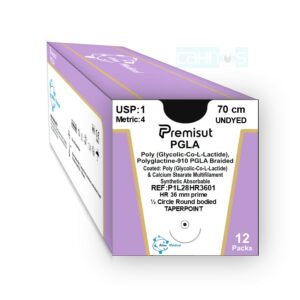
Absorbable Multifilament Suture PGLA Poliglactin 910 Premisut Prime | 1/2 Circle Cylindrical Needle Taperpoint Conical Point HR 36 mm | USP 1 Gauge (Metric 4) | Colourless 70 cm | Ref. P1L28HR3601 – Box of 12 units
Original price was: 39,90 €.32,60 €Current price is: 32,60 €. In stockAdd to basket
The choice of the appropriate suture in ophthalmic surgery depends on several criteria that should be reviewed before placing the order: the USP gauge required according to the tissue to be sutured (from very fine references USP 5/0 for microsurgery to USP 0–1 gauges for more consistent planes), the geometry and size of the needle (Micropoint spatula for flat and delicate tissues, or cylindrical Taperpoint for deeper passages), the length and colour of the thread (violet for greater visibility in the field, colourless when minimal staining is sought), and the predictability of absorption by hydrolysis, key in areas where suture removal is not viable. It is also relevant to verify the presentation — box of 12 units, sterility by ethylene oxide, reference and traceable batch — and the minimum order conditions to align the purchase with the actual operating theatre volume, avoiding both immobilised stock and supply shortages. In short, a good selection combines clinical suitability, quality consistency and a stable supply model.
If your ophthalmology department, hospital or purchasing centre needs technical advice to configure a batch of polyglactin 910 sutures adapted to your procedure portfolio, or if you require quotations for volume orders and periodic contracts, our commercial team is at your disposal to study your case, validate equivalent references and support you in planning recurring orders. Contact Cahnos and we will help you define the combination of gauges, needles and thread lengths that best suits your surgical practice and your actual consumption needs.