


Description
1. Complete and sterile kit for percutaneous airway access
The percutaneous dilatation kit Ref. TP02-65 is the complete single-use solution for establishing a safe airway quickly, minimally invasively and in a controlled manner in the critically ill adult patient. It follows the Griggs technique with forceps over a guidewire and incorporates a 8 mm tracheostomy tube with fixed cervical flange and dedicated subglottic suction lumen, a feature particularly valued in intensive care units for its contribution to the prevention of ventilator-associated pneumonia (VAP).
All the necessary material is presented in a single sterile kit, ready to use: a single order, a single code and the assurance that the team has all the instruments with complete traceability. Preparation time is reduced, the risk of forgetting material is minimised and standardisation of the procedure is facilitated in ICU, emergency departments, operating theatre and airway units.
2. Technical explanation of the equipment and procedure
Percutaneous dilatational tracheostomy (PDT) according to the Griggs technique is an evolution of the Ciaglia technique: it is performed at the bedside, usually under bronchoscopic control, without the need to transfer the critically ill patient to the operating theatre. The procedure begins with tracheal puncture using the 16 G introducer needle, continues with the passage of the J-tip guidewire (atraumatic tip that minimises tissue damage) and ends with progressive dilatation of the stoma using the Howard-Kelly dilatation forceps, which advance over the guidewire opening the orifice in a single movement, followed by advancement of the pre-mounted cannula over the introducer with locking system and conical tip, which avoids steps and maintains the position of the tube during insertion.
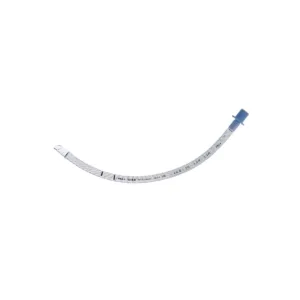
The cannula incorporates an additional subglottic suction lumen with an outlet above the balloon (cuff), which allows aspiration of secretions accumulated in the subglottic space and reduces the risk of contaminated micro-aspirations towards the lower airway. The fixed cervical flange, flexible and in transparent plastic, facilitates stable fixation and visualisation of the stoma; the balloon is low-pressure and the connector is universal 15 mm (15M), compatible with the ventilator circuit. All components are single-use, latex-free and phthalate-free.
3. Technical specifications and kit contents
Kit contents (Ref. TP02-65)
| Component | Specification |
|---|---|
| Tracheostomy tube | 8 mm tube with fixed flange and subglottic suction lumen |
| Dilatation forceps | Griggs type (Howard-Kelly), dilatation over guidewire |
| Tracheostomy tube introducer | Locking system and conical tip for safe and progressive insertion |
| Dilator | 14 Fr for progressive dilatation of the stoma |
| Guidewire | J-tip 0.05\”, NiTiNol core resistant to kinking |
| Guide catheter | For guiding the dilator and the tube |
| Safety scalpel | No. 15, with retractable shield and fixed blade |
| Syringe | 10 ml |
| Introducer needle | 16 G |
| Fixation band | Velcro-type closure |
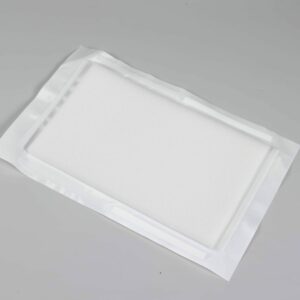
| Instrument table cover | Sterile field cover |
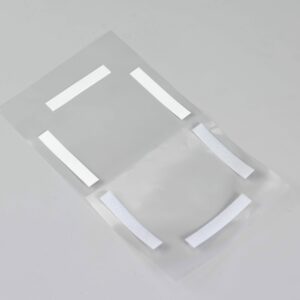
| Tracheal compress | 9 × 9 cm, three-layer foam |
| Gauze swabs | 10 × 10 cm |
| Sterile lubricating gel | Individual sachet |
Technical features of the tube
| Parameter | Specification |
|---|---|
| Internal tube diameter | 8.0 mm |
| Reference outer diameter | 11.9 mm |
| Flange type | Fixed, cervical, flexible, transparent plastic |
| Subglottic suction | Yes, integrated dedicated lumen |
| Balloon (cuff) | Low pressure |
| Connector | Universal 15 mm (15M) |
| Radiological control | Radiopaque line |
| Dilatation forceps | Included (Griggs technique) |
| Use | Single-use (disposable) |
| Sterilisation | Ethylene oxide (ETO), process validated according to EN 11135-1; desorption in accordance with ISO 10993-7 |
| Presentation | Sterile, individually packaged in TYVEK pouch in accordance with EN ISO 11607-1/2 |
| Materials | Latex-free and phthalate-free in all components |
| Regulatory classification | CE Class IIa medical device (Directive 93/42/EEC) |
| Indication | Percutaneous tracheostomy, cricothyrotomy, coniotomy or laryngotomy |
Family of Griggs kits with fixed flange at Cahnos
| Reference | Diameter | Flange | Subglottic suction | Forceps |
|---|---|---|---|---|
| TP02-67 | 7 mm | Fixed | No | Yes |
| TP02-68 | 8 mm | Fixed | No | Yes |
| TP02-69 | 9 mm | Fixed | No | Yes |
| TP02-64 | 7 mm | Fixed | Yes | Yes |
| TP02-65 (this product) | 8 mm | Fixed | Yes | Yes |
| TP02-66 | 9 mm | Fixed | Yes | Yes |
| TP02-74 | 7 mm | Fixed | Yes | No |
| TP02-75 | 8 mm | Fixed | Yes | No |
| TP02-76 | 9 mm | Fixed | Yes | No |
| TP02-77 | 7 mm | Fixed | No | No |
| TP02-78 | 8 mm | Fixed | No | No |
| TP02-79 | 9 mm | Fixed | No | No |
4. Equivalences and Cross-References
The Griggs technique with dilatation forceps over a guidewire is a widely established standard in percutaneous tracheostomy. The best-known references are listed below, classified according to the level of verification achieved; none should be treated as an exact 1:1 equivalence.
- Comparable at category level: Portex kits (ICU Medical / Smiths Medical) from the GRIGGS family with Blue Line Ultra Suctionaid tube, series 100/891 (with forceps) and 100/893 (without forceps), in sizes 7.0 / 8.0 / 9.0 mm (refs. 100/891/080 and 100/893/080 for 8.0 mm). Same functional family (Griggs technique, tube with suction lumen and introducer), but different manufacturer, materials and component geometry: not interchangeable 1:1. Confirmed in authorised distributor catalogue and in ICU Medical documentation.
- Comparable at category level: TRACOE experc kit (REF 520, TRACOE) completed with tracheal cannula with subglottic suction device. Same clinical indication and subglottic suction function, different component configuration and dilatation technique: not interchangeable 1:1.
- Comparable at category level: Griggs technique kits from DEAS/ACCEX (Deaflux line) with tracheostomy tube with fixed flange or for subglottic suction. Same procedural approach and reference components, different commercial presentation: not interchangeable 1:1.
Within the Cahnos catalogue, the closest references are TP02-64 (7 mm) and TP02-66 (9 mm), which share an exact configuration (fixed flange, subglottic suction and forceps) and differ only in diameter: direct range equivalents, not interchangeable 1:1 depending on the patient. TP02-78 corresponds to the Ciaglia technique with a single dilator, not comparable for procedural purposes. There is no manufacturer-validated equivalence table that allows this reference to be cross-referenced with specific codes from other suppliers; it is recommended to consult the technical department of Cahnos before using this datasheet in a tendering or stock replacement process.
5. Selection tips and variants of interest
The cannula diameter should be chosen according to the patient’s anatomy and ventilation requirements: the 7 mm (TP02-64) variant is suitable for adults of smaller build or more limited anatomies; the 8 mm (TP02-65, this kit) is the reference calibre for adults of medium build; the 9 mm (TP02-66) is reserved for wide airways or patients with higher ventilatory flow demand.
If the patient is to require prolonged mechanical ventilation or presents abundant secretions, the subglottic suction of this series is especially recommended for its role in preventing ventilator-associated pneumonia (VAP). If the department prefers to complete the dilation with forceps under endoscopic control, keep the versions with forceps (TP02-64, TP02-65 and TP02-66); if the single-dilator sequence is chosen, there are versions without forceps (TP02-74, TP02-75 and TP02-76). For variable cervical anatomies, consult the adjustable flange series (TP02-07 to TP02-39). All kits in the family are single-use: check the integrity of the sterile packaging and the expiry date before use, and dispose of them after the procedure as healthcare waste in accordance with current local regulations.
Reviews
There are no reviews yet.