
Description
1. Introduction
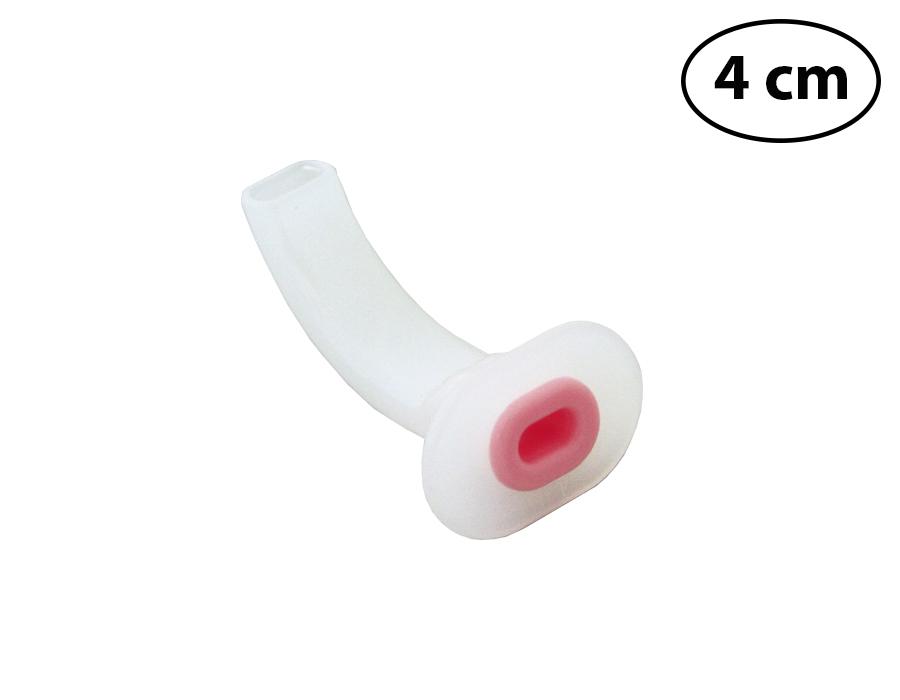
The 4 cm oropharyngeal cannula (ref. 5100 / SKU BRL5100) is a sterile, single-use medical device designed to preserve the patency of the oropharyngeal cavity in patients with loss of muscle tone, who are unconscious or under anaesthesia. Made of polyethylene and latex- and phthalate-free, it is the reliable, safe and quick-to-place solution that anaesthesia, emergency, ICU, resuscitation and medical transport services need on their airway trolley.
2. Technical explanation of the device
The oropharyngeal cannula (Guedel type) works by preventing the tongue and soft tissues from collapsing against the posterior pharyngeal wall, keeping the upper airway open in patients who cannot maintain it themselves. Its anatomical curve reproduces the morphology of the palate and pharynx, and its central channel ensures a continuous and stable airflow during ventilation with a self-inflating bag, anaesthetic induction or cardiopulmonary resuscitation. The bite block prevents occlusion of the airway by patient pressure. Being a sterile, single-use product that is latex- and phthalate-free, it prevents cross-contamination between patients and minimises the risk of allergic reactions. This 4 cm size is indicated for oropharyngeal airways of reduced length, typically young paediatric patients or small anatomies.
3. Technical Specifications
Sterile single-use medical device for maintaining the patency of the oropharyngeal airway. Its main specifications are detailed below:
| Manufacturer reference | 5100 / BRL5100 |
| Length / size | 4 cm |
| Min. inner diameter | 2.5 mm |
| Material | Polyethylene (PE) |
| Sterility | Sterile, single-use |
| Latex-free | Yes |
| Phthalate-free | Yes |
| Function | Maintain the patency of the oropharyngeal cavity |
| Marking | CE-marked medical device |
4. Equivalences and Cross-References
There is no official equivalence table validated by the manufacturer for reference 5100 / BRL5100; please consult our technical department before using it in tenders or direct substitution. In terms of functional comparison by length, the 4 cm (40 mm) size follows the length coding system used by most manufacturers of Guedel-type oropharyngeal cannulas, so it is comparable (not interchangeable 1:1) with the sterile 4 cm cannula in a box of 50 units from Cahnos (ref. 5100, ISO 4) and with the Guedel cannula ISO 4 per unit (ref. 830001M). In the Cahnos catalogue, the adjacent sizes of the same family (refs. 5110, 5010, 5000 to 5005) are also available to complete the airway trolley stock. The GIMA references in 40 mm (refs. 57751 and GM34431, size 000) are equally comparable by length. Always verify the measurement, material, sterility and packaging type in the technical data sheet before substituting a reference.
5. Selection tips and variants of interest
To choose the correct oropharyngeal cannula size, measure the distance between the patient’s labial commissure and the angle of the mandible: the cannula length should approximate this distance without exceeding it. The 4 cm size fits oropharyngeal airways of reduced length (young paediatric patients); for larger patients, consider larger sizes in the range (5 to 11 cm, refs. 5010 and 5000 to 5005) or the rigid Guedel cannulas per unit (refs. 830001M to 830060M). It is recommended to lubricate the cannula before insertion and place it with a 180-degree rotation to minimise trauma; the device should only be used in unconscious patients or those with depressed consciousness, never in conscious patients with a gag reflex. Consult our technical-commercial team for volumes, supply conditions and configuration of airway kits adapted to your service.

Reviews
There are no reviews yet.