
Description
1. Introduction
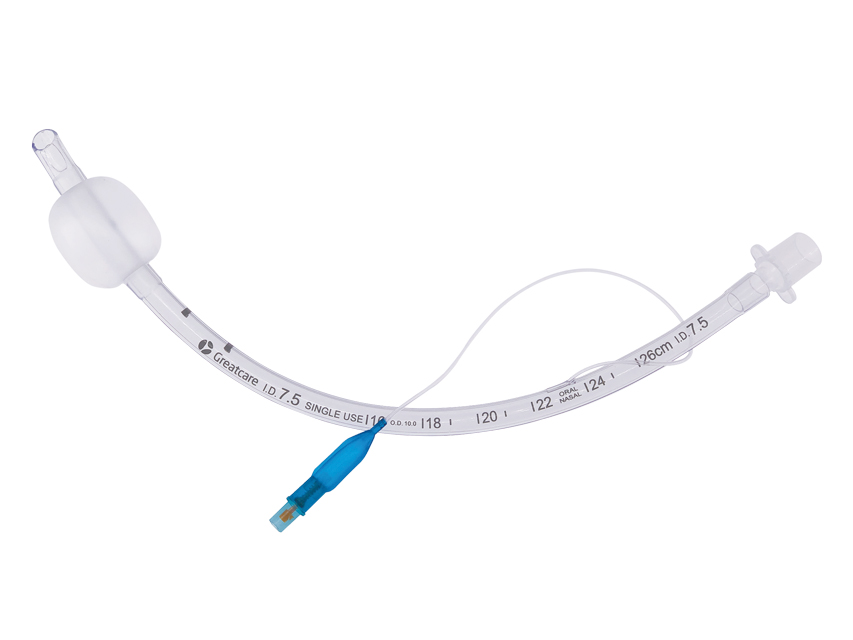
The 3.5 mm diameter cuffed endotracheal tube (reference 57651) is the airway solution that anaesthesia, emergency, paediatrics and intensive care services need to ensure positive pressure ventilation and anaesthesia administration when the use of a face mask is not feasible. Made of medical-grade thermosensitive PVC, it is supplied sterile in a box of 100 units, designed to maintain a hospital stock always available in intubation trolleys, operating theatres and ICU bays.
2. Technical explanation of the device and procedure
In orotracheal intubation, the tube is inserted orally under laryngoscopic vision, passes through the glottis and sits in the trachea, where it conducts gases from the ventilator or anaesthesia circuit to the lungs. Its reinforced wall maintains a patent lumen and ensures adequate ventilation for all types of patients, while a wide range of sizes allows a secure airway to be maintained throughout the procedure.
The high-volume, low-pressure cuff, inflated via the pilot balloon with valve, seals the tracheal lumen: it prevents gas leaks, prevents aspiration of secretions and stabilises the device during mechanical ventilation. The bull-nose rounded tip minimises trauma when advancing the tube, the smooth Murphy eyes act as an alternative ventilation route in case of distal obstruction, and the crack-resistant radiopaque line allows radiographic verification of correct placement. It is a single-use device: after each patient it must be discarded to avoid the risk of cross-infection.
3. Technical Specifications
The tube incorporates a set of features designed to offer safety and comfort in small-calibre intubation procedures:
- High-volume, low-pressure cuff, barrel shape
- Sensitive-response pilot balloon
- Finely thermowelded cuff
- Bull-nose rounded tip
- Crack-resistant radiopaque line
- Smooth Murphy eyes
- Kink-resistant thermosensitive tube
| Parameter | Specification |
|---|---|
| Manufacturer reference | 57651 |
| Diameter (Ø) | 3.5 mm |
| Tube length | 18.5 cm |
| Material | Medical-grade thermosensitive PVC |
| Cuff type | High volume / low pressure, barrel shape |
| Marking | Crack-resistant radiopaque line |
| Sterility | Yes, sterile |
| Use | Single-use, disposable |
| Presentation | Box of 100 units |
Product data
| Manufacturer | GIMA |
|---|---|
| Sales unit | Box of 100 units |
| Device type | Medical device |
| Device class | II A |
| CND | R010399 |
| EAN | 6972091920038 |
4. Equivalences and Cross-References
Reference 57651 is the manufacturer’s catalogue code (Italy) for this 3.5 mm cuffed endotracheal tube; there is no equivalence table validated by the manufacturer that authorises a 1:1 cross-reference with other brands. The following references are comparable by clinical category (not 1:1 interchangeable) and must be compared datasheet by datasheet before substitution:
- ETAN35C02 (Cahnos): Magill-type oral endotracheal tube with cuff and Murphy eye, ID 3.5 mm, box of 10 units.
- 841035 (Cahnos, ENDOSID family): 3.5 mm endotracheal tube with low-pressure balloon and Murphy eye.
- ETPO35C02 (Cahnos): preformed oral endotracheal tube with cuff and Murphy eye, ID 3.5 mm.
- ETPN35C02 (Cahnos): preformed nasal tracheal tube with cuff and Murphy eye, ID 3.5 mm.
On the market, lines such as Rüsch® AGT Oral Cuffed (Teleflex, ref. 111780035 in 3.5 mm, box of 10) or Shiley™ paediatric preformed tubes (Medtronic) respond to the same general indication, but may differ in material, length and cuff design. There is no equivalence table validated by the manufacturer; consult the technical department of Cahnos before using these references in specifications or tenders.
5. Selection tips and variants of interest
Selection by patient (usual use in clinical practice, not manufacturer specification): the 3.5 mm cuffed size is commonly used in paediatric patients approximately 3–6 years old, in small airways or in adults with a narrow airway; the final choice must be based on the service protocol and anaesthetic assessment (age, weight and estimated airway calibre).
Cuff pressure: inflate via the pilot balloon with a syringe and maintain a seal pressure of 20–30 cmH₂O (usual clinical practice range) to minimise damage to the tracheal mucosa; monitor with a manometer if available in the service.
Pre-intubation verification: check the integrity of the cuff, the patency of the Murphy eyes and the correct attachment of the connector. Variants of interest in the catalogue: if you need the same configuration in other sizes or configurations (standard oral, preformed oral, preformed nasal), the Cahnos catalogue covers the full range of cuffed endotracheal tubes in the intubation section. For hospital volume needs, consult the technical-commercial department of Cahnos for supply conditions and reference homologation.
Reviews
There are no reviews yet.