
Description
1. Product Presentation
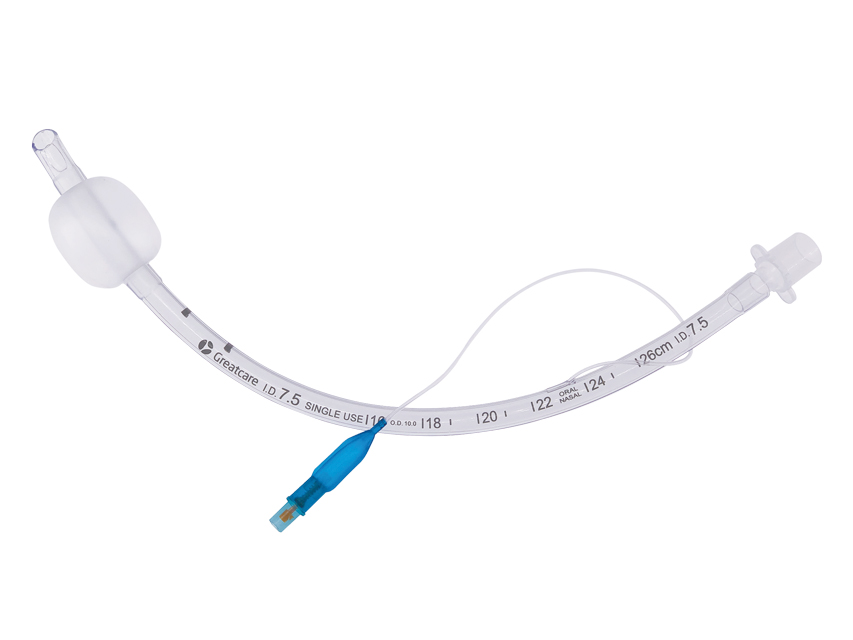
The cuffed endotracheal tube (cuffiato) of Ø 7.5 mm (Ref. 57659) is the airway solution that your anaesthesia, intensive care and emergency departments need to ensure effective ventilation in critical procedures. Made of transparent, sterile polyvinyl chloride (PVC), this single-use tube combines sturdy walls with reliable sealing thanks to its high-volume, low-pressure cuff. It is supplied in a box of 100 individually packaged units, the ideal format for hospital replenishment of the intubation trolley, operating theatre and critical care units.
2. Technical explanation of the equipment and procedure
In orotracheal intubation, the tube is inserted orally under laryngoscopic vision, passes through the glottis and sits in the trachea below the vocal cords, conducting gases from the ventilator, anaesthesia circuit or resuscitation bag to the lungs. The cylindrical high-volume, low-pressure cuff, inflated via the pilot balloon, seals the tracheal lumen, prevents gas leaks, reduces the risk of aspiration of secretions and stabilises the device during positive-pressure ventilation. Its design is intended to maintain a safe airway throughout the procedure: thermosensitive tubes resist kinking, bull-nose tips facilitate less traumatic insertion, smooth Murphy eyes act as a backup ventilation route in case of obstruction, and the radiopaque line resistant to splitting allows radiographic verification of the tube position.
3. Technical Specifications
The specifications set out below correspond to the technical data published for this reference in the manufacturer’s catalogue:
| Manufacturer reference | 57659 |
|---|---|
| Diameter | 7.5 mm |
| Tube length | 31.5 cm |
| Material | Polyvinyl chloride (PVC) |
| Sterility | Sterile |
| Use | Single-use |
| Sleeve | Cylindrical, high-volume, low-pressure, with sensitive pilot balloon |
| Tip | Bull-nose tip |
| Murphy eye | Yes, smooth |
| Radiopaque line | Resistant to splitting |
| Resistance | Thermosensitive tube, resistant to kinking; sturdy walls that ensure adequate ventilation |
| Sales unit | Box of 100 units |
Product data
| Manufacturer | GIMA |
|---|---|
| Sales unit | Box of 100 units |
| Device type | Medical device |
| Device class | II A |
| CND | R010399 |
| EAN | 6972091920113 |
Key features from the manufacturer’s catalogue: cylindrical high-volume, low-pressure cuffs, sensitive pilot balloons, finely heat-sealed cuffs, bull-nose tips, radiopaque lines resistant to splitting, smooth Murphy eyes and thermosensitive tubes resistant to kinking. A range of sizes ensures the maintenance of a safe airway throughout the surgical procedure.
4. Equivalences and Cross-References
No equivalence table validated by the manufacturer is available for reference 57659 in the official sources consulted. This cuffed endotracheal tube of Ø 7.5 mm falls within the functional category of oral PVC cuffed tubes with a high-volume, low-pressure cuff and Murphy eye for adult patients, comparable to market families such as those from Teleflex (Rüsch®/Sheridan®), Medtronic (Shiley™), ICU Medical (Portex®), Intersurgical (InTube™) or Asid Bonz (ENDOSID®). Before substituting or using this reference in tenders, verify field by field (diameter, length, cuff type, presence of Murphy eye, material and regulatory classification) against each manufacturer’s technical data sheet and consult the technical department of Cahnos.
5. Selection tips and variants of interest
The 7.5 mm diameter is one of the sizes commonly used in adult patients; as a general clinical practice guideline (not a manufacturer specification), sizes from 7.0 to 8.5 mm are used in adults depending on body habitus and airway assessment, always selecting the largest size compatible with the patient’s anatomy. The cuffed tube is particularly indicated when an airtight seal is required for positive-pressure ventilation, prolonged ventilation or general anaesthesia. Before intubation, check the integrity of the cuff, pilot balloon and valve, the patency of the Murphy eye and the correct anchoring of the connector. Maintain the sealing pressure within the usual clinical range (indicative 20–30 cmH₂O; confirm with the department protocol) to minimise the risk of pressure injury to the tracheal mucosa. Single-use device: do not re-sterilise or reuse; dispose of it after removal according to the centre’s healthcare waste management protocols. For volume conditions, samples or hospital supply lead times, contact the technical-commercial department of Cahnos.
Reviews
There are no reviews yet.