
Description
1. Product Presentation
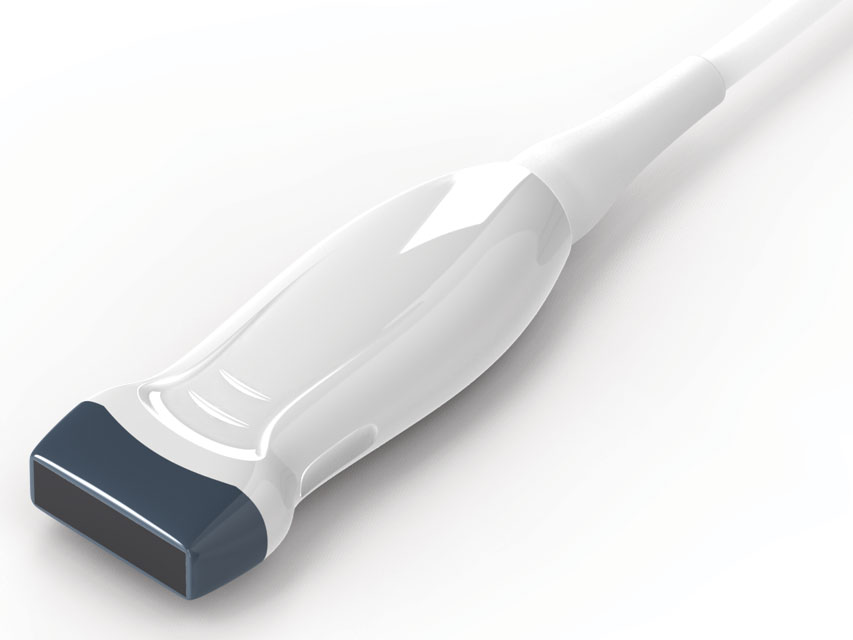
The CHISON L7S-A linear probe (ref. 33871) is the manufacturer’s original transducer designed to extend or replace the capabilities of the ECO 1/2/3/5/6 series portable ultrasound scanners. With a main frequency of 9.0 MHz and an excellent level of resolution, it is the reference option for examining superficial tissues in the diagnostic imaging practice: small parts, musculoskeletal system, vascular, paediatrics and orthopaedics. It is a verified replacement compatible with the CHISON ecosystem, ensuring perfect electrical, mechanical and software integration with the equipment, reliable image quality and a long service life.
2. Technical explanation of the probe
The linear probe emits a parallel ultrasound beam, generating a rectangular image field ideal for structures located at shallow depth. Its 30 mm contact footprint design – more compact than a conventional linear probe – makes it especially easy to handle in areas with limited access, without compromising the high resolution characteristic of high-frequency transducers. With a main frequency of 9.0 MHz and a working range of 5.3 to 11 MHz, it allows the balance between near-field spatial resolution and penetration to be adjusted according to the structure to be examined. This scanning method is preferred when the sharpness of superficial anatomical detail is decisive: glands, tendons, ligaments, nerves and superficial vessels, as well as paediatric or orthopaedic structures.
3. Technical Specifications
| Characteristic | Specification |
|---|---|
| CHISON code | L7S-A |
| Examination method | Linear (with 30 mm footprint for higher-resolution superficial tissue examinations) |
| Main frequency | 9.0 MHz |
| Frequency range (MHz) | 5.3 / 11 |
| Applications | Small parts, MSK (musculoskeletal), vascular, paediatrics and orthopaedics |
Product data
| Brand | Chison |
|---|---|
| Sales unit | 1 pc |
| Device type | Medical device (Medical device) |
| Device class | II A |
| CND | Z11040182 |
| EAN | 6945121407403 |
Compatibility
| Compatible equipment | Observations |
|---|---|
| CHISON ECO 1, ECO 2, ECO 3 | ECO series portable ultrasound scanners |
| CHISON ECO 5 and ECO 6 | ECO 1/2/3/5/6 series models for which the L7S-A probe is indicated |
4. Equivalences and Cross-References
This probe is supplied under reference 33871 and is marketed on Cahnos under code GM33871, corresponding to CHISON code L7S-A; both references are interchangeable when ordering the product. It is compatible with CHISON portable ultrasound scanners of the ECO series (ECO 1, ECO 2, ECO 3, ECO 5 and ECO 6). Within the same range of probes for CHISON portable ultrasound scanners, the catalogue also includes the general linear probe L7M-A of 5.3-10 MHz (ref. 33999), the convex probe C3-A (ref. 33998), the microconvex probe MC6-A (ref. 33997), the transvaginal microconvex V6-A (ref. 33872), the transrectal R7-A (ref. 33873) and the microconvex MC3-A (ref. 33874), among others. There is no official 1:1 equivalence table with other manufacturers validated by CHISON for this specific reference; for any replacement or tender, always verify the compatibility of the transducer with your equipment in the manufacturer’s official technical data sheet.
5. Selection tips and variants of interest
Select this 9.0 MHz linear probe (L7S-A) if your practice focuses on the examination of superficial tissues: small parts, musculoskeletal system, peripheral vascular, paediatrics or orthopaedics, where near-field resolution is decisive. Always confirm that your equipment belongs to the indicated ECO series (ECO 1, ECO 2, ECO 3, ECO 5 or ECO 6) before incorporating it. If you need a wider field of view in superficial tissues, consider the general linear probe L7M-A (ref. 33999); for abdomen and deep organs, consider the convex or microconvex probe; and if you perform gynaecological or obstetric examinations, the transvaginal probe V6-A. For large orders you can request a quote: tell our technical-commercial department your application and volume and we will advise you without obligation to configure the most suitable combination of probes for your clinical needs.
Reviews
There are no reviews yet.