


Description
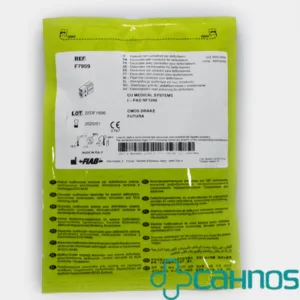
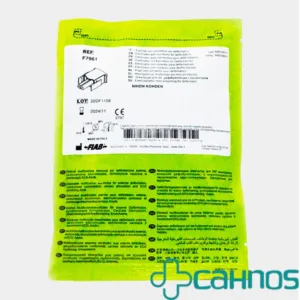
Ensure paediatric resuscitation for your automated external defibrillator with this pair of standard paediatric defibrillator electrodes with internal cable, reference Cahnos F7959P, designed for CMOS Drake equipment from the Futura series (AED Life 400 Futura). It is the clinical spare part indicated for schools, nurseries, sports centres, paediatric practices, ambulances and any heart-safe location with children present: when connecting the paediatric electrode pair, the device automatically detects child mode and limits the energy of the shock, providing safe and effective therapy for the smallest patients. It is sold as a pair (2 units) in an individual heat-sealed package that preserves the gel and the expiry date.
Technical explanation of the device and procedure
Disposable multifunction electrodes are the interface between the defibrillator and the patient: through them the device analyses the cardiac rhythm, delivers the transthoracic shock and, in many models, allows ECG monitoring. In the CMOS Drake AED Life 400 Futura, connecting the paediatric electrode pair automatically activates child mode (Kid Mode), which limits the shock to a 50 J sequence (by default 50 J – 50 J – 50 J; optional 50/70/70 J and 50/70/85 J), avoiding delivering to a child’s heart the energy intended for adults, in accordance with international cardiopulmonary resuscitation guidelines.
This variant with integrated internal cable allows a direct and secure connection to the device connector, with simple assembly: connect the connector, remove the protective liner, apply the pads following the anatomical diagrams on the packaging and the defibrillator is ready for analysis and therapy. In patients under 8 years or weighing less than 25 kg, the recommended placement is sternal-apical; if the child’s chest does not allow the two pads to be separated by at least 4 cm, place one anterior and one posterior (anteroposterior position). The low-impedance conductive adhesive gel on a medical foam backing ensures stable adhesion, uniform current distribution and a reliable signal. They are single-use: they must be replaced after each intervention or upon reaching the expiry date printed on the packaging.
Technical specifications
| Parameter | Specification |
| Reference Cahnos (SKU) | F7959P |
| Product type | Paediatric multifunction defibrillator electrode pair, standard, with internal cable |
| Brand / compatible equipment | CMOS Drake – AED Life 400 Futura (Futura model) |
| Indicated population | Children under 8 years or weighing less than 25 kg (55 lb) |
| Energy | Automatic paediatric mode: the device limits the shock to 50 J when paediatric electrodes are connected (sequences 50/50/50 J; optional 50/70/70 J and 50/70/85 J) |
| Cable | Internal (direct connection to the device connector) |
| Functions | External defibrillation, synchronised cardioversion and ECG monitoring |
| Adhesive ring width | 0.7 cm |
| Total area (per electrode) | 75 cm² (paediatric series) |
| Active area (per electrode) | 40 cm² (paediatric series) |
| Supported shocks | 50 to 100 J (paediatric series) |
| Conductive gel | Low-impedance conductive adhesive gel |
| Conductive material | Metal foil |
| Backing material | Medical foam (1 mm thick) |
| Connection type | Safety anti-shock connector / clip (depending on device model) |
| ECG monitoring | Max. 24 h |
| Use | Single-use, disposable |
| Composition | Latex-free and phthalate-free |
| Presentation | 1 pair (2 electrodes); 5 pairs per box (paediatric series) |
| Operating temperature | 0 °C to +50 °C |
| Storage | Dry place between +5 °C and +35 °C; occasional exposure from -30 °C to +65 °C (max. 7 days) |
| Shelf life | 30 months from the date of production |
| Expiry | As indicated on the packaging; do not use after the expiry date |
| Regulatory standard | Medical device class IIb (Directive 93/42/EEC); ANSI/AAMI DF-80; IEC/EN 60601-1 and 60601-2-4; ISO 10993-10 |
Technical note: the values for active surface (40 cm²), total area (75 cm²), shocks (50–100 J) and adhesive ring (0.7 cm) correspond to the standard paediatric electrode series of this product family; confirm them with the technical data sheet of the supplied batch and the device manual before use in tenders. Always check that the connector fits into the defibrillator socket before clinical use.
Equivalences and cross-references
Reference F7959P is the Cahnos distribution code for this compatible electrode; it is not an official CMOS Drake reference. The original factory reference for the paediatric electrode of the AED Life 400 Futura is LT49147 (adhesive disposable paediatric shock pads), documented in appendix A (accessories list) of the equipment’s official user manual; CMOS Drake also distributes an alternative variant under reference LT72488. CMOS Drake does not publish an equivalence table authorising the replacement of its original electrodes with third-party pads: the manual expressly warns that only original electrodes must be used so as not to compromise the patient’s ECG analysis, and the connector, originality/validity detection and energy management are proprietary. Any comparison with other brands must be understood as comparable at category level, not interchangeable 1:1, verifying connector, energy range and algorithm before any replacement.
| Manufacturer / Brand | Family / Model | Reference code / SKU | Equivalence level | Technical differences / Remarks |
| CMOS Drake (equipment manufacturer) | Adhesive disposable paediatric shock pads – AED Life 400 Futura | LT49147 (also LT72488, alternative variant) | Comparable by category (not interchangeable 1:1) | Original factory reference documented in appendix A of the official Life 400 Futura user manual; same paediatric criteria (<8 years / <25 kg) and same automatic reduction to 50 J in child mode. Check expiry date and connector fit before replacement. |
| ZOLL Medical | Pedi-Padz II (paediatric electrodes) | 8900-0810-01 | Comparable by category (not interchangeable 1:1) | Same paediatric range (0–8 years / <25 kg) with energy automatically adjusted to paediatric levels (50/70/85 J); connector, algorithm and management electronics exclusive to ZOLL (AED Plus and AED Pro). Code verified in GUDID (UDI 00847946001438). |
| Philips | Infant/Child Reduced Energy Pads (HeartStart FR2 / FR2+) | M3870A | Comparable by category (not interchangeable 1:1) | Reduces energy from 150 J to 50 J for children <8 years / <25 kg; proprietary Philips connector and algorithm, exclusive to the HeartStart FR2/FR2+ series. Code verified in GUDID (UDI-DI 00884838023734). |
| Defibtech | Lifeline AED Child / Pediatric Electrode Pads | DDP-200P | Comparable by category (not interchangeable 1:1) | Paediatric electrodes with integrated energy attenuator for children under 8 years or <25 kg; connector, algorithm and management electronics proprietary to Lifeline equipment. GUDID/FDA UDI-DI registration 00815098020430. |
| Cardiac Science (ZOLL) | Powerheart Pediatric Pads (series 9200/9300) | 9730-002 | Comparable by category (not interchangeable 1:1) | Reduced energy (~50 J) for patients under 8 years or <25 kg; connector and attenuation proprietary to the Powerheart G3 and GE Responder AED series. Code verified in GUDID. |
There is no equivalence table validated by the equipment manufacturer that cross-references the original Life 400 Futura reference with third-party electrodes; consult the Cahnos technical department before using it in a tender. Before accepting any alternative, the following must be verified one by one: equipment connector, automatic paediatric energy detection (50 J), target population (<8 years / <25 kg) and package expiry date.
Selection tips and variants of interest
Confirm the equipment model: this pair of electrodes corresponds to the AED CMOS Drake Life 400 Futura. Check the model on the equipment nameplate and the connector fit before ordering; do not use the pair in equipment of other brands with a different connector. The adult version of this same family for CMOS Drake is supplied under reference F7959.
Check the expiry date: always check the date printed on the packaging and do not use expired electrodes or electrodes with open or damaged packaging: the gel may lose conductivity and compromise the effectiveness of the shock. Store the product in a dry place between +5 °C and +35 °C.
Paediatric provision: in centres with a child population, always keep a pair of paediatric electrodes with the defibrillator, periodically check that the equipment is operational with the pads in date, and immediately replace the pair after any actual use. The equipment recognises the originality and validity of the pads and records their status in the history.
Variants within the Cahnos catalogue: for equipment from other manufacturers, the same standard paediatric series with internal cable is available in F7950P (Philips), F7951P (ZOLL), F7952P (Physio-Control / Bexen Cardio / Cardioline / Mindray) and F7958P (CU Medical Systems); for artefact-free imaging requirements, consider the radiolucent versions of the F775xP series.
Stock and tender management: establish FIFO rotation by expiry date and always replace the electrode after use or expiry. For volume orders or tenders, contact the Cahnos technical department stating the exact model and serial number of the defibrillator.
Reviews
There are no reviews yet.