
Two-part and three-part syringes: buying guide
8 products in the catalogue
The syringe is a single-use medical device. When buying, the decision with the greatest consequences is not just the volume, but the configuration: the three-part syringe includes a sealing gasket on the plunger, while the two-part syringe does without it. That difference changes the feel of the plunger and the definition of the reference.
The selection brings together two-part syringes of 2, 5, 10 and 20 ml with a Luer tip, three-part syringes of 10 ml with an eccentric tip or Luer Lock, and larger-capacity irrigation syringes with a catheter tip or Luer adapter. Before finalising an order, fix four data points: capacity, number of parts, tip type and latex-free declaration.
Other related families
-
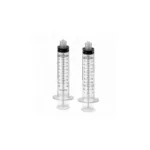 Braun Three-Part Syringes
Brings together three-part syringes, with a sealing gasket on the plunger.
-
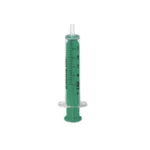 Braun Two-Piece Syringes
Groups two-part syringes, the alternative with a plunger without a separate gasket.
-
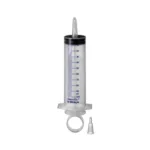 Braun Irrigation and Feeding Syringes
Concentrates syringes with a catheter tip for irrigation, a different termination from the Luer.
Products in this guide
- 2 ml 2
- 3 ml 2
- 5 ml 3
- 10 ml 3
- 20 ml 3
- 100 ml 1
- 50 / 60 ml 4
- Polypropylene 7
- Polyethylene 1
-
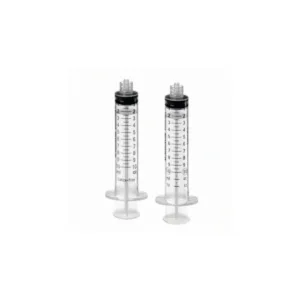
Omnifix Solo syringe B. Braun 10 ml eccentric Luer, 3-part, latex-free | Ref. 4616103V | Box of 100 units
14,50 € In stockAdd to basket -
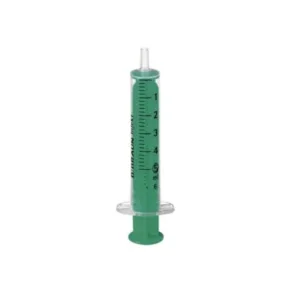
Injekt 2 ml two-piece Luer cone syringe B. Braun | Ref. 0644007 | Box of 100 sterile units
5,33 € In stockAdd to basket -
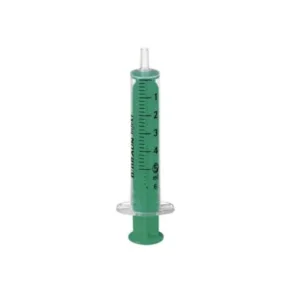
Injekt 5 ml two-part syringe central Luer cone B. Braun | Ref. 0644002 / 4606051V | Box of 100 sterile units
7,66 € In stockAdd to basket -
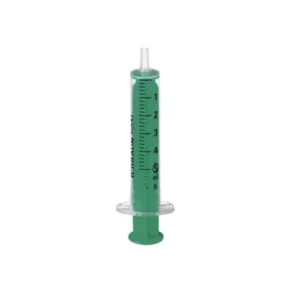
Injekt Solo 10 ml two-part Luer cone syringe B. Braun | Ref. 4606108V / 0644003 | Box of 100 sterile units
11,00 € In stockAdd to basket -
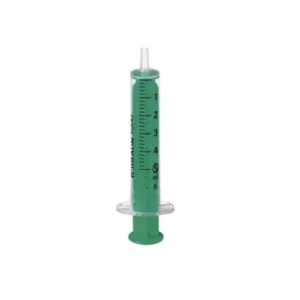
Injekt 20 ml 2-piece syringe with eccentric Luer cone B. Braun | Ref. 4606205V / 0644004 | Box of 100 sterile units
16,17 € In stockAdd to basket -
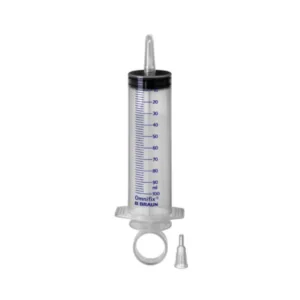
Irrigation syringe 50/60 ml with catheter tip, latex-free, B. Braun Omnifix® | Ref. 461350F
193,06 € In stockAdd to basket -
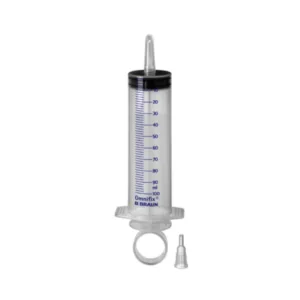
Irrigation syringe Omnifix® 100 ml with Luer adapter without latex B. Braun | Ref. 4614003F
316,45 € In stockAdd to basket -
Syringe B. Braun Omnifix® Luer Lock 10 ml, three-piece, latex-free | Ref. 4617100V | Box of 100 units
49,50 € In stockAdd to basket
Buying and selection tips
-
Fix the number of parts before the volume
The three-part syringe includes a sealing gasket that two-part syringes do not have. Decide this as a buying criterion and not as a detail in the description.
-
Match the capacity to the nominal volume
The volumes in this selection range from 2 ml to 100 ml. Check the nominal capacity and the printed scale of each reference, not just the number in the name.
-
Choose the tip type deliberately
There are concentric and eccentric tips, Luer, Luer Lock and catheter tips. Two references of the same volume with a different tip are not equivalent.
-
Require sterile and single-use, with packaging that guarantees it
The sterile and single-use status must appear in the reference's technical information. Follow the manufacturer's instructions on opening the packaging.
-
Check compatibility before ordering a large size
If the syringe is to be used in a pump, check that it appears on the pump's compatibility list. Equivalence by volume is not enough.
-
Record the latex-free status
Several references are declared latex-free. If the centre has standardised on this, state it in the order and do not infer it from the appearance of the product.
Compatibility
- Catheter tip and Luer connections
- The catheter tip is a different termination from the Luer. It should not be treated as just another Luer when pairing it with other devices.
Frequently asked questions
How do I tell a two-part syringe from a three-part one in the description?
The three-part syringe declares barrel, plunger and sealing gasket; the two-part one has no separate gasket. Check the number of parts on each reference.
What check avoids buying large-volume syringes that are unusable in an infusion pump?
Verifying that the syringe appears on the compatibility list of the specific pump. Volume alone does not establish compatibility.
Can I replace an eccentric-tip syringe with a concentric-tip one if the volume matches?
Not automatically. The position of the tip is part of the product definition; matching capacity does not make the references equivalent.
What is the difference between a Luer tip syringe and a Luer Lock one?
They are different connections and give rise to different references. State the connection type in the order.
Is it worth requiring a latex-free declaration across the whole syringe line?
Yes, if the centre has standardised on it. Asking for it in writing avoids mixing families with different compositions in the store.
Common questions
Believing that a large-volume syringe from any manufacturer works with the pump
Volume is not the criterion. Pumps are configured for specific models; outside its compatibility list, the syringe is not considered equivalent.
Thinking that the catheter tip is a Luer under another name
It is a different termination, designed for irrigation, and does not connect to the same circuit as a Luer tip.