
Buying guide: nitrile examination gloves
45 products in the catalogue
The nitrile examination glove is a single-use, ambidextrous, non-sterile glove made from synthetic rubber (NBR) instead of natural latex. It is used for examinations, handling equipment and laboratory or pharmacy tasks where a barrier against fluids and good mechanical resistance are wanted without exposing the wearer to natural latex protein.
The choice is not settled by the word "nitrile". Two gloves of the same material can differ in the acceptable quality level (AQL) for pinholes, in thickness, in cuff length, in colour, in whether they are powdered or powder-free and in the presence of vulcanisation accelerators. This guide sets out the criteria worth settling before buying and the checks that prevent substitution between products that appear equivalent.
Other related families
-
 Nitrile Gloves
The central family of this guide: it groups the single-use nitrile gloves that the buyer will compare with each other.
- Disposable Protection Covers the single-use disposable material that completes the purchase for a clinic or a laboratory.
-
 Vinyl Gloves
An alternative material, compared by performance and by intended use.
Products in this guide
- Nitrile 45
- Rubber 2
- L 17
- M 16
- S 14
- XL 14
- Box OF 100 39
- Box OF 50 5
- Box OF 200 1
- 30 cm 10
- 40 cm 1
-
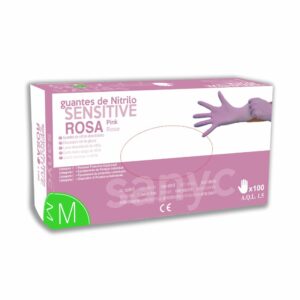
Nitrile Glove SANYC Sensitive Pink Size P (G7271) · Latex-Free · Box of 100 Units
5,16 € In stockAdd to basket -
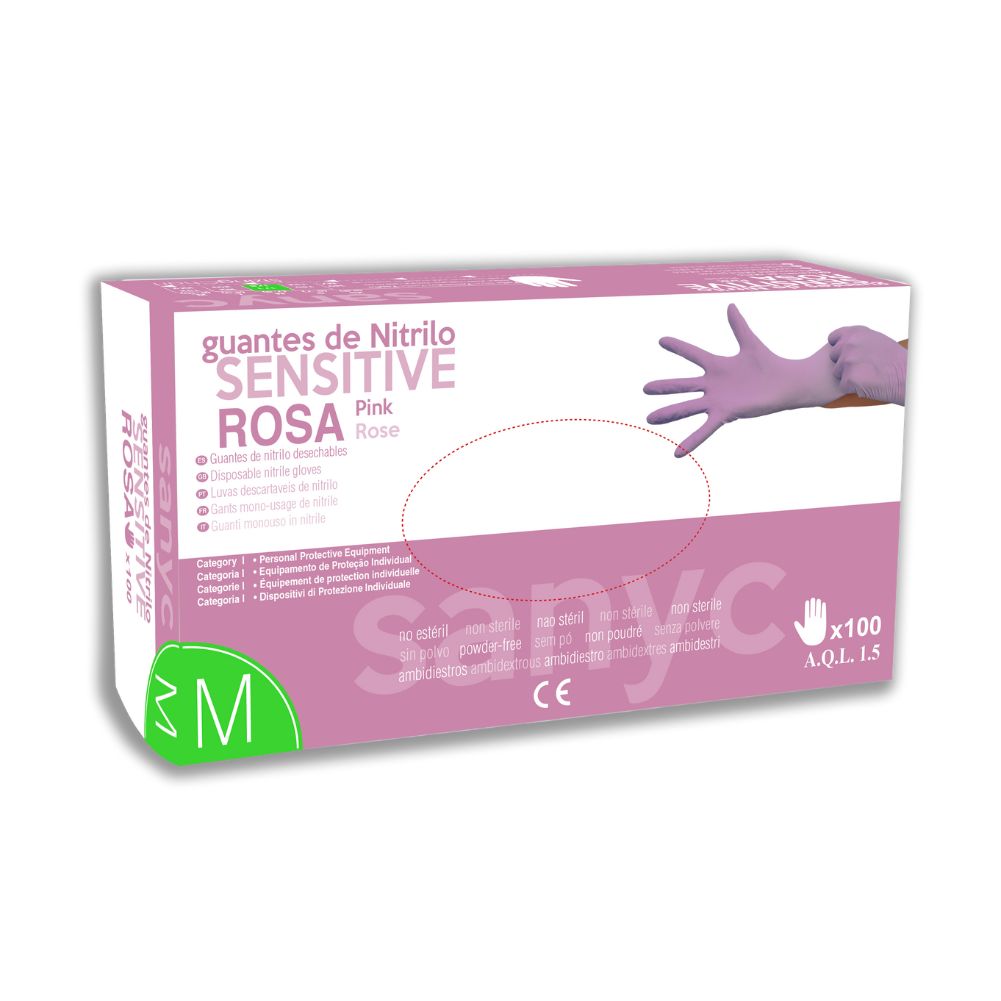
Nitrile Glove SANYC Sensitive Pink Size M (G7272) – Box of 100 Units · Latex-Free
5,16 € In stockAdd to basket -
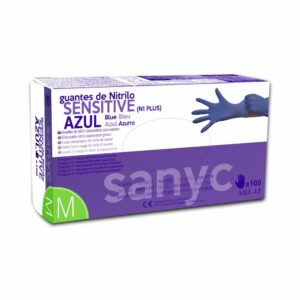
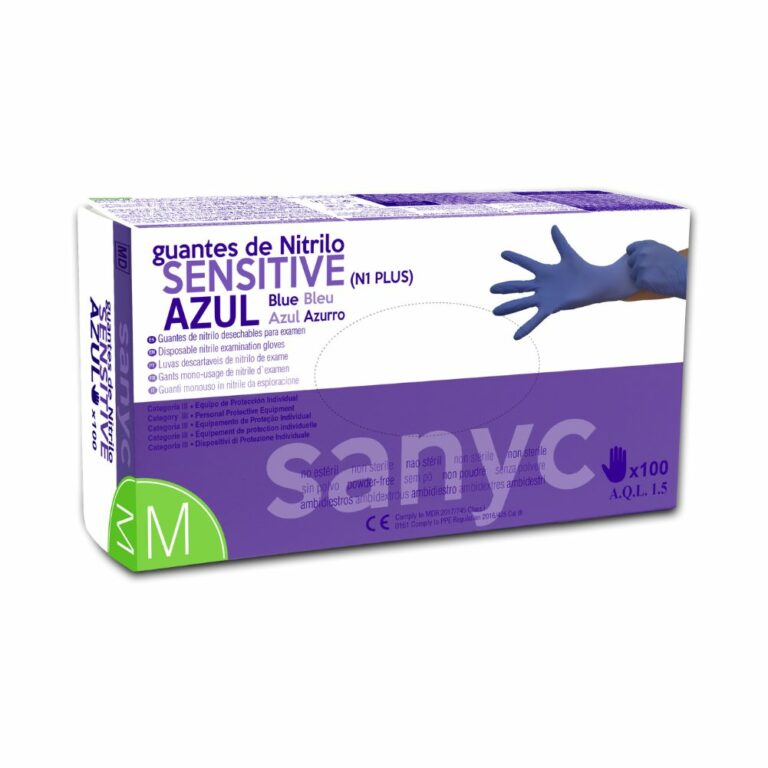
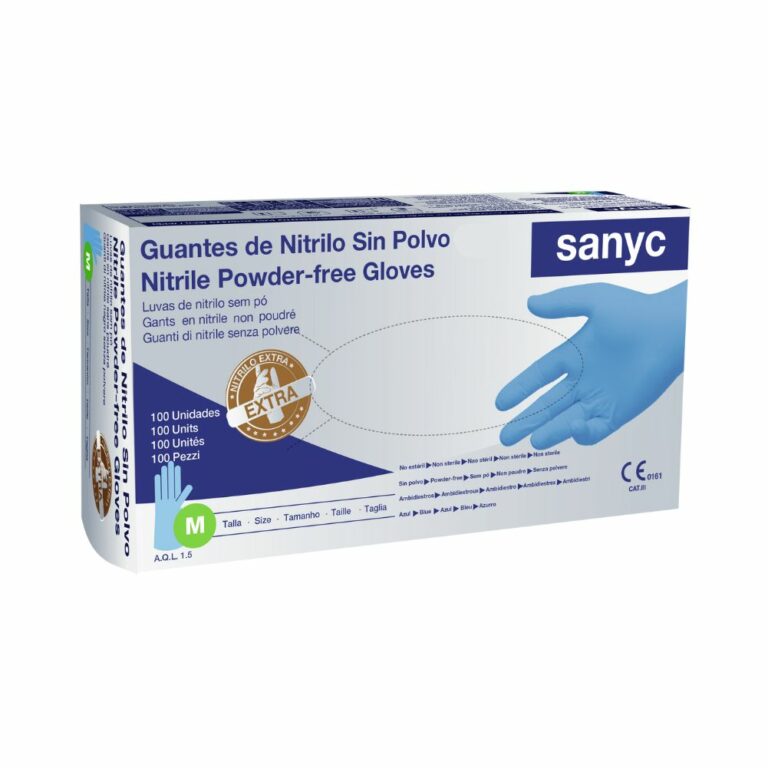
Nitrile Glove SANYC Sensitive Blue Size XP (Extra Small) · Latex-free and Powder-free · Micro-textured and Chlorinated · Box of 100 Units for Medical Examination (SKU G270)
4,48 € In stockAdd to basket -
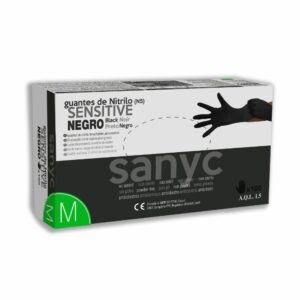
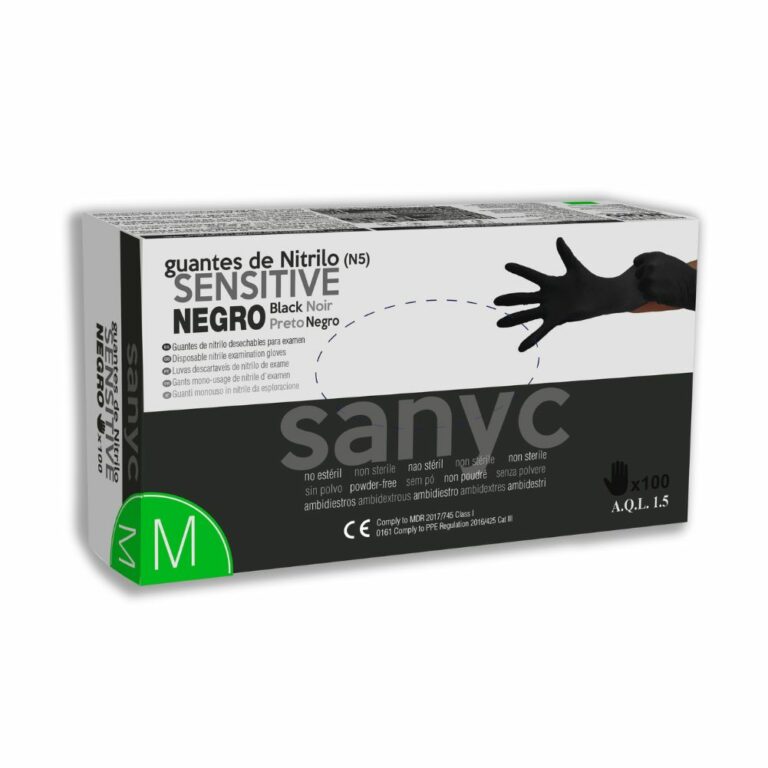
Nitrile Glove SANYC Sensitive Black Size XG for Medical Examination – Box of 100 Units, Latex-Free and High Sensitivity
4,75 € In stockAdd to basket -
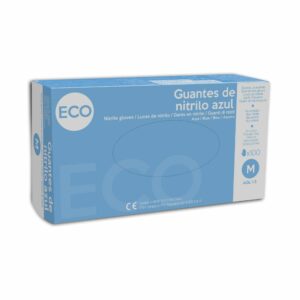
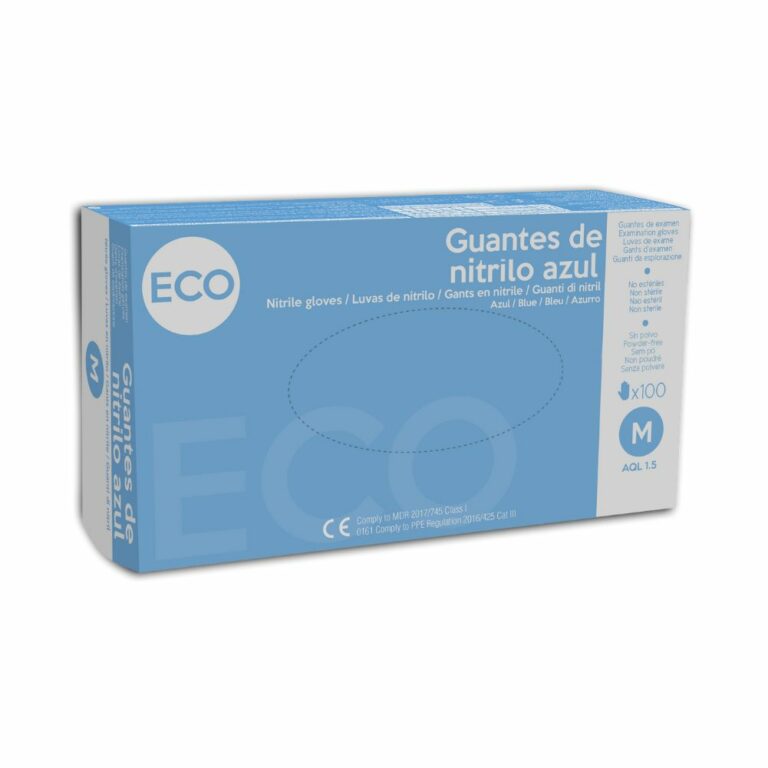
Eco Sanyc Blue Nitrile Examination Glove, Size M – Box of 100 Units, Latex-Free
4,32 € In stockAdd to basket -
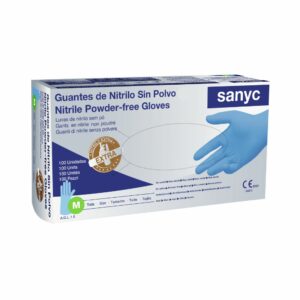
Extra Strong Nitrile Glove SANYC Blue Size G (Large) · Latex-free · Micro-textured and Chlorinated · Box of 100 Units · SKU G10002
9,92 € In stockAdd to basket -
Extra Strong Nitrile Glove SANYC Blue Size P (Small) · Latex-Free · Microtextured and Chlorinated · Box of 100 Units · SKU G10003
9,92 € In stockAdd to basket -
Extra-Strong Nitrile Glove SANYC Blue Size XG (Extra Large) · Latex-free · Micro-textured and Chlorinated · Box of 100 Units · SKU G10004
9,92 € In stockAdd to basket
Buying and selection tips
-
Settle the AQL before anything else
The pinhole criterion is the first to close: EN 455-1 requires an AQL of ≤ 1.5 for single-use medical gloves. A glove declared at AQL 2.5 under ASTM does not meet EN 455-1 without further testing, so the two values are not interchangeable. Always ask for the standard and the value.
-
Thickness in millimetres, not weight
The weight per glove is not the thickness: to compare, look at the millimetres at the palm and at the finger. Always compare both points, not a single figure, because they affect sensitivity and strength.
-
Cuff length according to the task
There are examination gloves of normal length and longer gloves, of around 30 cm. The longer the cuff, the greater the coverage, but comfort in fine tasks may change. Choose the length according to the role.
-
EN 455 and EN ISO 374 standards
A nitrile examination glove that states only EN 455 is not presented as protection against chemicals. If the task requires it, check that it also states EN ISO 374-1 and, for microorganisms, EN ISO 374-5 with the word VIRUS.
-
"Latex-free" is not "hypoallergenic"
A latex-free glove may contain vulcanisation accelerators. If there are sensitive users, look for products described as accelerator-free or sensitive type and consult the manufacturer's description.
-
Fit and size
Nitrile examination gloves are offered in sizes from extra small (XS) to extra large (XL). Measure the hand before settling the size: a poorly fitting glove tears more and is changed more often.
Frequently asked questions
Is it enough for the glove to be nitrile to protect against viruses?
No. Protection against viruses requires EN ISO 374-5 with the VIRUS mention. Without that word, the standard covers only bacteria and fungi.
How do I compare two nitrile gloves from different manufacturers?
Settle family, material, AQL, thickness, length, sizes and, where applicable, the chemical and microorganism standard. Two nitrile gloves with EN 455 are not equivalent if one adds EN ISO 374-1 and EN ISO 374-5 VIRUS.
What do types A, B and C mean on a nitrile glove?
They indicate how many substances on the test list exceed the required permeation time: type A, six or more; type B, at least three; type C, at least one. This is a detail of EN ISO 374-1, not of EN 455.
How do I choose the glove size for my department?
Measure the hand and check the fit at the palm and fingers before settling the size. An incorrect size increases tearing and consumption.
What is the difference between blue, black and pink nitrile gloves?
The colour does not determine performance: compare AQL, thickness and standards. Some colours are associated with particular ranges, such as sensitive-skin ranges.
Common questions
"Latex-free" means hypoallergenic
No. A latex-free glove may contain accelerators that cause allergy. They are two different matters and are checked separately.
Glove weight indicates its thickness
The weight per glove is not the thickness. Compare the millimetres at the palm and at the finger.
Assuming that all nitrile gloves meet the same standards
Some state only EN 455 and others add EN ISO 374. Check which standards each product states before grouping orders.
More products in this guide
-
Extra Strong Nitrile Glove SANYC Blue Size XXG (Extra Extra Large) – Box of 100 Units for Medical Examination, Latex-Free | Ref. G10006
9,92 € In stockAdd to basket -
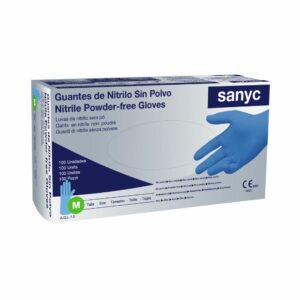
Nitrile Glove SANYC Blue Size M · Latex-Free and Powder-Free · Micro-Textured and Chlorinated · Box of 100 Units for Medical Examination (SKU G1001)
6,58 € In stockAdd to basket -
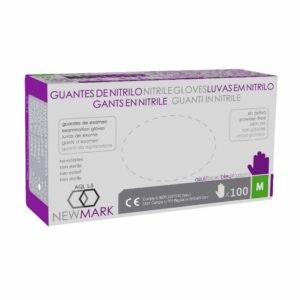
Nitrile Glove New Mark Sensitive Blue Size G (Large) for Medical Examination – Latex-Free and Micro-Textured | Box of 100 Units (Ref. G11002)
6,25 € In stockAdd to basket -
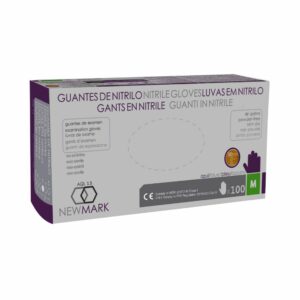
Nitrile Glove New Mark Blue 30 cm Size G (Large) – Box of 100 Units for Medical Examination, Latex-free | Ref. G110021
13,25 € In stockAdd to basket -
Nitrile Glove New Mark Sensitive Blue Size P (Small) – Medical Examination, Latex-Free and Micro-Textured | Box of 100 Units (Ref. G11003)
6,25 € In stockAdd to basket -
Nitrile Glove New Mark Blue 30 cm Size P (Small) – Box of 100 Units | Ref. G110031
13,25 € In stockAdd to basket -
Nitrile Glove New Mark Sensitive Blue Size XG (Extra Large) – Box of 100 Units | Ref. G11004
6,25 € In stockAdd to basket -
Nitrile Glove New Mark Blue 30 cm Size XG (Extra Large) – Box of 100 Units for Medical Examination, Latex-free | Ref. G110041
13,25 € In stockAdd to basket