
Description
Introduction
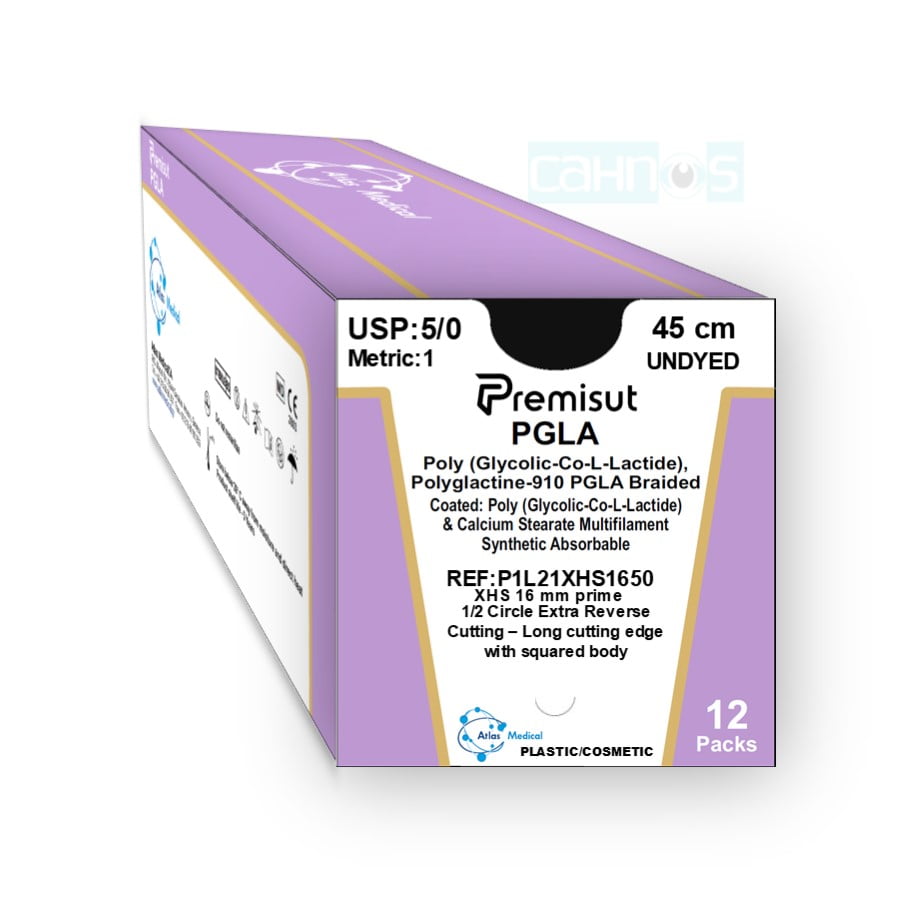
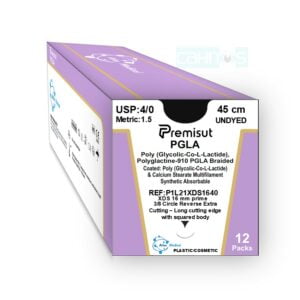
The Absorbable Multifilament PGLA Polyglactin 910 Suture from the Prime line is the trusted choice for professionals seeking the perfect balance between handling, knot security and controlled absorption. Presented with a ½ circle needle with a precision reverse cutting triangular point and a square body of 16 mm, it is designed for procedures that require clean penetration and minimal tissue resistance, both in tissue approximation and in ligatures and ophthalmic surgery.
Technical description
It is a synthetic absorbable braided (multifilament) suture made from polyglactin 910, a copolymer composed of 90 % glycolide and 10 % L-lactide. Its absorption mechanism is hydrolysis, a predictable process that does not depend on tissue enzymes and guarantees a constant mass loss between 56 and 72 days. The colourless, non-grooved thread offers a regular surface that facilitates sliding through tissue and firm knot anchorage. The XHS16 mm needle, with a reverse cutting triangular point and square body, is ideal for resistant tissues such as skin and mucous membranes, providing controlled penetration with minimal injury to the bed.
Technical specifications
| Material | Polyglactin 910 (PGLA): copolymer 90% glycolide / 10% L-lactide |
| Structure | Braided multifilament, non-grooved |
| Thread colour | Colourless (also available in violet on request) |
| USP size | 5/0 |
| Thread length | 45 cm |
| Needle shape | ½ circle |
| Needle tip | Precision reverse cutting triangular |
| Needle body | Square |
| Needle size | XHS 16 mm (extra-long precision cutting) |
| Quality | Prime |
| Sterilisation | Ethylene oxide (EtO) |
| Presentation | Box of 12 units |
| Reference | P1L21XHS1650 |
Absorption profile and tensile strength retention
| Parameter | Value |
| Absorption type | Hydrolysis |
| Absorption time | 56 – 72 days |
| Tensile strength at 2 weeks | 75 % |
| Tensile strength at 3 weeks | 50 % |
| Tensile strength at 4 weeks | 30 % |
| Tissue reaction | Minimal |
| Indications | Tissue approximation, ligatures and ophthalmic surgery |
Furthermore, this suture stands out for its minimal tissue reaction, excellent tensile strength, firm knot tying and a predictable absorption rate, making it especially useful in tissue approximation, ligatures and ophthalmic surgery.
Equivalences and cross-references
Polyglactin 910 is the most widely used multifilament absorbable material in the surgical market. This reference can be equated, according to usual clinical practice, to the braided absorbable polyglactin 910 lines of the main international manufacturers. In the Cahnos catalogue, the stock version of this same presentation corresponds to reference AMP1L21XHS1650. As alternatives of the same material with other configurations, P1L21XHS1640 (same XHS16 needle in gauge 4/0), P1L21XDS1650 (3/8 needle, reverse cutting XDS16, 5/0) and P1L21XNS1650 (3/8 needle, conventional cutting XNS16, 5/0) stand out. For needs of greater thread length, reference P1L22DS1650 (3/8, DS16, 5/0, 75 cm) can be considered. For faster reabsorption applications, the Rapid lines of the same family are available.
Selection tips and variants of interest
The ½ circle needle with a precision reverse cutting point and square body is especially recommended for firm or difficult-to-penetrate tissues, where control and high puncture capacity are required without tearing. For smaller spaces or superficial suture planes, the 3/8 variant (XDS or XNS) can be considered. If the healing plan requires longer tensile support, consult our absorbable monofilament polydioxanone lines; if faster absorption is sought, request advice on the Rapid range. For high visibility conditions in the field, the same reference is available in violet on request. Contact our technical-commercial team to optimise your order by boxes and benefit from special B2B conditions.
Reviews
There are no reviews yet.