
Description
1. Commercial Introduction
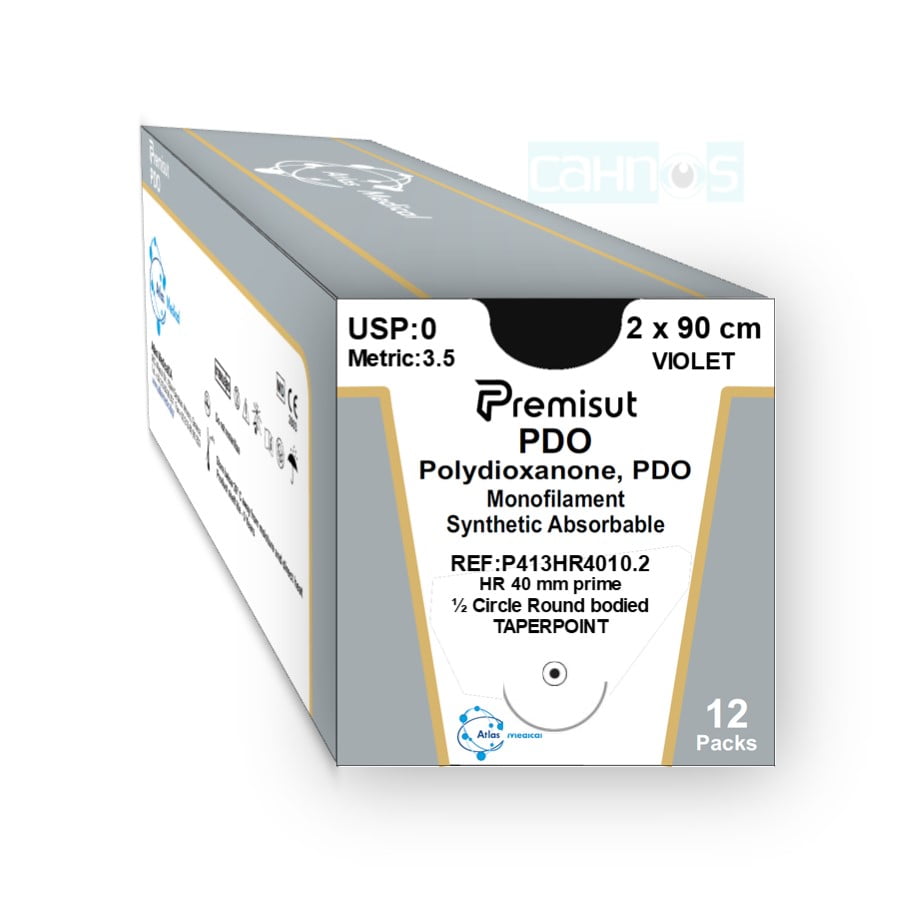
If you are looking for a long-lasting absorbable suture with exceptional handling and a smooth, atraumatic needle pass, this Polydioxanone (PDO/PDS) monofilament suture is the trusted choice for your operating theatre service. Made from poly(p-dioxanone), it offers predictable absorption, minimal tissue reaction and prolonged tensile strength retention that supports tissue healing during the first weeks. It is supplied with a ½ circular cylindrical needle with a 40 mm grooved taperpoint (HR40), USP 0 gauge, and two 90 cm threads in violet, in a box of 12 units. An excellent technical and commercial solution for purchasing centres and hospital tenders.
2. Technical Explanation
Polydioxanone is a synthetic polyester that is absorbed by hydrolysis, without depending on tissue enzymes, which guarantees a uniform and predictable degradation kinetics in all patients. Being monofilament, it has low friction and lower microorganism uptake compared with braided sutures, facilitating a clean passage through tissue. It maintains approximately 75 % of its tensile strength at 2 weeks, 60-70 % at 4 weeks and 45 % at 8 weeks, with complete absorption between 180 and 210 days. The cylindrical body needle with grooved taperpoint is designed to pass through soft tissues with minimal trauma, ideal for anastomoses and delicate tissues, including paediatric cardiovascular tissue and ophthalmological procedures.
3. Technical Specifications
| Characteristic | Specification |
|---|---|
| Material | Polydioxanone (PDO/PDS) – poly(p-dioxanone) |
| Structure | Synthetic absorbable monofilament |
| Absorption mechanism | Hydrolysis, 180–210 days |
| Tensile retention | 75% (2 weeks) / 60–70% (4 weeks) / 45% (8 weeks) |
| Needle shape | 1/2 circle |
| Needle body | Cylindrical (round body) |
| Needle tip | Taperpoint |
| Needle size | 40 mm (HR40) |
| Gauge (USP) | 0 |
| Thread length | 2 x 90 cm |
| Colour | Violet |
| Sterilisation | Ethylene oxide (EO) |
| Presentation | Box of 12 units |
Reference identification: the factory reference is P413HR4010.2 (equivalent to our SKU AMP413HR4010.2): P413 = PDO/PDS line with cylindrical taperpoint needle, HR40 = ½ circle 40 mm needle, 10 = USP 0 gauge, .2 = double 90 cm thread.
4. Equivalences and Cross-References
Polydioxanone is a global standard in long-lasting absorbable monofilament sutures; the main manufacturers have homologous families. The only cross-reference verified against a public source at the time of writing this data sheet is detailed below:
| Manufacturer / Brand | Family / Model | Reference Code / SKU | Equivalence Level | Technical Differences / Remarks |
|---|---|---|---|---|
| Healthium Medtech | PDSYNTH | 109635 (authorised distributor SKU) | Comparable by category (not interchangeable 1:1) | Same material (polydioxanone), 1/2 cylindrical needle 40 mm and USP 0, violet colour; the thread length differs (70 cm vs 2 x 90 cm). |
Other homologous reference families on the market, to be verified against the official catalogue before any substitution: PDS II / PDS Plus (Ethicon, J&J MedTech), polydioxanone monofilament for soft tissue approximation, including paediatric cardiovascular tissue, microsurgery and ophthalmology; and Monoplus (B. Braun), polydioxanone monofilament. In both cases, the exact combination of 1/2 circle taperpoint 40 mm needle, USP 0 and 90 cm thread must be confirmed with the manufacturer in their official catalogues, since needle and length combinations vary by market; there is no manufacturer-validated equivalence table; consult the technical department before using in a tender.
5. Selection tips and variants of interest
For general surgery procedures and soft tissue anastomosis, USP 0 gauge with a 40 mm needle is a robust choice; if you work with more delicate or paediatric tissues, consider lower gauges (USP 2/0 to 6/0) with smaller radius needles, available in our PDO range with Ultra Plus trocar point (greater penetration power) or standard 3/8 circle taperpoint for more superficial spaces. Always check the needle diameter against the tissue to be sutured: the taperpoint is indicated for soft and vascular tissues, while the trocar point is reserved for more fibrous tissues. For volume orders and tenders, contact our technical department; we offer special conditions per box and scheduled supply.
Reviews
There are no reviews yet.