

Description
1. Commercial Introduction
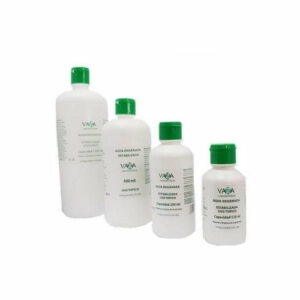
Discover our hydrogen peroxide in a 250 ml bottle, the essential antiseptic for external use in daily practice in pharmacies, surgeries, clinics, wound dressing units and professional first-aid kits. Formulated with hydrogen peroxide (H₂O₂), it is indicated for cleaning and disinfection of superficial wounds, cuts and grazes, as well as for skin hygiene in first aid. Its 250 ml bottle presentation offers maximum product freshness with each use and a convenient format for nursing stations, dressing trolleys and domestic first-aid kits. Sold per unit, with immediate dispatch.
2. Technical explanation
Hydrogen peroxide (H₂O₂) is a fast-acting oxidising antiseptic with little residual effect. On contact with tissue catalase and organic matter it decomposes, releasing nascent oxygen: the resulting effervescence produces a mechanical cleaning action that removes debris, clots and microorganisms from the wound surface, while the oxidising action on the protein structures of germs provides a contact antiseptic effect (ATC pharmacotherapeutic group D08AX01, antiseptics and disinfectants). It is a product for external use only: it must not be ingested, contact with eyes and mucous membranes must be avoided, and it must not be used in closed body cavities (risk of tissue damage and gas embolism due to turbulent oxygen release). Its decomposition is accelerated by light, heat, agitation and contact with metals; it should therefore be stored in a cool place, protected from light and with the container tightly closed.
3. Technical Specifications
| Parameter | Specification |
|---|---|
| Active ingredient | Hydrogen peroxide (H₂O₂) |
| Declared concentration | 6% (according to the commercial labelling of SKU 3335959) |
| Volumes | 10 volumes (note: the standard chemical equivalence of 10 volumes is ≈3% w/v; confirm the container label before use in protocols) |
| Volume | 250 ml per unit |
| Presentation | Unit bottle |
| Route of use | External / topical · Do not ingest |
| Aspect | Clear and colourless solution |
| Spectrum of action | Oxidising antiseptic by oxygen release; contact bactericidal action |
| Indications | Cleaning and disinfection of superficial wounds, cuts and grazes; first aid |
| Directions for use | Apply directly to the area or with sterile cotton/gauze; do not occlude |
| Storage | Store in a cool place protected from light; keep container tightly closed; room temperature |
| Expiry | See date printed on the packaging |
| Incompatibilities | Do not mix with reducing agents, alkalis, iodides, permanganates or strong oxidising agents; do not use on the same area with povidone-iodine |
| ATC classification | D08AX01 (antiseptics and disinfectants, other antiseptics) |
| Reference / SKU | 3335959 |
| Sales unit | Price per unit |
Presentations in the same line in the Cahnos catalogue:
| Format | Volume | Reference | Recommended use |
|---|---|---|---|
| This product | 250 ml | 3335959 | First-aid kits, nursing stations and low-to-medium volume wound care |
| Medium format | 500 ml | 3335966 | Surgeries and medium-volume departments |
| Large format | 1,000 ml (1 L) | 3335935 | Wound dressing units and high turnover, best cost per millilitre |
4. Equivalences and Cross-References
Reference 3335959 is Cahnos’s own code for its 250 ml bottle of hydrogen peroxide. There is no manufacturer-validated equivalence table cross-referencing this reference with products from other brands; the references listed below are functional category comparisons verified against the official patient information leaflet (CIMA/AEMPS) and laboratory and distribution catalogues. They are not interchangeable 1:1: before any substitution, the concentration, pharmaceutical form, volume, registration and presentation must be validated field by field.
| Manufacturer / Brand | Family / Model | Reference code / SKU | Equivalence level | Technical differences / Remarks |
|---|---|---|---|---|
| Foret (Peroxfarma S.A., Spain) | Foret 3% hydrogen peroxide cutaneous solution and concentrate for buccal solution, 250 ml bottle | AEMPS (CIMA) registration 40859 · Ref. 702449 · EAN 8470007024491 | Comparable by category (not interchangeable 1:1) | Same active ingredient, same presentation (250 ml) and same clinical indication (superficial wounds and mouth rinse after extractions). They differ in the declared concentration (3% = 10 volumes versus the commercial 6% of this SKU), the regulatory status (CIMA-registered medicine) and the excipient (phosphoric acid). |
| Acofar (Acofarma, Spain) | Hydrogen peroxide 10 volumes, 250 ml bottle | Ref. 146399 · EAN 8428452800115 | Comparable by category (not interchangeable 1:1) | Same volume (250 ml) and same indication for antisepsis and wound cleaning with 10 volumes; the exact concentration declared on the container (Acofarma also markets the 5% formulation), the excipients, the registration and the batch must be verified before substitution. |
Other brands on the market cover the same clinical indication with 10 volumes hydrogen peroxide in a similar format (e.g., Kabana Labs in 500 ml, cosmetic grade for external use, according to the manufacturer’s catalogue; and references C-1312 in 250 ml in a box of 48 units and C-1314 in 1,000 ml in a box of 12 units, which appear in national distribution catalogues such as Calvo Izquierdo 2025); in these cases, the container code must be confirmed with the authorised laboratory or distributor before use. It is always recommended to check the declared concentration (10 volumes ≈ 3% w/v) on the container label.
There is no manufacturer-validated equivalence table for reference 3335959; consult the technical department before use in tendering.
5. Selection tips and variants of interest
Format by consumption: the 250 ml bottle (Ref. 3335959) is the ideal option for first-aid kits, nursing stations and low-to-medium volume wound dressing units. In the Cahnos catalogue, the same line is available in 500 ml (Ref. 3335966) for medium-volume departments and in 1 litre (Ref. 3335935) for high-turnover units, with the best value per millilitre.
Correct use: apply to superficial wounds directly or with sterile gauze, allow to act briefly and dry without rubbing; do not occlude the area or use in closed cavities. For mouth rinses after dental extractions, dilute to 50% with water and use a maximum of 4 times a day.
Compared with other antiseptics: for antisepsis of healthy skin prior to punctures and injections, 96º alcohol is recommended; for open wounds, minor burns and skin antisepsis with a broader spectrum, 10% povidone-iodine (POV range from Cahnos). Do not apply hydrogen peroxide and povidone-iodine concomitantly to the same area (incompatibility).
Storage and traceability: store in a cool, dry place away from light, with the container tightly closed and upright; record the opening and expiry dates according to the centre’s protocol.
Professional B2B purchasing: for replenishment orders, purchasing groups or special volume conditions, contact our technical-commercial department.
Reviews
There are no reviews yet.