


Description
1. Introduction
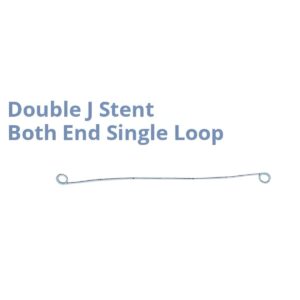
The double J ureteral stent with single loop at both ends is the urinary drainage solution that your urology department needs to ensure ureteral patency in critical situations: obstructive renal stones, tumour compression or after endoscopic procedures. This complete configuration includes fixation suture, guide wire and steerable pusher, so that the team has everything needed in a single sterile package, ready to use. Available in blue or white finish, with the quality and consistency of MEDpro stents, designed for easy handling, excellent patient comfort and reliable clinical performance.
2. Technical explanation of the product and procedure
The double J stent is a flexible tube with loops or coils at each end that are fixed in the renal pelvis and the bladder, preventing migration. Its main function is to keep the ureter open and ensure urine drainage from the kidney to the bladder when natural flow is compromised, for example, by a renal stone or by tumours near or within the ureter, often inoperable. In these cases, the stent is used as a temporary measure to protect the obstructed kidney until the cause is resolved, or as palliative treatment for continuous drainage.
In patients undergoing procedures known as stone extraction or ‘basket retrieval’, the stent is placed for approximately one week to prevent the ureter from spasming or collapsing after the trauma of instrumentation. The standard material is Tecoflex®, a radiopaque polyurethane that combines flexibility and shape memory, facilitating placement, patient tolerance and radiological control visualisation. For longer dwell times, the Long Duro version made of Carbothane® is available, with greater hardness and resistance.
3. Technical specifications and tables
The technical features of the double J stent with suture, guide wire and steerable pusher are detailed below:
| Characteristic | Detail |
|---|---|
| Design | Double J with single loop at both ends |
| Kit contents | Stent + fixation suture + guide wire + steerable pusher |
| Available colours | Blue or white |
| Standard material | Tecoflex® radiopaque |
| Long-duration material | Carbothane® (Long Duro version, yellow) |
| Available sizes | Values |
|---|---|
| Length | 12, 14, 16, 18, 20, 22, 24, 26, 28 and 30 cm |
| Gauge (French) | 3.0, 3.5, 3.8, 4.0, 4.5, 4.7, 4.8, 5.0, 5.5, 6.0, 6.5, 7.0 and 8.0 Fr |
| End configuration | BEC (both ends closed), BEO (both ends open), OEO (one end open) |
| Indications and presentation | Detail |
|---|---|
| Standard dwell time | Up to 30 days (blue or white stent) |
| Extended dwell time | Long Duro stent (yellow) for longer periods |
| Main use | Obstruction due to renal calculus, tumour compression of the ureter, post-endoscopic treatment or stone extraction |
| Presentation | Sterile individual packaging, single-use product |
| Re-evaluation | Periodic evaluation is suggested while it remains in place |
4. Equivalences and Cross-References
This single-loop double J stent corresponds to the classic and most universal configuration of internal ureteral drainage, making it clinically interchangeable with standard double J systems made of polyurethane or silicone from other leading manufacturers such as Cook Medical (Universa® Soft and Sof-Flex® series), Boston Scientific (Percuflex®) or B. Braun (Urosoft®). It matches the length and gauge formats commonly used in urology and nephrostomy (12–30 cm and 4.7–7 Fr for usual adult use), as well as the BEC, BEO and OEO end configurations required by the different placement techniques and professional preferences. The availability of a standard version (Tecoflex®) and a long-duration version (Carbothane®) covers the same clinical spectrum as the standard and long-stay ranges of the main manufacturers on the market.
5. Selection tips and variants of interest
To choose the most appropriate reference, first assess the estimated dwell time: if it is up to 30 days, opt for the standard blue or white stent; if the obstruction requires longer drainage, select the yellow Long Duro variant. Next, determine the length (12–30 cm) according to the patient’s anatomy and height, and the French gauge most appropriate to the ureteral diameter. Finally, choose the end configuration: BEC for maximum resistance to migration, BEO when maximum distal patency is required, or OEO for mixed needs.
Depending on the additional material you prefer to handle in the operating theatre, this same family of double J stents is offered in alternative configurations: stent only, suture only, with suture and forceps, with clamp, with guide wire, with pusher, or combinations of these accessories, all in blue or white. Consult our technical-commercial department to select the presentation in boxes of 20 or 25 units and to customise the most suitable configuration for your department.
Reviews
There are no reviews yet.