
Sterile suture material
In this category you will find sterile suture material for surgical use, designed so that hospitals, clinics, purchasing groups and healthcare professionals have access to safe threads with batch traceability and predictable performance in every procedure. We bring together absorbable and non-absorbable sutures, monofilament and multifilament, in various USP sizes, thread lengths and needle profiles (cylindrical, cutting triangular and taperpoint), always sterilised by ethylene oxide and single-use. Whether you need to approximate soft tissues, perform ligatures or undertake general surgery, ophthalmology, cardiovascular, neurosurgery or plastic surgery procedures, here you can select the most suitable reference for each technique and each tissue type, with the flexibility to adjust the order to the real needs of your department.Main applications and variety:Absorbable multifilament sutures (polyglactin 910 / PGLA): medium tensile support and predictable absorption by hydrolysis, indicated for approximation of soft tissues, ligatures and ophthalmic surgery.Absorbable monofilament sutures (polydioxanone / PDO-PDS): prolonged support and low tissue reaction, recommended for closures requiring longer residence time and for delicate tissues.Non-absorbable monofilament sutures (polypropylene): inert behaviour and duration exceeding three months, used in general surgery, cardiovascular, ophthalmology, neurosurgery and plastic surgery.Variety of sizes, lengths and needles: different USP, thread measurements and needle-body-point combinations (HR, XNS, taperpoint and triangular) to suit the technique and target tissue.
Products
Showing all 2 results
-
Sale!
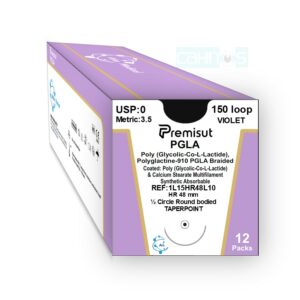
Absorbable Multifilament Polyglactin 910 (PGLA) Suture | ½ Circle Needle Cylindrical Body Conical Point HR 48 mm | Gauge USP 0 | Violet Thread 150 cm with Loop | Ref. 1L15HR48L10
Original price was: 49,90 €.42,80 €Current price is: 42,80 €. In stockAdd to basket -
Sale!
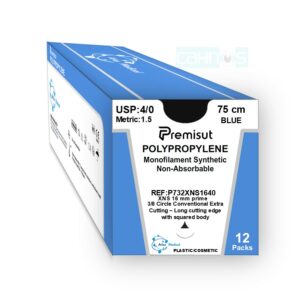
Polypropylene suture Premisut Prime USP 4/0 blue 75 cm – ⅜ circle needle XNS 16 mm, triangular point, precision conventional cutting with square body (Factory ref. P732XNS1640)
Original price was: 62,22 €.36,20 €Current price is: 36,20 €. In stockAdd to basket
Selecting the appropriate sterile suture material involves weighing several criteria: the type of tissue to be approximated, the support time required by the wound (absorbable multifilament sutures offer a short-to-medium absorption profile, while PDO/PDS monofilament sutures provide prolonged support and non-absorbable polypropylene sutures maintain their strength beyond three months), the USP size and thread length demanded by the technique, as well as the needle profile —cylindrical for soft tissues, cutting triangular for skin and taperpoint for deep planes—. It is also advisable to review the box presentation, ethylene oxide sterilisation, batch traceability and storage conditions, so that the choice aligns with clinical safety, minimises tissue reaction and optimises the cost per procedure.
Our team is at your disposal to help you configure the optimal range of sterile suture material according to your speciality, the volume of your operating theatre and the rotation of your stock. If you need technical advice, comparisons between references, special conditions for high-volume orders or a personalised proposal for your hospital or purchasing group, contact us and a specialist will assist you directly and confidentially.