

Description
1. Introduction
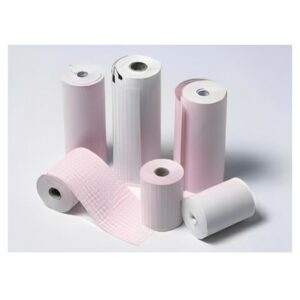
The roll of thermal paper Biocare model 3030 (ref. 0553198) is the recording consumable indicated for thermal printing equipment with a width of 112 mm in healthcare settings. Its format of 112 mm × 25 m with red grid ensures sharp, stable and high-contrast tracings, facilitating the reading of electrocardiographic recordings and other clinical curves. It is supplied in a box of 20 rolls, a presentation designed to ensure continuous replenishment in practices, cardiology departments, functional diagnostic units and health centres.
2. Technical Explanation
This consumable uses direct thermal printing: the equipment’s thermal printhead transfers heat to the paper’s thermosensitive layer, generating the trace without the need for ink, toner or ribbon. This reduces equipment maintenance and maintains consistent print quality throughout the roll.
The printed red grid acts as a measurement reference (amplitude, speed and intervals) indispensable for the interpretation of electrocardiograms and other clinical recordings, as it offers excellent contrast on the white background. The 112 mm width corresponds to the standard format of printers integrated into multi-channel recording equipment. For correct operation, the paper must be kept protected from direct sunlight and humidity, at a stable temperature between 5 °C and 40 °C.
3. Technical Specifications
| Model | 3030 (Biocare) |
| Brand | Biocare |
| Roll dimensions | 112 mm (width) × 25 m (length) |
| Grid colour | Red |
| Paper type | Thermal-sensitive paper |
| Printing system | Direct thermal via heat head (no ink or toner) |
| Application | Medical recording: electrocardiograms, monitors and equipment with 112 mm thermal printer compatible with the grammage |
| Presentation | Box of 20 units |
| Reference Cahnos | 0553198 |
| Line code | 16715 |
| Storage | Cool, dry and dark place; stable temperature between 5 °C and 40 °C |
4. Equivalences and Cross-References
The 112 mm × 25 m format with red grid is a standard shared by recording equipment from several manufacturers. The following references, available in the Cahnos catalogue for other equipment brands, match dimension for dimension in measurements and grid colour with the product analysed; as they are distribution codes specific to other lines and not an official manufacturer table, they are classified as comparable by category.
| Manufacturer / Brand | Family / Model | Code / SKU | Equivalence level | Technical differences / Remarks |
| Progetti | EPG 6 View (thermal recording paper) | 0553060-PG | Comparable by category (not interchangeable 1:1) | Same dimensions 112 mm × 25 m and red grid; presentation in box of 20 units; line code 12807. |
| Del Mar Reynolds | Voyager 6 (thermal recording paper) | 0553060-MR | Comparable by category (not interchangeable 1:1) | Same dimensions 112 mm × 25 m and red grid; presentation in box of 20 units; line code 12807. |
There is no equivalence table validated by the manufacturer for this reference against other brands; the cross-references indicated have been verified in the Cahnos distribution catalogue and must be confirmed with the technical department before use in tendering.
5. Selection tips and variants of interest
Check the roll width: 112 mm is the format of printers integrated into multi-channel recording equipment; a narrower width (57, 58, 63 or 110 mm) corresponds to single-channel equipment or spirometers and is not interchangeable with this consumable.
Check the grid colour: the red grid is the most common for manual ECG reading; some equipment also accepts orange grid, which must not be mixed with this red format without prior verification.
Variants of the same family in Cahnos: Biocare 300 G roll of 63 mm × 30 m with orange grid (ref. 0553132-BC); Progetti EPG 6 View and Del Mar Reynolds Voyager 6 roll in 112 mm × 25 m format (refs. 0553060-PG and 0553060-MR); Trismed CARDIPIA roll of 110 mm × 30 m (ref. 0553186).
Storage conditions: keep the rolls in a cool, dry and dark place, avoid exposure to sunlight and heat sources before use, and do not fold the recording on the thermosensitive side once printed to preserve the durability of the trace in the clinical archive.
Reviews
There are no reviews yet.