

Description
1. Lead eye protection for healthcare professionals
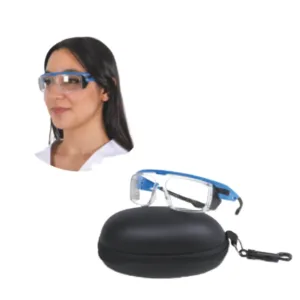
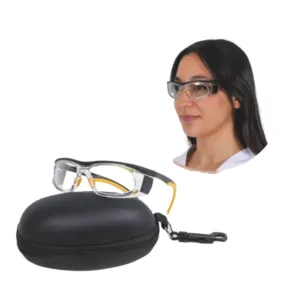
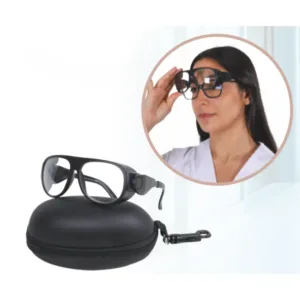
The lead glasses model RG33 (ref. RXRG3300) are the eye protection equipment indicated for healthcare personnel working near X-ray sources: radiologists, haemodynamics specialists, interventional cardiologists, image-guided surgeons, urologists, dentists and nuclear medicine staff. Their combination of frontal protection of 0.75 mm Pb and lateral protection of 0.50 mm Pb effectively attenuates scattered radiation reaching the lens, one of the most radiosensitive tissues in the body, without sacrificing lightness, visual clarity and comfort during long shifts.
2. Technical explanation: attenuation of scattered radiation and protection of the lens
During any interventional or diagnostic radiology procedure, scattered radiation (scatter) generated when the main beam interacts with the patient and the table propagates in all directions and directly reaches the operator’s ocular area. The lens accumulates dose throughout professional life, which is why radiation protection regulations and recommendations from bodies such as the ICRP require increasingly restrictive equivalent dose limits for this organ.
These glasses act as an attenuating barrier: the high-quality leaded optical lenses absorb X-ray radiation before it reaches the eye, both in frontal incidence (0.75 mm Pb) and lateral (0.50 mm Pb), which is precisely the most frequent entry path of scattered radiation when working close to the equipment in fluoroscopy. Its ergonomic rubber frame, with a wraparound and lightweight design, also allows the simultaneous and stable use of personal prescription glasses, ensuring a secure fit without pressure points. As personal protective equipment, the product is certified with CE marking 0598 in accordance with Regulation (EU) 2016/425.
3. Technical Specifications
The full technical specifications of the lead glasses model RG33 are detailed below:
| Characteristic | Specification |
|---|---|
| Model | RG33 |
| Reference (SKU) | RXRG3300 |
| Product type | Lead glasses for ocular radiological protection (PPE) |
| Front protection | 0.75 mm Pb equivalent |
| Side protection | 0.50 mm Pb equivalent |
| Frame material | Ergonomic rubber, wraparound design |
| Compatibility | Prescription glasses (comfortable and stable simultaneous use) |
| Total weight | 90 grams |
| Colour | Black |
| Included accessories | Adjustable safety cord and rigid zipped case in black |
| Storage temperature | Between -10 °C and +40 °C |
| Standards / Regulation | CE marking 0598, in accordance with Regulation (EU) 2016/425 (PPE) |
Frame measurements:
| Dimension | Size |
|---|---|
| Lens size | 62 mm |
| Bridge size | 15 mm |
| Temple length | 145 mm |
| Total weight | 90 g |
Protection areas:
| Protection area | Lead equivalence | Main function |
|---|---|---|
| Front vision | 0.75 mm Pb | Attenuation of direct and scattered radiation from the front |
| Lateral vision | 0.50 mm Pb | Reinforcement of peripheral eye coverage |
Indicative table of eye protection equivalences according to the level of shielding:
| Lead equivalence | Recommended use |
|---|---|
| 0.50 mm Pb | Basic protection for general radiodiagnosis and low workload |
| 0.75 mm Pb | Recommended protection for interventional radiology, haemodynamics and prolonged procedures |
4. Equivalences and Cross-References
Within the radiological eye protection range from Cahnos, the RG33 lead glasses (RXRG3300) share the same shielding level as the RXRG20000 lead glasses (model RG200, leaded optical glass, 52 mm lens, weight 80.6 g), the RXRG20600 lead glasses (model RG206, high-impact nylon frame, 50 mm lens, weight 75 g) and the adjustable RXRG6600 lead glasses (model RG66, adjustable temples, 62 mm lens, weight 110 g), with which they can be compared according to fit preference, field of view, weight and compatibility with prescription optics.
On the market, glasses with a frontal equivalence of 0.75 mm Pb and lateral of 0.50 mm Pb are equivalent to eye protectors from leading radioprotection manufacturers such as MAVIG (models BR115, BR124, BR125 and OverFit), Wolf X-Ray, Bar-Ray, ORLA Radioprotection or HHAO, as well as the lead glasses distributed by Hospidis and Quirumed. For a comprehensive radiological protection outfit for the professional, these glasses are complemented by the RX35000 lead cap, the RX51500 thyroid protector, the RX64200 and RX64300 lead aprons, the RX21400, RX21500 and RX21600 lead gloves and mittens, and the RXPD00 wall-mounted support for lead garments. Our technical-commercial team can confirm exact equivalences according to the reference you wish to replace in your service.
5. Selection tips and variants of interest
- Choose the equivalence according to workload: for interventional radiology, haemodynamics or prolonged procedures, 0.75 mm Pb frontal is the recommended option; for general diagnostic radiology and dentistry, 0.50 mm Pb models may be sufficient.
- Consider lateral protection: scattered radiation frequently strikes from the side; a lateral shield of 0.50 mm Pb significantly reduces the dose to the lens.
- If you wear prescription glasses: the RG33 model (RXRG3300), with ergonomic rubber frame and 62 mm lens, is one of the most comfortable options for simultaneous use, along with the adjustable RXRG6600.
- Storage: always keep the glasses in their protective rigid case, avoiding drops, pressure, direct heat and intense sunlight; the recommended storage temperature is -10 °C to +40 °C.
- Cleaning and disinfection: clean the lenses with a soft cloth and neutral detergent, dry with a microfibre cloth and avoid solvents, alcohol and abrasive products that could damage the optical treatment.
- Inspection: periodically check the condition of the lenses and frame, and replace the product if deep scratches, deformations or structural damage appear that compromise attenuation.
- Accessories: combine these glasses with a lead apron, thyroid protector, cap and gloves for comprehensive operator protection against scattered radiation.
The RG33 lead glasses (RXRG3300) offer an ideal combination of safety, ergonomics and comfort, being indispensable in any medical environment where X-rays are used.
Reviews
There are no reviews yet.