

Description
1. Introduction
The paediatric nasal cannula of American tie type (Ref. OS/12PED) is the reference solution for low-flow oxygen administration in infant patients: children in paediatric wards, emergency departments, intermediate care or home therapy. Its flexible 160 cm tube offers freedom of movement in bed or cot with a stable flow, while its DEHP-free manufacture makes it especially safe for sensitive skin and mucous membranes. A single-use product, designed for the professional who demands traceability, comfort and regulatory compliance in every therapy.
2. Technical explanation of the device
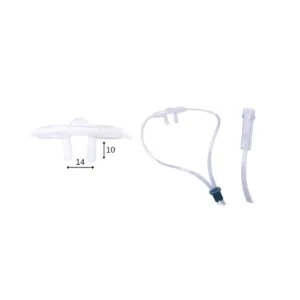
The nasal cannula is the most widely used low-flow oxygen therapy system in paediatric patients: two curved, soft nasal prongs sit in the nostrils and oxygen reaches the nasal distributor from the source (flowmeter, concentrator or cylinder) through the flexible tube. The American tie flow design incorporates a securing loop that surrounds the child’s head and stabilises the device without excessive pressure on the septum, reducing the risk of skin injury and keeping the prongs in the correct position during therapy. The absence of DEHP is a critical criterion in paediatrics: this plasticiser is associated with risks in prolonged exposures during developmental stages, so its removal from the oxygen administration circuit is a common requirement in hospitals. The flexible tube maintains a constant gas flow even with patient movement, and the standard terminal connector ensures coupling with conventional supply systems.
3. Technical Specifications
| Characteristic | Specification |
|---|---|
| Reference / SKU | OS/12PED |
| Product type | Paediatric American tie nasal cannula |
| Target population | Paediatric infant patients |
| Design | American tie flow type, soft nasal prongs |
| Flow tube | 160 cm length, flexible design |
| Material | DEHP-free (without phthalates), safe for paediatric medical use |
| Flow type | Low-flow oxygen (according to clinical prescription) |
| Connector | Standard connector, compatible with common oxygen systems |
| Use | Single-use, disposable |
| Presentation | Box of 100 units |
Note: the characteristics indicated correspond to the data declared by the distributor for reference OS/12PED; for use in tenders, confirm the full specifications with the technical department.
4. Equivalences and Cross-References
Reference OS/12PED corresponds to the catalogue’s own nomenclature Cahnos. There is no equivalence table validated by the manufacturer for direct reference-to-reference substitution; the following comparisons are functional category comparisons, not interchangeable 1:1, and must be validated with the technical department before use in tenders.
| Manufacturer / Brand | Family / Model | Code / SKU | Equivalence level | Technical differences / Remarks |
|---|---|---|---|---|
| Medline (Hudson RCI® / Teleflex) | Softech® Plus paediatric, green Star Lumen™ tube | HUD1871 | Comparable by category (not interchangeable 1:1) | Paediatric cannula without DEHP with curved non-flared prongs, five-channel anti-collapse tube of 210 cm (7 feet) and standard connector, box of 50 units; differs in tube length (210 cm vs 160 cm), five-channel internal lumen and packaging format. |
There is no equivalence table validated by the manufacturer for direct reference-to-reference substitution; consult the technical department before use in tenders.
5. Selection tips and variants of interest
For newborn and premature patients, the OS/12NEO variant (same American tie family, 160 cm DEHP-free tube, box of 50 units) covers the neonatal size of the same design. If a longer anti-collapse tube is required for children up to 12 months, the infant Star Lumen cannulas (1101P and 1828CE, with a five-channel 210 cm tube) are functional alternatives in the same category. For adult patients in the same family, reference OS/12A (with positioning ring and 210 cm anti-crush tube) completes the range. If the oxygen source is far from the bed, the OS/40 and OS/41 extension tubes (200 cm) extend the circuit without flow loss. Always check the connector on your flowmeter or concentrator, follow the prescribed flow rate in paediatrics and use a new cannula per patient to prevent cross-contamination. Store the product in a cool, dry place.
Reviews
There are no reviews yet.