
Description
1. Commercial Introduction
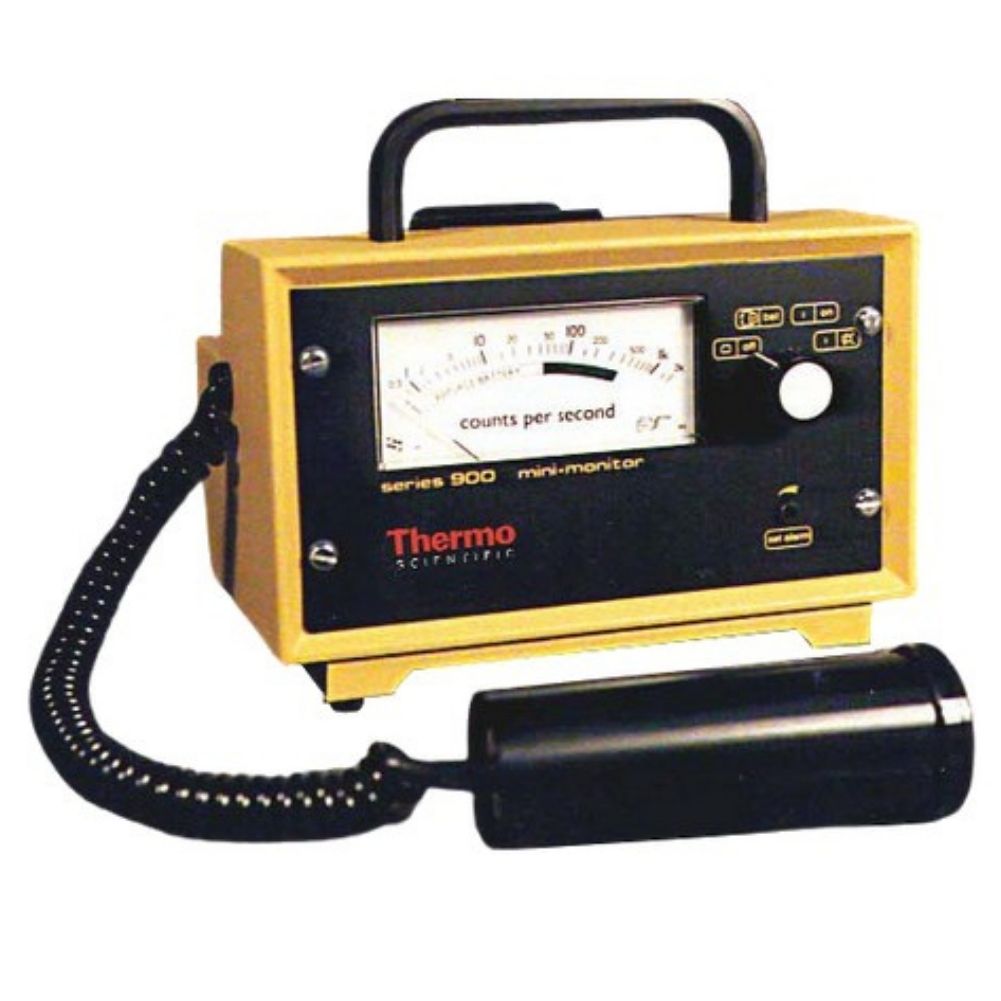
The 900 radiation meter with type 44A scintillation probe is the reference technical and economical solution for the detection and control of radioactive contamination in Nuclear Medicine and Radiology departments. Its design stands out for its ease of use: it works equally as a handheld portable instrument or as a benchtop instrument, and provides an immediate, reliable reading with audible response of radiation intensity, without the need for complex configurations. It is the daily work companion of the radiation protection professional, the nuclear medicine physician and the nursing staff who need to check surfaces, work areas and patients quickly and safely.
2. Technical explanation of the equipment
The assembly consists of a series 900 monitor and a type 44A scintillation probe. The probe uses a sodium iodide crystal activated with thallium, NaI(Tl), 32 mm in diameter by 2.5 mm thick, mounted on the front surface of the housing, which allows scanning of large contaminated areas with excellent sensitivity for energies approximately between 15 keV and 250 keV (gamma radiation and X-rays). The thin aluminium window of 14 mg/cm² facilitates the detection of low-energy emitters and, above 500 keV, the probe also has sensitivity to beta radiation.
The monitor incorporates a logarithmic scale indicator with an open scale at the lower end (visible even at background levels), a built-in loudspeaker that converts radiation intensity into a proportional audible signal and an adjustable alarm at any point on the scale. It operates on batteries —6 AA batteries, alkaline (IEC LR6) or rechargeable (IEC KR 15/51)— with an approximate battery life of 300 hours at 4 hours per day, and can also operate connected to the mains via an external 12–18 V DC power supply. Its lightweight aluminium housing (≈1 kg) and proven reliability make it especially suitable for laboratories, hospitals and industry.
3. Technical Specifications
The verified technical features of the 900 radiation meter with type 44A probe are detailed below, in accordance with the manufacturer’s documentation.
| Parameter | Specification |
| Set type | Series 900 radioactive contamination monitor, portable or benchtop |
| Detector / probe | Type 44A scintillation probe with sodium iodide NaI(Tl) crystal |
| Detector crystal | 32 mm diameter × 2.5 mm thickness |
| Crystal mounting | Front surface of the probe, for scanning large contaminated areas |
| Energy range | ≈15 keV – 250 keV (gamma and X-rays); sensitive to beta above 500 keV |
| Probe window | Aluminium, 14 mg/cm² |
| Probe dimensions | 50 mm diameter × 180 mm length |
| Sensitivity | ≈3.8 cps per 1 Bq/cm² of I-125 |
| Indication | Logarithmic scale with open scale at bottom, acoustic feedback and adjustable alarm |
| Power supply | 6 AA batteries (alkaline IEC LR6 or rechargeable IEC KR 15/51); mains option 12–18 V DC |
| Battery life | ≈300 hours at 4 h/day |
| Physical characteristics | Lightweight aluminium housing, weight ≈1 kg |
| Regulatory standard | Compliant with IEC 325 |
| Intended use | Nuclear Medicine, Radiology, laboratories, contamination control and radioprotection |
| Reference Cahnos | CAH-RM0000 |
Comparison of scintillation probes compatible with the series 900:
| Catheter | Crystal | Energies | Indicative application |
| 41 | NaI(Tl) 19 × 25 mm, with lead shielding | From 25 keV | Directional detection with reduced background |
| 42A | NaI(Tl) 23 × 1 mm, aluminium window 14 mg/cm² | ≈10–15 keV to 60 keV and above | Thyroid monitoring of I-125, under collimator |
| 44A | NaI(Tl) 32 × 2.5 mm, aluminium window 14 mg/cm² | ≈15 keV – 250 keV (+ beta > 500 keV) | Scanning of large contaminated areas (this product) |
| 44B | NaI(Tl) 32 × 2.5 mm, beryllium window | From ≈5 keV | Detection of very low energies (e.g. Fe-55) |
4. Equivalences and Cross-References
This equipment belongs to the 900 series of scintillation monitors, historically marketed by Mini Instruments and currently by Thermo Scientific as Mini 900 with 44A probe. The type 44A probe is functionally equivalent to the 900-44A probe of the same family and compatible with the 900 series monitors (Mini 900 / 900-Series Scintillation Monitor). The same range includes the 41, 41S, 42A, 42B and 44B probes, as well as the 900 series monitors with Geiger-Müller tube (types R, G, D and X) for measuring dose rate and X-ray leakage.
In the Cahnos catalogue, this meter is complemented by the FLIR identiFINDER R425 portable radionuclide detector and identifier (ref. CAH-FLIR IDENT R 425), recommended when, in addition to detecting, spectral identification of the radionuclide is required. For professional protection, lead aprons, thyroid shields and lead glasses from the Cahnos Radiation Protection range can be added. Our technical-commercial team can confirm the exact equivalence of this reference with the Mini 900/44A models from other suppliers according to your tender.
5. Selection tips and variants of interest
- Large-area scanning: choose the 900 + 44A probe configuration when you need to quickly check contaminated surfaces (tables, trolleys, workbenches, floors and radiopharmaceutical handling areas).
- Very low energies: if your protocol requires detecting emitters of approximately 5 keV (e.g. Fe-55), consider the type 44B probe with beryllium window.
- Thyroid or organ monitoring: for I-125 measurements in the thyroid or the localisation of deep vein thrombi, the 42A probe with lead collimator is the most suitable.
- X-ray leakage and high rates: for the verification of X-ray equipment or high fields, use the 900 monitors with Geiger-Müller tube (types D or X), not the scintillation probes.
- Verification and maintenance: carry out the daily check with a control source (e.g. low-activity Cs-137), keep the batteries in good condition and consider an annual periodic calibration according to your centre’s radiation protection plan.
- Accessories: combine this equipment with the spectral identification of the FLIR identiFINDER R425 and with the personal radiation protection equipment from Cahnos for complete service coverage.
Reviews
There are no reviews yet.