


Description
1. Complete and sterile kit for percutaneous airway access
The percutaneous dilatation kit Ref. TP02-17 is the integral single-use solution for establishing a safe airway quickly, minimally invasively and in a controlled manner in the adult patient. It follows the Griggs technique with forceps over a guidewire and incorporates a reinforced 7 mm tracheostomy tube with adjustable cervical flange, a combination especially valued in intensive care for its structural resistance to kinking and its adaptation to variable cervical anatomies (oedema, variations in neck thickness).
All the procedure material is presented in a single sterile ready-to-use pack: one single order, one single code and the assurance that the team has all the instruments with full traceability. Preparation time is reduced, the risk of forgetting material is minimised and standardisation of the procedure is facilitated in ICU, emergency, operating theatre and airway units.
2. Technical explanation of the equipment and procedure
Percutaneous dilatational tracheostomy (PDT) according to the Griggs technique is an evolution of the Ciaglia technique: it is performed at the bedside, usually under bronchoscopic control, without the need to transfer the critically ill patient to the operating theatre. The procedure begins with tracheal puncture using the 16 G introducer needle, continues with the passage of the J-tip guidewire (atraumatic tip that minimises tissue damage) and ends with progressive dilatation of the stoma using Howard-Kelly type dilatation forceps, which advance over the guidewire opening the orifice in a single controlled movement, followed by advancement of the pre-mounted cannula over the conical-tip introducer with locking system, which avoids steps and maintains the position of the tube during insertion.
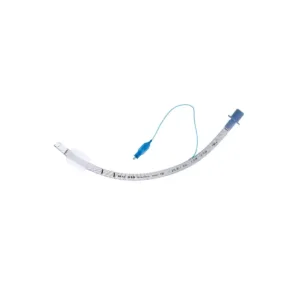
The tube incorporates reinforced anti-kink helical reinforcement, low-pressure balloon, universal 15 mm (15M) connector compatible with the ventilator circuit, radiopaque line for radiological control and an adjustable cervical flange in transparent plastic that allows the fixation to be adapted to each patient while maintaining correct visualisation of the stoma. All components are single-use, latex-free and phthalate-free.
3. Technical specifications and kit contents
Kit contents (Ref. TP02-17)
| Component | Specification |
|---|---|
| Tracheostomy tube | Reinforced 7 mm tube with adjustable flange, anti-kink helical reinforcement |
| Dilatation forceps | Griggs type (Howard-Kelly), dilatation over guidewire |
| Tracheostomy tube introducer | Conical tip for safe and progressive insertion |
| Dilator | 14 Fr for progressive dilatation of the stoma |
| Guidewire | J-tip 0.05 inch, nitinol core (NiTiNol) kink-resistant |
| Guide catheter | For guiding the dilator and tube during placement |
| Safety scalpel | No. 15, with retractable shield and fixed blade |
| Syringe | 10 ml |
| Introducer needle | 16 G |
| Fixation band | Skin colour, with Velcro-type closure |
| Instrument table cover | Sterile field cover |
| Stoma accessories | Tracheal compress 9 × 9 cm (three-layer foam), gauze swabs 10 × 10 cm and sterile lubricating gel |
Technical data for the tube and kit
| Parameter | Specification |
|---|---|
| Technique | Percutaneous dilatational tracheostomy, Griggs technique with forceps |
| Internal tube diameter | 7.0 mm (exact outer diameter and length according to the tube’s technical data sheet) |
| Tube type | Reinforced, with anti-kink helical reinforcement |
| Flange type | Adjustable, cervical, flexible, transparent plastic |
| Cuff | Low pressure |
| Connector | Universal 15 mm (15M) |
| Radiological control | Radiopaque line |
| Dilatation forceps | Included (Griggs technique) |
| Subglottic suction | No (see variants with subglottic lumen in the series) |
| Use | Single-use (disposable) |
| Sterilisation | Ethylene oxide (ETO), process validated according to EN 11135-1; desorption in accordance with ISO 10993-7 |
| Presentation | Sterile, individually packaged in TYVEK bag in accordance with EN ISO 11607-1/2 |
| Materials | Latex-free and phthalate-free in all components |
| Regulatory classification | CE medical device class IIa (Directive 93/42/EEC) |
| Indication | Percutaneous tracheostomy, cricothyrotomy, coniotomy or laryngotomy |
Family of percutaneous kits from the TP02 series (adjustable flange)
| Reference | Diameter | Tube type | Flange | Forceps |
|---|---|---|---|---|
| TP02-07 | 7 mm | Standard | Adjustable | Yes |
| TP02-08 | 8 mm | Standard | Adjustable | Yes |
| TP02-09 | 9 mm | Standard | Adjustable | Yes |
| TP02-17 (this product) | 7 mm | Reinforced | Adjustable | Yes |
| TP02-18 | 8 mm | Reinforced | Adjustable | Yes |
| TP02-19 | 9 mm | Reinforced | Adjustable | Yes |
| TP02-27 | 7 mm | Standard | Adjustable | No |
| TP02-28 | 8 mm | Standard | Adjustable | No |
| TP02-29 | 9 mm | Standard | Adjustable | No |
| TP02-37 | 7 mm | Reinforced | Adjustable | No |
| TP02-38 | 8 mm | Reinforced | Adjustable | No |
| TP02-39 | 9 mm | Reinforced | Adjustable | No |
4. Equivalences and Cross-References
The SKU TP02-17 corresponds to a Cahnos own reference within the family of percutaneous tracheostomy kits with adjustable flange. As a direct range equivalent, references TP02-18 (8 mm) and TP02-19 (9 mm) share the exact configuration (reinforced tube, adjustable flange and dilatation forceps) and only differ in the cannula diameter: not interchangeable 1:1 without validating the patient’s anatomy and ventilation requirements. Reference TP02-07 (7 mm standard with forceps) shares the gauge and instruments but differs in the type of tube (standard versus reinforced), and TP02-37 (7 mm reinforced) omits the forceps: comparable at category level, not interchangeable for procedure purposes.
At category level, the set is comparable to percutaneous dilatational tracheostomy systems from other manufacturers, always as a functional and category comparison, not interchangeable 1:1: the Griggs technique kits from Portex/ICU Medical (Blue Line Ultra family, series 100/891 with dilatation forceps over guidewire), the TRACOE experc kit (REF 520, TRACOE/Atos Medical), the percutaneous sets from Cook Medical (Ciaglia and Melker families, with single Blue Rhino type dilator) and the kits from the Deaflux line from DEAS/ACCEX. The component configuration, cannula geometry, material and dilatation technique may differ, so none of these references should be treated as an exact equivalence.
There is no equivalence table validated by the manufacturer that allows this reference to be cross-referenced with specific codes from other suppliers; it is recommended to consult the technical department at Cahnos before using this datasheet in tendering processes or stock replacement.
5. Selection tips and variants of interest
Diameter: the 7 mm variant (TP02-17, this kit) is suitable for adults of smaller build or more restricted anatomies; the 8 mm (TP02-18) is the usual size for adults of medium build; the 9 mm (TP02-19) is reserved for large airways or patients with greater ventilatory flow demand.
Reinforced tube versus standard: the reinforced helical construction of this kit offers greater resistance to compression and kinking, recommended in patients with a short neck, obesity, deep stomas, frequent mobilisation or prolonged tracheostomy. If structural reinforcement is not required, the standard variant of the same size is the TP02-07.
With versus without forceps: this kit includes dilation forceps, ideal for departments that apply the full Griggs sequence with instrumental dilation under endoscopic control; if dilation with a single 14 Fr dilator is preferred, the same reinforced 7 mm configuration without forceps is available (TP02-37).
Adjustable flange: allows the fixation to be adapted to cervical oedema or variable neck thicknesses. If a fixed and simplified fixation is preferred, see the Griggs series with fixed flange; and if the patient requires suction of subglottic secretions for the prevention of ventilator-associated pneumonia, consider the series with subglottic suction lumen (TP02-64 to TP02-76). All kits in the family are single-use: check the integrity of the sterile packaging and the expiry date before use, and dispose of them after the procedure as clinical waste in accordance with current local regulations.
Reviews
There are no reviews yet.