


Description
1. Complete and sterile kit for percutaneous airway access
The percutaneous dilatation kit Ref. TP02-39 is the comprehensive single-use solution for establishing a safe airway quickly, minimally invasively and in a controlled manner in adult patients. It follows the Griggs technique sequence (puncture, guide wire and dilatation) and incorporates a reinforced 9 mm tracheostomy tube with adjustable cervical flange, the largest calibre variant in the series, designed for patients with a wide airway or high ventilatory flow demand.
All the necessary material is presented in a single sterile, ready-to-use kit: one order, one code and the assurance that the team has all the instruments with full traceability. Preparation time is reduced, the risk of forgetting material is minimised and standardisation of the procedure is facilitated in intensive care, emergency, anaesthesia and airway units.
2. Technical explanation of the equipment and procedure
Percutaneous dilatational tracheostomy (PDT) is performed at the bedside, usually under bronchoscopic control, without the need to transfer the critically ill patient to the operating theatre. In the Griggs-type sequence, the procedure begins with tracheal puncture using the 16 G introducer needle, continues with the passage of the J-tip guide wire (atraumatic tip that minimises tissue damage) and ends with progressive dilatation of the stoma. This variant does not include dilatation forceps: the opening is made with the 14 Fr dilator that advances over the guide wire (single dilator sequence), followed by advancement of the pre-mounted cannula over the conical-tip introducer for safe and progressive insertion.
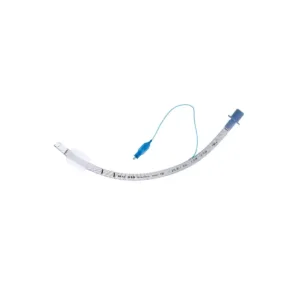
The reinforced 9 mm tube offers greater resistance to compression and kinking, which is especially useful in deep stomas or when the tract between skin and trachea is long. The cannula incorporates a low-pressure balloon (cuff), a universal 15 mm connector compatible with the ventilator circuit, a radiopaque line for radiological control and an adjustable cervical flange that allows the fixation to be adapted to the anatomy of the neck (oedema, thickness variations) while maintaining correct visualisation of the stoma. All components are single-use, latex-free and phthalate-free.
3. Technical specifications and kit contents
Kit contents (Ref. TP02-39)
| Component | Specification |
|---|---|
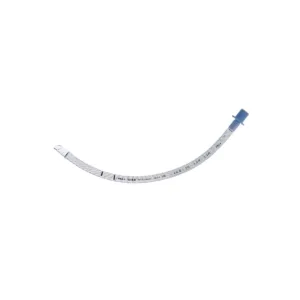
| Tracheostomy tube (cannula) | Reinforced, 9 mm calibre, low-pressure cuff, universal 15 mm connector, radiopaque line and adjustable flange |
| Tracheostomy tube introducer | Conical tip for safe and progressive insertion |
| Dilator | 14 Fr, for progressive dilatation of the stoma (without forceps) |
| Guidewire | J-tip 0.05 inch, nitinol core (NiTiNol) kink-resistant |
| Guide catheter | For guiding the dilator and tube during placement |
| Safety scalpel | No. 15, with retractable shield and fixed blade |
| Syringe | 10 ml |
| Introducer needle | 16 G |
| Fixation band | Skin colour, with Velcro-type closure |
| Instrument table cover | Sterile field cover |
| Stoma accessories | Tracheal compress 9 × 9 cm (three-layer foam), gauze swabs 10 × 10 cm and sterile lubricating gel |
Technical data
| Parameter | Specification |
|---|---|
| Technique | Percutaneous dilatational tracheostomy, Griggs sequence with single dilator (without forceps) |
| Internal tube diameter | 9.0 mm (14 Fr dilator) |
| Tube type | Reinforced, resistant to compression and kinking |
| Flange type | Adjustable, cervical, flexible |
| Balloon (cuff) | Low pressure |
| Connector | Universal 15 mm (15M) |
| Radiological control | Radiopaque line |
| Dilatation forceps | Not included (dilatation with 14 Fr dilator) |
| Use | Single-use (disposable) |
| Sterilisation | Ethylene oxide (ETO), process validated per EN 11135-1; desorption per ISO 10993-7 |
| Presentation | Sterile, individually packaged |
| Materials | Latex-free and phthalate-free in all components |
| Regulatory classification | CE Class IIa medical device |
| Indication | Percutaneous tracheostomy, cricothyrotomy, coniotomy or laryngotomy |
Family of percutaneous kits with adjustable flange at Cahnos (TP02 series)
| Reference | Diameter | Tubing | Flange | Forceps |
|---|---|---|---|---|
| TP02-37 | 7 mm | Reinforced | Adjustable | Without forceps |
| TP02-38 | 8 mm | Reinforced | Adjustable | Without forceps |
| TP02-39 (this product) | 9 mm | Reinforced | Adjustable | Without forceps |
| TP02-19 | 9 mm | Reinforced | Adjustable | With forceps |
| TP02-09 | 9 mm | Standard | Adjustable | With forceps |
| TP02-28 | 8 mm | Standard | Adjustable | Without forceps |
| TP02-08 | 8 mm | Standard | Adjustable | With forceps |
4. Equivalences and Cross-References
The SKU TP02-39 corresponds to a Cahnos own reference within the family of percutaneous tracheostomy kits. Within the same range, references TP02-37 (7 mm) and TP02-38 (8 mm) share the exact configuration (reinforced tube, adjustable flange, without forceps) and only differ in calibre: direct range equivalents, not interchangeable 1:1 without validating the patient’s anatomy and ventilation requirements. Reference TP02-19 (9 mm reinforced adjustable) differs only in the inclusion of dilatation forceps: comparable at category level, not interchangeable for procedure purposes, as it changes the dilatation sequence.
At category level, the set is comparable to percutaneous dilatational tracheostomy systems from other manufacturers. Comparable at category level, not interchangeable 1:1: Griggs technique kits from Portex/ICU Medical (Blue Line Ultra family, series 100/891 with forceps and 100/893 without forceps), Cook Medical percutaneous sets (Ciaglia and Melker families, with single Blue Rhino-type dilator), the TRACOE experc kit (REF 520, Atos Medical/TRACOE, Ciaglia dilatation technique) and kits from the Deaflux line from DEAS/ACCEX. This comparison is functional and categorical: the dilatation technique (forceps versus single dilator), component configuration, geometry and cannula material may differ, so it should not be considered an exact equivalence between brands.
There is no manufacturer-validated equivalence table that allows this reference to be cross-referenced with specific codes from other suppliers; it is recommended to consult the technical department at Cahnos before using this reference in tenders or stock replacement protocols.
5. Selection tips and variants of interest
The cannula diameter should be chosen according to the patient’s anatomy and ventilation requirements: 7 mm for adults of small build (TP02-37), 8 mm as the usual standard calibre (TP02-38) and 9 mm for patients with a wide airway or greater ventilatory flow demand (TP02-39, this kit).
The reinforced tube provides a clinical advantage in deep stomas or long tracts between skin and trachea, as it resists compression and kinking. The adjustable flange is especially useful in patients with cervical oedema or variations in neck thickness, as it allows the tube fixation to be adapted while keeping the stoma visible. This kit dispenses with dilatation forceps and performs the opening with the 14 Fr dilator over the guidewire, making it ideal for departments that prefer the single-dilator sequence or a more cost-effective per procedure; if the full Griggs sequence with instrumental dilatation under endoscopic control is preferred, consider the TP02-19 variant (9 mm with forceps). For patients with copious secretions and prolonged mechanical ventilation, consult the series with subglottic suction lumen (fixed flange, refs. TP02-75 and TP02-76). Before use, verify the integrity of the sterile packaging and the expiry date; dispose of the kit after the procedure as clinical waste in accordance with current local regulations.
Reviews
There are no reviews yet.