

Description
1. Introduction
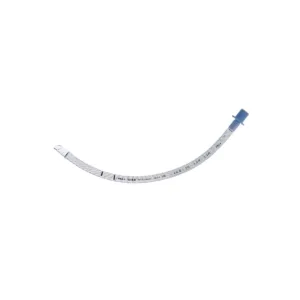
The preformed oral endotracheal tube with cuff and Murphy eye of 4.0 mm (reference ETPO40C02) is the airway solution that anaesthesia, paediatrics, emergency and intensive care departments need to ensure ventilation of paediatric or adult patients with a narrow airway. Its preformed RAE/AGT geometry keeps the ventilation circuit away from the surgical field, which is particularly valuable in oral, maxillofacial, ENT and ophthalmic surgery. It is supplied in a box of 10 sterile, single-use units, designed to keep hospital stock always available and ensure traceability of the device.
2. What it is and how it works
In orotracheal intubation, the tube is inserted through the mouth, passes through the glottis and sits in the trachea to conduct gases from the ventilator or anaesthesia system to the lungs. The preformed curve follows the anatomy of the upper airway: it reduces the risk of kinking, minimises local trauma and facilitates fixation of the tube at chin level. The high-volume, low-pressure cuff (pneumatic seal) seals the trachea after inflation via the pilot balloon with self-sealing valve, allowing positive pressure ventilation without significant leaks. The Murphy eye, a distal lateral hole, ensures an alternative gas passage if the tube tip becomes obstructed (by secretions or by the bevel resting against the tracheal wall). The continuous radiopaque line and depth scale allow radiographic confirmation of correct placement. It is a single-use device: it must be discarded after each patient to avoid any risk of cross-infection.
3. Technical Specifications
The main technical features of the tube are as follows:
| Parameter | Specification |
|---|---|
| Reference | ETPO40C02 (own code Cahnos) |
| Type | Preformed oral endotracheal tube (RAE/AGT type) with cuff and Murphy eye |
| Internal diameter (ID) | 4.0 mm |
| Material | Medical-grade polyvinyl chloride (PVC), transparent, latex-free |
| Cuff type | High volume / low pressure, with pilot balloon and self-sealing valve |
| Murphy eye | Yes, distal lateral safety opening |
| Connector | 15 mm standard, compatible with ISO circuits (ISO 5356-1) |
| Marking | Continuous radiopaque line and depth scale (cm) |
| Use | Single-use (sterile) |
| Indication | Positive pressure ventilation and anaesthesia administration when face mask is not viable |
| Presentation | Box of 10 units |
Note: this category of tracheal tubes is manufactured in accordance with the requirements of standard ISO 5361 (tracheal tubes and connectors) and the biocompatibility standards applicable to airway devices; verify the manufacturer’s declaration of conformity and CE marking on each supplied batch.
Other sizes in the same family (ETPO series, same design and presentation):
| Inner diameter | SKU (box of 10 units) |
|---|---|
| 3.5 mm | ETPO35C02 |
| 4.0 mm | ETPO40C02 |
| 4.5 mm | ETPO45C02 |
| 5.0 mm | ETPO50C02 |
| 5.5 mm | ETPO55C02 |
| 6.5 mm | ETPO65C02 |
| 7.0 mm | ETPO70C02 |
| 8.0 mm | ETPO80C02 |
| 8.5 mm | ETPO85C02 |
| 9.0 mm | ETPO90C02 |
4. Equivalences and Cross-References
SKU ETPO40C02 is the own code of Cahnos for this generic PVC reference; it must not be confused with the official part number of any specific manufacturer, so no exact reference equivalence can be declared and there is no manufacturer-validated equivalence table.
- Comparable at category level (not 1:1 interchangeable): the Rüsch® AGT Oral Preformed Cuffed ETT line from Teleflex, reference 111780040 (size 4.0, box of 10), consistently appears in authorised distributor catalogues responding to the same indication and general geometry (oral preformed, with cuff and Murphy eye, paediatric). It differs in material (thermo-sensitive Ruschelit® PVC) and cuff design, so it must be checked against the official technical data sheet before any use in tenders.
- Comparable by category, without 1:1 verification: generic imported oral preformed tubes (BOENMED, Greetmed, Pinmed, etc.), with PVC, low-pressure cuff, Murphy eye, 15 mm connector and radiopaque line, but with slight differences in geometry, length or cuff inflation pressure.
- Confirmed in Cahnos’s own catalogue: the other diameters in the ETPO series (see table) share design and presentation; only the internal diameter changes.
There is no manufacturer-validated equivalence table for this reference; consult Cahnos’s technical department before using this reference as an equivalence in tender documents or tenders.
5. Selection tips and variants of interest
- Selection by patient (usual practice in clinical use, not manufacturer specification): the 4.0 mm ID cuffed size is commonly used in paediatric patients of approximately 4–6 years or in small airways; the final choice must always be based on the department’s protocol and anaesthetic assessment (age, weight and estimated airway size).
- Cuff pressure: inflate the cuff with a syringe through the valve and maintain a sealing pressure of 20–30 cmH2O (usual clinical practice range) to avoid tracheal damage; monitor with a manometer if the department has one.
- Preferred indications: oral and maxillofacial surgery, ENT, ophthalmology and head and neck procedures where it is desirable to keep the circuit out of the operative field, as well as mechanical ventilation in intensive care.
- Catalogue variants of interest: if you need other sizes, the ETPO series covers from 3.5 mm to 9.0 mm (ETPO35C02 to ETPO90C02). For nasal approach of the same diameter, the ETPN series (preformed nasal tracheal tube) is available; for patients with a difficult airway or risk of kinking, consider the metal spiral-reinforced tubes from the same intubation section, as well as the emergency kits with stylet and syringe from the same airway range.
Reviews
There are no reviews yet.