

Description
1. Latex-free allergy lancet: precision in every skin test
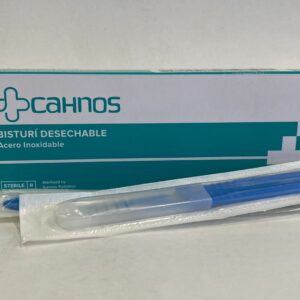
The latex-free allergy lancet (Ref. 0658027) is the reference instrument for performing skin sensitivity tests in allergology, dermatology and primary care centres. Made of sterilised stainless steel with a concave tip design and smooth edge, it allows clean, rapid penetration with minimal discomfort for the patient, avoiding both bleeding (which would cause false positives) and insufficient pressure (which would generate false negatives).
2. How it works and how to use it
The allergy lancet is a manual puncture instrument designed to prick the skin so that the allergen extract to be applied reaches the epidermis. The procedure is simple and standardised: a drop of extract is placed on the skin and, with the lancet in perpendicular position (90° angle), it is pricked for approximately one second, so that the tip introduces a small amount of the solution (3.3 × 10⁻⁶ ml) into the epidermis. It is essential to pierce the drop with the lancet to avoid false negatives and to use a new lancet for each extract so as not to mix allergens, ensuring the reliability of the diagnosis.
3. Technical Specifications
| Characteristic | Value |
|---|---|
| Reference / SKU | 0658027 |
| Product type | Sterile allergy lancet (skin puncture – prick test), hypodermic line |
| Material | Sterilised stainless steel, latex-free and nickel-free |
| Shaft length | 398 mm |
| Tip dimensions | ± 1 mm |
| Tip design | Concave, smooth edge and sharp tip |
| Extract introduced | Approx. 3.3 × 10⁻⁶ ml per puncture |
| Condition of use | Sterile, single-use, disposable |
| Packaging | Individual disposable |
| Presentation | 200 units per box |
| Expiry | 5 years from production date |
| Regulatory classification | Medical device class IIa (rule 6) |
4. Equivalences and Cross-References
Reference 0658027 falls into the category of metal blade lancets for skin sensitivity tests (allergy test), sterile, disposable and for manual use. The following cross-reference has been checked against official manufacturer documentation (technical data sheet and product catalogue). It does not constitute an exact reference equivalence validated by the manufacturer, but a verified functional comparison:
| Manufacturer / Brand | Family / Model | Code / SKU | Equivalence level | Technical differences / Remarks |
|---|---|---|---|---|
| Vitrex Medical A/S (Denmark) | Vitrex® Steel – Allergy | 365213 | Comparable by category (not interchangeable 1:1) | Flat blade lancet in medical-grade stainless steel, sterile by gamma irradiation and single-use, indicated for skin sensitivity tests (allergy test); box of 200 units; dimensions 34.0 ± 1.0 × 5.5 ± 0.5 mm. Verified in official technical data sheet of Vitrex Medical Group. They differ in tip design (concave vs. asymmetric), dimensions and sterilisation method. |
In the reference market there are also stainless steel lancets for general capillary puncture — such as the standard Vitrex® Steel blood lancet (Art. 350213, same range) or blade-type lancets distributed in Spain (e.g. MediPoint or Nahita style) — whose specific versions for allergy could not be confirmed in primary sources; consult with the technical department before use in tenders or replacement of approved material. There is no equivalence table validated by the manufacturer relating reference 0658027 to the above codes; the equivalences shown are verified functional comparisons against public sources. Consult with the technical department before use in tenders or replacement of approved material.
5. Selection tips and variants of interest
Select this allergy lancet (0658027) when your centre performs skin sensitivity tests by puncture (prick test) and requires a sterile, latex-free and nickel-free pricker with a soft penetration tip that minimises skin trauma. To ensure reliable results: place the lancet perpendicularly, always pierce through the drop of extract, do not press excessively (avoids bleeding and false positives) and use a different lancet for each allergen. Remember it is a single-use device: dispose of it in a sharps container in accordance with current healthcare waste regulations. As interesting variants within the capillary puncture catalogue, you have the Economy blood lancets (1110101), Tip Top Tip (1110102 and 1110108) and Safety lancets (1110115 to 1110118) and rectangular lancets (1110130 to 1110133), for capillary blood sampling in clinical analysis and blood glucose monitoring.
Reviews
There are no reviews yet.