
Description
1. Introduction
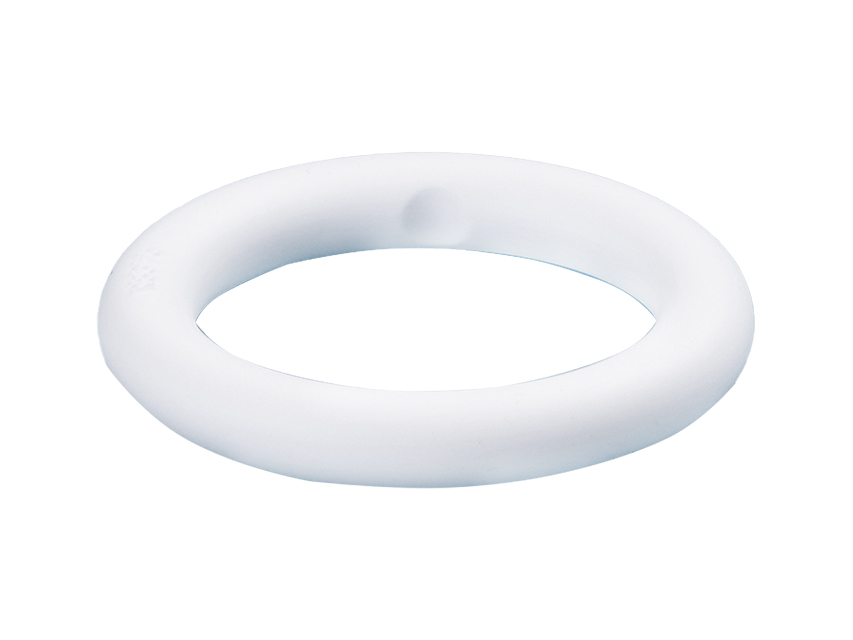
The silicone ring pessary of Ø 57 mm (reference 30032) is a conservative, non-surgical solution intended for the treatment of first- and second-degree uterine prolapse, as well as cystocele, rectocele and stress urinary incontinence associated with pelvic organ descent.
Manufactured entirely from medical-grade silicone and 100 % latex-free, this device restores the patient’s anatomical support comfortably and safely, as an alternative to surgical intervention. It is supplied individually, in an individual cardboard pack, ready for clinical use in gynaecology, urogynaecology and pelvic floor clinics. The box and instructions are multilingual (GB, FR, IT, ES, PT, DE, NL, SE, LV, PL, HU, SI, HR, RO, BG, GR and Arabic).
2. Technical explanation of the device
The ring pessary acts as an intravaginal mechanical support element: it surrounds the cervix and keeps the uterus and vaginal walls elevated, reducing the symptoms of prolapse and providing suburethral support that helps to control stress urinary incontinence.
It is an invasive device inserted vaginally through a natural orifice, without the need for connection to any active medical equipment. Its elastic ring design allows it to be folded to facilitate insertion and removal, then recovering its original shape. It is intended for single-patient use (monopatient) and provides immediate relief, allowing the patient to immediately resume her daily activities. Placement, dwell time and follow-up must always be indicated and supervised by a gynaecologist or qualified specialist.
3. Technical Specifications
Medical-grade silicone ensures softness and flexibility, and its latex-free composition makes it suitable for patients with latex sensitivity or allergy.
| Manufacturer | GIMA |
|---|---|
| Manufacturer reference | 30032 |
| Designation | Silicone ring pessary – white |
| Measurements | Ø 57 mm |
| Colour | White |
| Material | Medical-grade silicone, latex-free |
| Indications | First and second degree uterine prolapse, cystocele, rectocele and stress urinary incontinence |
| Use | Single patient |
| Sales unit | 1 pc |
| Presentation | Individual packaging in cardboard box; box and multilingual instructions |
| Device type | Medical device |
| Device class | II A |
| CND | U089005 |
| EAN | 6972994800031 |
4. Equivalences and Cross-References
No equivalence table validated by the manufacturer is available for this reference. Silicone ring pessaries constitute a category present in other manufacturers in the sector, such as Dr. Arabin, Corysan, Fleming Comercial or CooperSurgical Milex, but they are in no case declared interchangeable 1:1 with reference 30032. As a guide, the foldable ring from CooperSurgical Milex ref. MXPER02 has the same diameter (Ø 57 mm / 2¼\”), although with silicone with a metallic core and autoclavable treatment; material, internal reinforcements, sterility and usage protocol must always be verified in each manufacturer’s data sheet before any substitution.
Within the catalogue itself and in Cahnos there are other complementary families of silicone pessaries: the silicone ring pessary with support of Ø 83 mm (ref. 30046 / GM30046), the latex-free silicone ring pessaries in sizes from 50 to 90 mm (refs. 0126018 to 0126021) for grade I-II prolapses, as well as Gellhorn and cubic silicone pessaries for higher grades or specific anatomies. In all cases, compare the technical data sheet of each reference beforehand.
5. Selection tips and variants of interest
The choice of pessary and its size must be made by the specialist after pelvic examination: the smallest size that eliminates the symptoms of prolapse should be used, checking that there is a space of approximately one finger (10-15 mm) between the edge of the pessary and the vaginal wall to avoid excessive pressure or pressure necrosis.
For insertion, fold the ring, pass the introitus and release the device so that it recovers its shape; a silicone-compatible vaginal lubricant may be used. This product, being 100 % silicone without a metallic core, is especially indicated for patients with allergy or sensitivity to latex and metal. All pessaries in this range must be prescribed and fitted by a specialised healthcare professional. For more information on sizes and variants, contact our technical department.
Reviews
There are no reviews yet.